Boris Johnson’s Net Zero goal in disarray as Rishi Sunak baulks at the £1.4trillion cost
27 Jul 2021 Leave a comment
Cuba’s Socialism Has Been a Total Failure
25 Jul 2021 Leave a comment

I like cross-country comparisons – such as North Korea vs South Korea and East Germany vs. West Germany – because they can be very informative when comparing the results of socialism vs. markets.
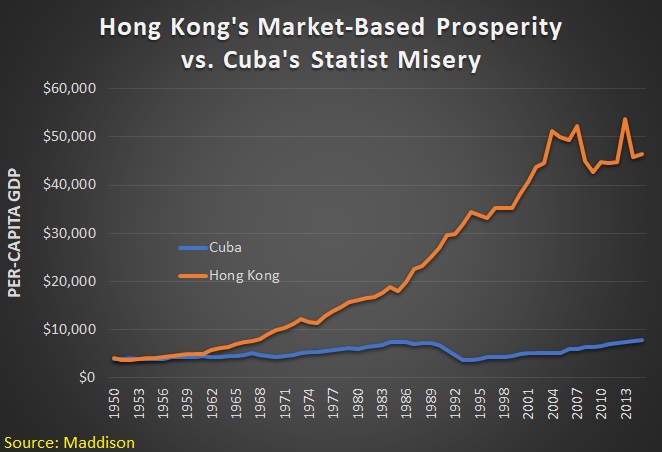 One of the most dramatic examples is Cuba vs. Hong Kong.
More than 60 years ago, back when Castro took power, the two jurisdictions had similar living standards.
But as Cuba tried socialism and Hong Kong chose free enterprise, there was a stunning divergence. Cuba is a basket case and Hong Kong is rich.*
In a column for Human Progress, Neil Monnery compares the two jurisdictions.
As the world entered the turbulent 1960s, two men, half a world apart, one a doctor and the other a classicist, both foreigners far from home, were charged with bringing human progress to their adopted countries. …One, Che Guevara, the well-known Argentinean revolutionary, was the architect of Cuba’s…
View original post 990 more words
July 24, 1567: Abdication of Mary I, Queen of Scots.
25 Jul 2021 Leave a comment

In late January 1567, Queen Mary I of Scotland prompted her husband, Henry Stuart, Lord Darnley, King consort of Scotland to return to Edinburgh. He recuperated from his illness in a house belonging to the brother of Sir James Balfour at the former abbey of Kirk o’ Field, just within the city wall.
Mary visited him daily, so that it appeared a reconciliation was in progress. On the night of February 9–10, 1567, Mary visited her husband in the early evening and then attended the wedding celebrations of a member of her household, Bastian Pagez. In the early hours of the morning, an explosion devastated Kirk o’ Field. Darnley was found dead in the garden, apparently smothered. There were no visible marks of strangulation or violence on the body. James Hepburn, 4th Earl of Bothwell, James Stewart, 1st Earl of Moray (the illegitimate son of King James V), Secretary Maitland…
View original post 644 more words
Follies of Infrastructure: Why the Worst Projects Get Built, and How to Avoid It Bent Flyvbjerg
25 Jul 2021 Leave a comment
in applied price theory, economics of bureaucracy, industrial organisation, managerial economics, organisational economics, Public Choice, survivor principle, transport economics, urban economics Tags: entrepreneurship, The fatal conceit, unintended consequences
Ever Ascendant: True Cost of Unreliable Wind & Solar Continues to Rise Unabated
24 Jul 2021 Leave a comment


If wind and solar power were truly competitive with conventional generators, there would be no need for even a nickel in subsidies. The fact they continue unabated says it all.
Claims that the cost of wind and solar generation are falling don’t stand a minute’s serious scrutiny. One group that has applied a blowtorch to the ‘wind and solar are free and getting cheaper all the time’ narrative is the Global Warming Policy Forum. Here’s Dr John Constable explaining why the true cost of unreliable wind and solar is always in the ascendant.
Fact checking IRENA: Ignore the renewables industry PR and turn to empirical data
Global Warming Policy Forum
John Constable
23 June 2021
In sharp contrast to claims by the renewables lobby, the costs of wind and solar energy are not falling, empirical data shows.
When soap bubbles burst they vanish in an instant. Financial bubbles by their…
View original post 675 more words
Compare and Contrast (Updated)
24 Jul 2021 Leave a comment

Sweden
In contrast to its European neighbors, Sweden iswelcoming tourists. Businesses and schools are open with almost no restrictions. And as far as masks are concerned, not only is there no mandate in place, Swedish health officialsare not even recommending them.
What are the results of Sweden’s much-derided laissez-faire policy? Data show the 7-day rolling average for COVID deaths yesterday waszero(see below). As innada. And it’s been at zero for about a week now.
with Australia
Anti-lockdown protesters are marching shoulder-to-shoulder through the streets of Sydney despite NSW recording its highest number of daily infections since the Covid-19 outbreak started.
A shock photo emerged showing the brazen protesters huddled together as they walked through Broadway in Sydney’s innerwest chanting, holding signs and halting traffic.
The protest is one of about nine across the country as anti-lockdown and anti-vaccine protesters hold a “worldwide…
View original post 142 more words
MEETING the KITTENS and bringing them inside
24 Jul 2021 Leave a comment
in applied price theory Tags: kittens
AMAZON UNBOUND: JEFF BEZOS AND THE INVENTION OF A GLOBAL EMPIRE by Brad Stone
24 Jul 2021 Leave a comment


Remember when Amazon first came online in 1995, they would discount books by 33-40%. This pricing lasted for a good 10-15 years then the discounts were reduced under the theory that once they conditioned you as a customer, they could slowly increase their profit margins. After a year of Covid-19 restrictions Amazon’s popularity and bottom line boomed as people were sequestered at home. Today the discount on books is usually 10-15%, and sometimes less, reflecting Amazon’s commitment to the bottom line. Only speaking of book pricing, but I have noticed similar trends with other products. The question is how we arrived at the present juncture, who is responsible, what are the historic trends when it comes to Amazon, and lastly what role has Jeff Bezos played in the process. These questions are answered in full along with a partial biographical portrait of Bezos and how he built Amazon into the…
View original post 1,102 more words
July 23, 1536: Death of Henry FitzRoy, Duke of Richmond and Somerset.
24 Jul 2021 Leave a comment
Henry FitzRoy, Duke of Richmond and Somerset, (June 15, 1519 – July 23, 1536), was the son of King Henry VIII of England and his mistress, Elizabeth Blount, and the only child born out of wedlock whom Henry VIII acknowledged. He was the younger half-brother of Queen Mary I, as well as the older half-brother of Queen Elizabeth I and King Edward VI. Through his mother, he was the elder half-brother of the 4th Baroness Tailboys of Kyme and of the 2nd and 3rd Barons Tailboys of Kyme. He was named FitzRoy, which means “son of the king”.
Birth
Henry FitzRoy was born in June 1519. His mother was Elizabeth Blount, Catherine of Aragon’s lady-in-waiting, and his father was Henry VIII. FitzRoy was conceived when Queen Catherine was approaching her last confinement with another of Henry’s children, a stillborn daughter born in November 1518. To avoid scandal, Blount was taken…
View original post 1,964 more words
CCC Says We Must Spend £9000 To Stop Homes “Overheating” In Thirty Years Time!
23 Jul 2021 Leave a comment
Crunch Time: Obsession With Unreliable Wind & Solar Threatens More Mass Blackouts
22 Jul 2021 Leave a comment
 Close more of these …
Power grids are among the most sophisticated organisms on earth, but they were never designed for the chaos delivered daily by intermittent wind and solar.
For power consumers the first realisation that there’s a problem comes with load shedding (controlled blackouts) or mass blackouts (when the grid manager loses control, altogether).
When sudden and unpredictable collapses of wind power (calm weather) and sudden and wholly predictable collapses of solar power (sunset) coincide with periods of peak demand, it’s candles, torches and Gensets to the rescue. Californians know it, South Australians know it and Texans are learning fast.
In Australia, the hard-green left (Greens and Labor) are determined to wipeout every last coal-fired power plants in the country, rendering power both unaffordable and even more unreliable. Sadly, there are all too many amongst the (notionally conservative) Liberal party eager to assist.
With coal-fired power plants providing…
View original post 525 more words


Recent Comments