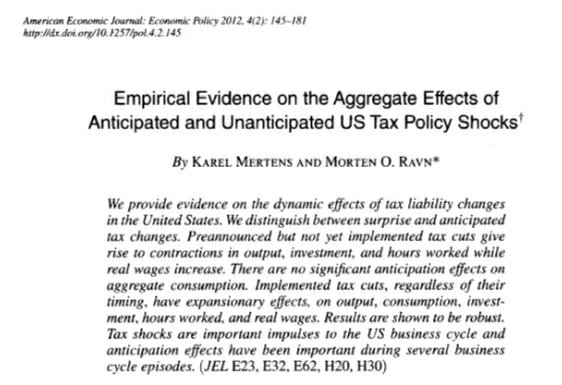
Teasing out the effect of tax policy on the business cycle
02 Feb 2021 Leave a comment
in applied price theory, business cycles, econometerics, economic growth, economic history, entrepreneurship, fiscal policy, human capital, labour economics, labour supply, macroeconomics, occupational choice Tags: real business cycles, taxation and entrepreneurship, taxation and investment, taxation and labour supply
Romer on the power of tax cuts
02 Feb 2021 Leave a comment
in applied price theory, economic growth, entrepreneurship, fiscal policy, history of economic thought, human capital, industrial organisation, labour economics, labour supply, macroeconomics, poverty and inequality, public economics, survivor principle Tags: taxation and entrepreneurship, taxation and investment, taxation and labour supply, taxation and savings
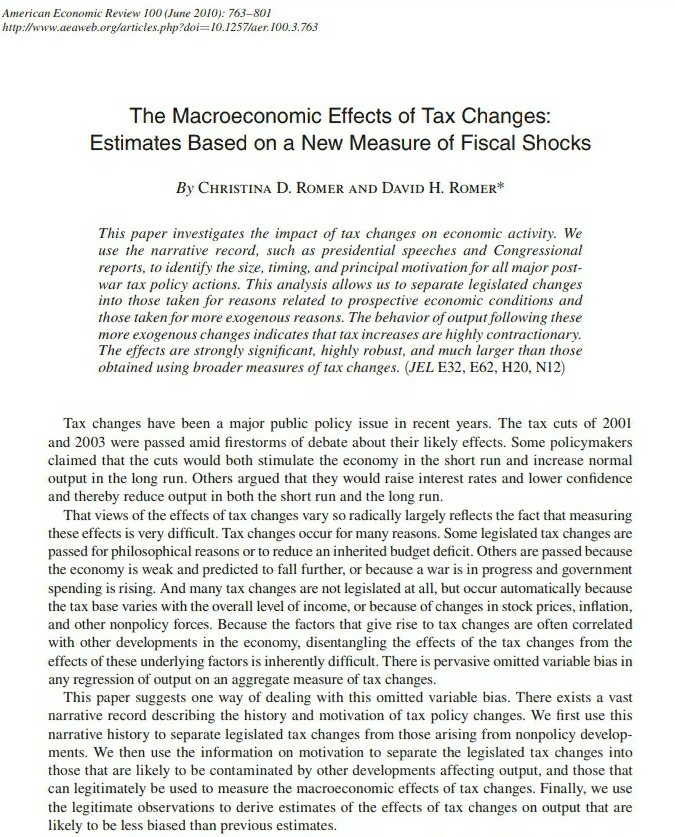
What’s behind the relatively large fall in UK GDP? (reprise…)
02 Feb 2021 Leave a comment

On Sunday, Labour’s Anneliese Doddstweeted that the UK ‘had the worst recession and the worst growth of any major economy last year’, and that ‘Covid closed much of our economy, but the Conservatives crashed it’. Of course, this is just a tweet and almost all politicians try to score points in this way. Nonetheless, it was still pretty sloppy.
The Shadow Chancellor was citing the latest IMFestimates for GDP growth in the G7 economies in 2020, rather than the actual data. The official numbers have either not been published (we have to wait until 12th February for the UK), or are slightly different. But the IMF probably wasn’t far wrong (UK GDP is indeed likely to have fallen by about 10%), so I’ll let that pass.
The real issue is how the data have been spun. For a start, rather than contrast the UK with the US…
View original post 1,129 more words
The Shards of the Office of Governor General of Canada
01 Feb 2021 Leave a comment

Introduction
In January 2021, Julie Payette resigned the Office of Governor General in disgrace. Her troubled tenure has shattered the credibility of the institution and provided anti-monarchists a greater platform on which to stand than they ever dared hope. In “A Star Goes Supernova,” I reviewed three years’ worth of newspaper reports which chronicled from 2018 to 2020 her steadfast refusal to carry out her constitutional and ceremonial duties and the toxic culture of harassment and recrimination which she brewed at Rideau Hall, leading to mass resignations, insincere and mendacious non-apology apologies, and, ultimately, to a damning independent report that proved her downfall. Payette’s resignation broke new ground in Canada but has precedents elsewhere in our sister Commonwealth Realms. In this piece, I will explain what happens when the Office of Governor General becomes vacant, review similar precedents in the other Realms where other Governors have resigned their…
View original post 5,205 more words
Richard D Wolff Vs David D Friedman | Socialism Vs Capitalism Debate
01 Feb 2021 Leave a comment
in applied price theory, applied welfare economics, Austrian economics, comparative institutional analysis, constitutional political economy, David Friedman, development economics, economic history, economics of bureaucracy, growth disasters, growth miracles, industrial organisation, labour economics, labour supply, law and economics, liberalism, libertarianism, Marxist economics, occupational choice, property rights, Public Choice, survivor principle
THE MAN WHO RAN WASHINGTON: THE LIFE AND TIMES OF JAMES BAKER III by Peter Baker and Susan Glasser
01 Feb 2021 Leave a comment


Peter Baker, the chief White House correspondent for the New York Times and Susan Glasser, a staff writer for The New Yorker have written an engrossing biography of James Baker III, a man whose impact from 1976 through the election of 2000 can not be denied. The book’s range is impressive as the authors describe a childhood under the thumb of a father whose nickname was “the Warden.” As an adult we witness the death of his wife from cancer at a young age and a remarriage that merged two families resulting in eight children, a number of which experienced numerous problems including drugs and alcohol. Baker would give up the practice of law in Texas and move on to a political education in Washington, D.C. that produced lessons that stressed how to accumulate power and…
View original post 1,649 more words
Europe’s unforeseen (?) renewables problem
01 Feb 2021 Leave a comment


Unforeseen? They must be joking. It has been painfully foreseeable for years to many of us, except maybe some of the more blinkered climate obsessives. The trouble is, as the article notes, ‘there is no silver bullet solution’ (except ones they don’t want to hear about).
– – –
As the share of renewables in the EU energy mix increase, so do problems with grid overloads and blackouts, says OilPrice.com.
Earlier this month, something happened in Europe. It didn’t get as much media attention as the EU’s massive funding plans for its energy transition, but it was arguably as important, if not more.
A fault occurred at a substation in Croatia and caused an overload in parts of the grid, which spread beyond the country’s borders. This created a domino effect that caused a blackout and prompted electricity supply reductions as far as France and Italy.
View original post 264 more words
On the Price Specie Flow Mechanism
31 Jan 2021 Leave a comment

I have been working on a paper tentatively titled “The Smithian and Humean Traditions in Monetary Theory.” One section of the paper is on the price-specie-flow mechanism, about which I wrote last month in my previous post. This section develops the arguments of the previous post at greater length and draws on a number of earlier posts that I’ve written about PSFM as well (e.g., here and here )provides more detailed criticisms of both PSFM and sterilization and provides some further historical evidence to support some of the theoretical arguments. I will be grateful for any comments and feedback.
The tortured intellectual history of the price-specie-flow mechanism (PSFM) received its still classic exposition in a Hume (1752) essay, which has remained a staple of the theory of international adjustment under the gold standard, or any international system of fixed exchange rates. Regrettably, the two-and-a-half-century life span of PSFM…
View original post 3,234 more words
Japan is driving around in circles on reducing emissions from motor vehicles
31 Jan 2021 Leave a comment
 Toyota’s Prius model
The Toyota boss reckons hybrids are a better idea than all-electric since no expensive new power supplies or charging points are needed, with recharging built-in to the vehicle. Also, lifetime CO2 emissions are comparable to EVs when all factors are taken into account. (No range anxiety
either). As someone demanding realism, one suspects he’s not too impressed by on-off renewables either.
– – –
In his first policy speech as prime minister last October, Yoshihide Suga pledged to reduce Japan’s greenhouse gas emissions to zero by 2050, thus giving substance to the government’s goal of eliminating the need for fossil fuels in the latter half of the 21st century, says the Japan Times.
Part of that goal is to ban new internal combustion engine cars by the mid-2030s, a pledge addressed by Akio Toyoda, the president of the world’s No. 2 automaker, Toyota Motor Corp., and…
View original post 377 more words
Should Companies Put Profits Before Social Responsibility?
31 Jan 2021 Leave a comment
in applied price theory, entrepreneurship, financial economics, history of economic thought, industrial organisation, Milton Friedman, survivor principle
Fatal Attraction: Transport & Construction Workers Add to Wind Industry’s Mounting Death Toll
30 Jan 2021 Leave a comment


Claims that 300 tonne wind turbines are safe as houses fall hollow with each self-immolation, total collapse and ‘component liberation’ event. Far from being safe, clean and green, this is an industry that has already killed 200 people.
By way of comparison, the French get 75-85% of their power from nuclear plants and haven’t suffered so much as a scratch since they started in 1962. By contrast, the wind industry (which really only got off the ground in the late 1990s and still generates a trifling amount of electricity) has clocked up around 220 fatalities – see the helpful collection of stats compiled by Caithness Windfarm Information Forum all available here: www.caithnesswindfarms.co.uk
A fair proportion of those killed and injured are maintenance, transport and construction workers, crushed or maimed by runaway turbine blades or toppling towers. Of the currently recorded 218 fatalities:
125 were wind industry…
View original post 208 more words
Vaccine politics look like normal politics – just more extreme
30 Jan 2021 Leave a comment

Point of Order has been consistent in anticipating an irritable post-Brexit relationship between Britain and the EU. But who would have thought vaccine politics would develop as a major flashpoint, let alone a possible relationship breaker?
Even hyper-critical Brits have had to acknowledge that the UK government is a leader in the global vaccination rollout. And as more background information seeps into the public arena, the British government’s decisiveness in supporting vaccine development, committing early to contracts and driving mass vaccination is looking better and better.
But the same comparisons spell political danger for European politicians. Co-ordination by the EU appears to have resulted in slowness: slowness in making commitments, in tweaking the production process and in approving the product.
View original post 324 more words
January 29th: Death of King George III of the United Kingdom in 1820 and the death of King Christian IX of Denmark in 1906.
30 Jan 2021 Leave a comment

Today is the anniversary of two deaths in European Royal history. The two royals are King George III of the United Kingdom and King Christian IX of Denmark.Today is the 115th anniversary of the death of King Christian IX of Denmark, Known as the ‘father-in-law of Europe’ and the ancestor of the monarchs of Denmark, Norway, the UK, Belgium, Luxembourg and Spain. The Duke of Edinburgh is one of his three surviving great-grandchildren.

Today I will highlight and focus on King George the third.
George III (George William Frederick; 4 June 1738 – 29 January 1820) was King of Great Britain and Ireland from 25 October 1760 until the union of the two kingdoms on 1 January 1801, after which he was King of the United Kingdom of Great Britain and Ireland until his death in 1820. He was concurrently Duke and Prince-elector of Brunswick-Lüneburg (“Hanover”) in the Holy Roman…
View original post 554 more words
Sex Ratios and the Marriage Market: WW1
30 Jan 2021 Leave a comment

Last week I wrote about the “marriage market“. In many ways, the marriage market is like a labor market: there are search costs, match quality, competition for mates, and so on. When one side of the market becomes more abundant, that side become less picky — their minimum willingness to accept goes down.
Today we examine war as a shock that makes women more abundant than men. The marriage market predicts this shock will mean a smaller fraction of women will marry but those that do receive a smaller share of the benefits from marriage. Also, a larger fraction of men will marry and receive a larger share of the benefits from marriage.
Ran Abramitzky, Adeline Delavande, and Luis Vasconcelos investigate marriage in pre-and-post World War 1 (WW1) France where an estimated 16.5 percent of the French male population died or were missing in WW1. You can see…
View original post 385 more words
The Tudors: Henry VII (1485-1509)
30 Jan 2021 Leave a comment

From out of the darkness of strife and civil war, late 15th century England emerged stable and filled with hope in the new ruling family: The Tudors. Thirty years of war, known as The Wars of the Roses, had torn the country apart in an unraveling a political struggle. At its height, the Plantagenets were the conquering victors at the battles of Crécy, Poitiers, and Agincourt. However, in its waning days, the Plantagenets had descended into madness and civil war. Two rival Plantagenet branches stemming from Edward III (the Houses of York and Lancaster) slaughtered each other mercilessly for decades until, in the end, the House of York under Richard III finally destroyed itself, and with it went the rule of the Plantagenets. It was a fitting end for the warrior kings of England.
The arrival of the Tudors promised a new path forward. It was the dawn of the…
View original post 2,163 more words


Recent Comments