School Transgender Policy 1. Brighton: Allsorts
24 Oct 2020 Leave a comment

I have done a number of twitter threads on School policies, ostensibly, about protecting “transgender children”. The only one I have blogged, thus far, focussed on the way they treat parents. We are treated as potential bigots who need educatingon Gender Identity issues. The Schools, invariably, take it upon themselves to keep parents in the dark about our ” Gender Dysphoric” kids. They blithely inform us our kids are at significant risk of attempting suicide but stillthink it is good practice to hide pertinent information from parents. You can read that post here: Putting the Loco in Loco Parentis.
I will now do a series on the policies I have found. Some have already been withdrawn but we need to preserve a record of the extent of the policy capture. Note that this series will be repetitive as they are clearly modelled on a small number of…
View original post 3,226 more words
Trump vs. Biden on the Minimum Wage
24 Oct 2020 Leave a comment

In another display of selfless masochism, I watched the Trump–Biden debate last night.
The candidates behaved better, for whatever that’s worth, but I was disappointed that there so little time (and even less substance) devoted to economic issues.
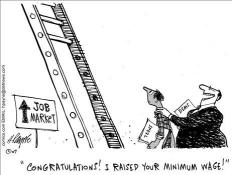 One of the few exceptions was the brief tussle regarding the minimum wage. Trump waffled on the issue, so I don’t give him any points, but Biden fully embraced the Bernie Sanders policy of basically doubling the minimum wage to $15 per hour.
This is very bad news for low-skilled workers and very bad news to low-margin businesses.
The economic of this issue are very simple. If a worker generates, say, $9 of revenue per hour, and politicians say that worker can’t be employed for less than $15 per hour, that’s a recipe for unemployment.
Earlier this month, Professor Steven Landsburg on the University of Rochester opined for…
View original post 754 more words
Book Review: “Cesare and Lucrezia Borgia: Brother and Sister of History’s Most Vilified Family” by Samantha Morris
24 Oct 2020 Leave a comment

 A family mired in myths and rumors of incest, murder, and intrigue for centuries. A brother and sister caught in the middle, attracting the attention of gossips and historians alike. No, I am not referring to a royal family in England. In fact, this story starts in Spain with Alonso de Borja, who moved to Italy and helped create the infamous Borgia family. Caught in the middle were the son and daughter of Rodrigo Borgia, Alonso’s nephew, and his mistress Vanozza Cattanei; Cesare and Lucrezia Borgia. How close were these famous siblings? What were their lives really like? In Samantha Morris’ latest biography, “Cesare and Lucrezia Borgia: Brother and Sister of History’s Vilified Family”, she dives deep into the archives to find out the truth about the legendary Borgia family.
I would like to thank Pen and Sword Books and Net Galley for sending me a copy of this book…
View original post 448 more words
Declassified footage of the biggest nuclear explosion ever
24 Oct 2020 Leave a comment

Here’s a rare video, previously classified but recently released, of the explosion of the “Tsar Bomba“, which the Soviet Union detonated on October 30, 1961. Wikipedia calls it “the most powerful nuclear weapon ever created and tested”, and it “remains the most powerful human-made explosive ever detonated.”
How powerful was this H-bomb? About 50 megatons of TNT; here’s a comparison to other Big Bombs:
The Tsar Bomba was the single most physically powerful device ever deployed on Earth. For comparison, the largest weapon ever produced by the U.S., the now-decommissioned B41, had a predicted maximum yield of 25 megatons of TNT (100 PJ). The largest nuclear device ever tested by the U.S. (Castle Bravo) yielded 15 megatons of TNT (63 PJ) because of an unexpectedly high involvement of lithium-7 in the fusion reaction; the preliminary prediction for the yield was from 4 to 6 megatons of TNT (17 to…
View original post 222 more words
Rare Economic Disasters: What Role Does Government Play? | Robert Barro
24 Oct 2020 Leave a comment
in applied price theory, applied welfare economics, budget deficits, business cycles, comparative institutional analysis, development economics, economic growth, economic history, economics of bureaucracy, economics of natural disasters, economics of regulation, energy economics, environmental economics, fiscal policy, global financial crisis (GFC), great depression, great recession, history of economic thought, industrial organisation, labour economics, labour supply, law and economics, macroeconomics, monetary economics, poverty and inequality, Public Choice, unemployment
THE LAST MILLION: EUROPE’S DISPLACED PERSONS FROM WORLD WAR TO COLD WAR by David Nasaw
23 Oct 2020 Leave a comment


Today we find that immigration reform and related issues like DACA and a southern border wall are at the forefront of our election debate aside from Covid-19. Immigration has been a very controversial issue throughout American history and one of the most contentious involved what to do with the hundreds of thousands of displaced persons that were a result of Nazi racial policy and their conduct during World War II. By the end of 1945 roughly one million displaced persons remained in Germany: Jews, Poles, Estonians, Latvians, Lithuanians, Ukrainians, among other groups who refused to return to their home countries or had no homes to return to. This group labeled the “Last Million” by author David Nasaw in his latest book, THE LAST MILLION: EUROPE’S DISPLACED PERSONS FROM WORLD WAR TO COLD WAR follows these individuals from three to five years as they lived…
View original post 1,537 more words
Efficient markets as normative systems
23 Oct 2020 Leave a comment

Recently, I came across this outstanding interview with Eugene Fama published by The Market / NZZ. Besides the main subject discussed -the inability of central banks to control inflation-, the interview is intertwined with gripping assertions about the limits of knowledge, such as the following ones:
Bubbles are things people see in hindsight. They don’t identify them in advance. Sure, you can look at the behavior of prices, and you may be able to identify cases where they are too high. But if you only look back and say: «Oh, stocks went down a lot, so that was a bubble», then that’s 20/20 hindsight. At the time, there was no evidence that there was a bubble.
I don’t say markets are completely efficient, but they’re efficient for most questions that I address. Models are never a 100 % true. If they were, we would call them reality…
View original post 728 more words
Environmentalists Weaponize Wildfire Danger in California to Halt Housing Construction
22 Oct 2020 Leave a comment

Environmentalists sue to halt logging, controlled burns, and forest thinning efforts that can reduce the likelihood of forest fires, and when the forests catch fire, the results can be devastating. Now, environmentalists in California use the destruction from the fires they largely contributed to in order to halt housing construction so people have places to live. It’s so much easier to tell others how or where people should live when environmentalists do not run the risk of not having a home.
Environmentalists use wildfire danger as new weapon against housing development
By J.K. Dineen, October 19, 2020, San Francisco Chronicle
From steep terrain in Napa Valley to the windswept hills of Contra Costa County, California environmentalists opposed to development in semi-urbanized areas are increasingly fighting projects with a weapon that would have been rare a few years ago — the dangers of wildfire.
Over the past three years…
View original post 299 more words
Henry Percy, earl of Northumberland: the brains behind the Gunpowder Plot?
22 Oct 2020 Leave a comment

As we approach Bonfire Night on 5 November, Dr Paul Hunneyball of our Lords 1558-1603 project ponders whether we should be remembering a much more prestigious figure than Guy Fawkes…
The Gunpowder Plot is one of the great ‘what ifs’ of British history. For more than four centuries we’ve commemorated the scheme’s failure – but if it had succeeded, and the House of Lords had been blown up during the state opening of Parliament on 5 November 1605, it would have been a devastating blow to England’s ruling elite. Potential casualties included the king, James I, his principal ministers and courtiers, almost the entire leadership of the Church of England, and many of the men who controlled local government. As the plotters calculated, political chaos would have ensued, opening the way for a possible Catholic rising and a dramatic change of regime. The Plot’s ambition and audacity was astonishing, and…
View original post 903 more words
Environmentalists Sue DHS to aid Portland Rioters and Looters
22 Oct 2020 Leave a comment
Some environmentalist groups along with other Leftist organizations (like the ACLU) are now taking to the courts to try to force the U.S. Department of Homeland Security to stop using teargas and other chemical weapons to halt the unrest in Portland, Oregon citing environmental risks. This lawsuit is nothing more than a way to assist the ongoing rioting and looting in Portland and other cities too. The teargas and other chemical-based methods used by police in Portland obviously worked. But the Left wants to put police at a disadvantage at every opportunity to continue the campaign of violence and destruction.
Environmental groups sue DHS over use of tear gas in Portland
By Darryl Coote
Oct. 21 (UPI) –A coalition of environmental, public health and social justice groups in Oregon has sued the Department of Homeland Security over its use of tear gas and chemical weapons to quell protests in Portland…
View original post 241 more words
Solar and Wind Energy Underestimated? Not.
22 Oct 2020 Leave a comment

 The first part of this post is a report that the IEA is accused of underestimating the amount of solar and wind power in recent years. The second part presents analyses showing that media hype and misinformation lead the public to routinely overestimate the portion solar and wind contribute to power modern societies.
The IEA is under pressure about their wind and solar energy numbers, as reported at energypost.eu World Energy Outlook 2020: IEA responds to some difficult questions. Excerpts in italics with my bolds
The IEA has issued an FAQ to try to answer some persistent questions and criticisms about their annual World Energy Outlooks (WEO). How come the growth of solar and wind have been consistently underestimated? When is “peak oil” going to happen? Will the IEA’s Sustainable Development Scenario limit the global temperature rise to 1.5 °C this century? Is it realistic? Why has a “Net…
View original post 2,211 more words
Movie Trailer Voices were the first proven natural monopoly?
22 Oct 2020 Leave a comment
in applied price theory, entrepreneurship, industrial organisation, movies Tags: creative destruction, natural monopolies
Australian Power Prices Set to Surge With Interconnector To Wind/Solar ‘Powered’ South Australia
21 Oct 2020 Leave a comment

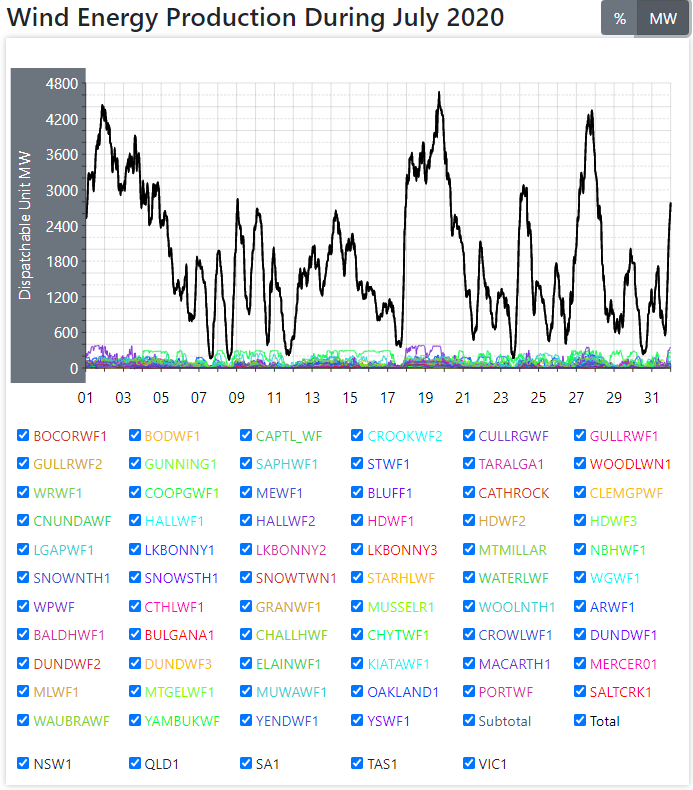
A maniacal reliance on chaotically intermittent wind and solar poses an existential threat to Australia’s power grid. And Australia’s power problems have absolutely nothing to do with the grid itself.
Depicted above – courtesy of Aneroid Energy – is the output delivered by Australian wind power outfits to the Eastern Grid during July.
Spread from Far North Queensland, across the ranges of NSW, all over Victoria, Northern Tasmania and across South Australia its entire capacity routinely delivers just a trickle of its combined notional capacity of 7,728MW.
Collapses of over 3,000 MW or more that occur over the space of a couple of hours are routine, as are rapid surges of equal magnitude, which make the grid manager’s life a living hell, and provide the perfect set up for power market price gouging by the owners of conventional generators, who cash in on the chaos.
During June there were lengthy periods…
View original post 855 more words
THAT WOULD BE AN INTERESTING PRECEDENT
21 Oct 2020 Leave a comment


It is reported the the Prime Minister is toying with the idea of allowing Winston Peters to make a valedictory speech to Parliament. Right now this is no Parliament and there won’t be until the Writs are handed in and Members sworn in … by which time Peters will have ceased to be an MP.
Interesting precedent but you can you really do it for just one MP … albeit a senior Minister, who lost his seat. What about Ministers Ron Mark and Tracey Martin. What about ex Minister’s Tim Macindoe and Alfred Ngaro. What about all the other MP’s who lost their seats?
IMHO you pays your money and you takes your chance. MP’s who announce their retirement prior to the election get to make their valedictories. They are still MP’s at that stage. That’s their privilege.
Having non MP’s make speeches from the floor of Parliament creates an…
View original post 19 more words


Recent Comments