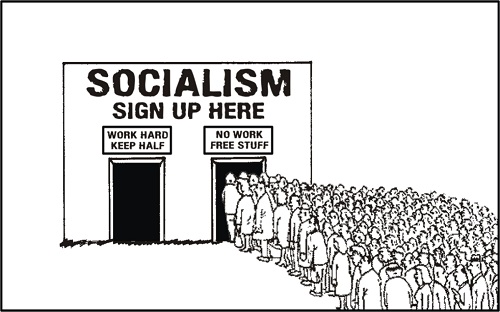
Is @BernieSanders right? Is there a difference between socialism and communism?
24 Apr 2020 Leave a comment
in applied price theory, applied welfare economics, Austrian economics, comparative institutional analysis, constitutional political economy, development economics, economic history, economics of bureaucracy, economics of regulation, growth disasters, income redistribution, industrial organisation, labour economics, labour supply, law and economics, liberalism, libertarianism, Marxist economics, privatisation, property rights, Public Choice, rentseeking, survivor principle Tags: economics of central planning, fall of communism, regressive left, The fatal conceit
UN Carbon Regime Would Devastate Humanity And The Environment
24 Apr 2020 Leave a comment
DISASTER divided : Two countries, one island, life-and-death differences
WITHOUT access to fossil fuels, every tree on the planet would have been cut down by now to provide for heating, cooking and industry.
THE greatest threat to the environment is not affluence, it is poverty.
BORDER between Haiti and Dominican Republic, a pristine example…
• ONE country embraces Fossil Fuels 🇩🇴
• THE other, signed up to the UN Paris Accord 🇭🇹
BORDER between Haiti and the Dominican Republic: Guess which country contains eco-criminals that can afford to use fossil fuels, and which country contains nature-lovers who are dependent on natural renewable organic biomass for energy?
*
HAITI is almost 99% deforested, as they rely almost entirely on natural ‘biomass’ (wood) for domestic and industrial fuels and building materials.
ON the other side, the forests of the fossil fuel burning, eco-terrorists – the Dominican Republic – remain lush and…
View original post 1,148 more words
COVID-19 in Italy: An analysis of death registry data
24 Apr 2020 Leave a comment
Gabriele Ciminelli and Sílvia Garcia-Mandicó in this voxeu piece:
There are still many unknowns about COVID-19. We don’t know its true mortality rate, nor the speed through which it spreads across communities. This lack of evidence complicates the design of appropriate response policies. The case of the UK is illustrative. The government first opted for the bare minimum in terms of mitigation. It then drastically reversed course after micro-simulations by the Imperial College COVID-19 Response Team showed that that strategy could have resulted in hundreds of thousands of deaths (Ferguson et al. 2020).
In a new paper (Ciminelli and Garcia-Mandicó 2020), we source daily death registry data for a sample of 1,161 Italian municipalities in the seven regions most severely hit by COVID-19 (Emilia-Romagna, Liguria, Lombardia, Marche, Piemonte, Toscana, and Veneto) and match them to census data to analyse COVID-19-induced mortality. Overall, the dataset covers a population of almost…
View original post 78 more words
The pro and cons of extending the Brexit transition
23 Apr 2020 Leave a comment
It’s been impossible to ignore the calls for the UK government to announce that it will be seeking an extension to the Brexit transition period, or at least to make clear that it’s still keeping its options open, as a result of the coronavirus crisis. Here I review the arguments on both sides – before coming down in favour of sticking to the current timetable.
The background
The UK has, of course, already left the EU. But it remains a member of the single market and customs union, and is still bound by EU rules, during a ‘transition period’ which is due to end on 31st December. This period is meant to provide time for the two sides to negotiate a new long-term relationship, covering issues such as trade and security cooperation, and to make the necessary preparations to implement the new arrangements.
The Withdrawal Agreement (WA) allows the…
View original post 1,856 more words
Genetic ignorance in the service of ideology
23 Apr 2020 Leave a comment
You do wonder why skin cancer varies across races and why Africa was the white man’s graveyard because of various local mosquito borne diseases
Angela Saini is a British science writer who belongs to what I call the Cordelia Fine School of Science Journalism (CFSSJ): a school whose members have an explicit ideological bias that colors all of their popular writing. In the case of Fine, her ideology is that there is essentially no evolutionary/genetic difference between the brains and neurology of men and women, and so any behavioral differences we see are of purely social origin. Further, hormones play little or no role in behavioral differences between the sexes. Fine’s motive is good—to reduce sexism and bias—but her modus operandus is not, for it involves misrepresenting science.
To buttress Fine’s ideology, her books aim at debunking every study that contradicts her preconceived thesis, even though there is now convincing indication of not only genetically based behavioral and morphological differences based on hormones, but also of differences in the brain. In contrast…
View original post 2,078 more words
Earth Day 2020 — CIA : “Climatological Research as it Pertains to Intelligence Problems”
23 Apr 2020 Leave a comment
“For 250 years most of the world suffered major economic and political unrest which could be directly or indirectly attributed to the climate of the neo-boreal era. Another Little Ice Age would cause hundreds of millions of deaths around the world and cause massive social unrest.”
CIA REPORT 1974
“I was horrified by what I found. Global warming really has become a new religion. Because you cannot discuss it. It’s not proper. It is like the Catholic Church.”
Dr Ivar Giaever — 1973 Physics Nobel Prize (2015 Mainau Nobel Conference)
April 22 2020 — Today, the world celebrates the 50th anniversary of Earth Day! I thought I should take this opportunity to remind you that a 1974 Central Intelligence Agency report warned that “Earth’s climate is returning to that of the neo-boreal era… an era of drought, famine, and political unrest in the western world.” Follow us on Twitter: @INTEL_TODAY
View original post 846 more words
MICHAEL MOORE : ‘Green Energy Is A Scam’
23 Apr 2020 Leave a comment
“The documentary does a good job
at proving that conservatives
were right to say that green energy is a scam“
“This urgent, must-see movie,
a full-frontal assault on our sacred cows,
is guaranteed to generate anger, debate.”
***
A must watch.
IT gets going at around the 13 minute mark, and then, kaboom…
•••
SEE also :
- SCOTLAND’S Net-Zero Forest Management Program | Climatism
- Michael Moore stumbles upon the truth about so-called ‘green’ energy – American Thinker (Climatism post title-tip)
RELATED :
- ‘GREEN’ Energy Future | Climatism
- IF CO2’s Your Poison, Renewable Energy Is No Antidote (Peer-reviewed) | Climatism
- TEAM GRETA Admits Climate Change Has Nothing To Do With The Environment | Climatism
- CADMIUM : The Toxic Problem Of Not-So-Clean Energy | Climatism
- ANGELA MERKEL : The New Climate Change ‘Denier’ | Climatism
- HOW DARE HE!…
View original post 110 more words
The Destructive Impact of Wealth Taxation
23 Apr 2020 Leave a comment
When I wrote about the wealth tax early this year, I made three simple points.
- A war on wealth is a war on capital (increased double taxation is needed since rich people have
a lot of saving and investment). - A war on capital is a war on productivity (every economic theory agrees there is no added output without saving and investment).
- A war on productivity is a war on workers (every economic theory agrees that there is a link between wages and how much workers produce).
I obviously have not been very persuasive.
At least in certain quarters.
A story in the Wall Street Journal explores the growing interest on the left in this new form of taxation.
The income tax..system could change fundamentally if Democrats win the White House and Congress. …Democrats want to shift toward taxing their wealth, instead of just their salaries and the income…
View original post 1,729 more words
The Korean War: Secret Soviet Involvement I
22 Apr 2020 Leave a comment

As in no other air war in recent history, the Korean War was fought by opposing combatants who had no stake whatsoever in the territory in dispute. When the North invaded the South, Americans entered the battle openly and with heavy commitment. The Soviets elected to go undercover with limited aid in material and especially in manpower. For whatever reason, neither side expressed a specific goal or objective, other than to fight one another and to hopefully bring the whole sad affair to an end. Unfortunately, the war never officially ended. In spite of over a half century of negotiation, neither side has surrendered or agreed on a formal truce to end the armed conflict. Instead, both sides signed a tenuous cease-fire agreement and technically the combatants remain in a state-of-war.
By the end of October 1950, the Korean and Chinese aviation assets had been combined into a single Unified…
View original post 3,190 more words
Snap Back From COVID-19 Crisis? Try Snapping Out Out Of The Obsession With Wind & Solar
22 Apr 2020 Leave a comment
Want to ‘snap back’? The answer’s right in front of you.
COVID-19 has left Australia’s economy a victim of involuntarily euthanasia; what’s not been wiped out by insane renewable energy policies has been finished off by government enforced lockdowns.
Australia’s PM, Scott Morrison talks about the economy enjoying a “snap back”, once the restrictions on business and movements are lifted. As if the deliberate destruction of the hospitality and tourism sectors will be alleviated overnight at the snap of his magical fingers.
Then there’s been talk about improving Australia’s “resilience” and “self-sufficiency”, suggesting a renaissance of Australian manufacturing and industry.
With Australian businesses suffering among world’s highest power prices (thanks to its obsession with intermittent wind and solar, South Australian households and businesses suffer highest prices in the world), all STT can say is: well, good luck with that!
The idea that once we “get over the bridge” investors will…
View original post 962 more words
Real economic costs of financial crises – part 1
22 Apr 2020 Leave a comment
Edward Prescott is sceptical about the cost of financial crises. He points out that although there were plenty of them over the course of the 19th century, America seem to still become the industrial leader.
A couple of days ago I looked at how one might best classify countries, as to whether or not they had experienced a “financial crisis” since 2007. But this chart is one reason why I’ve become increasingly sceptical that “financial crises”, however one defines them, have large or enduring adverse real economic effects. I think I first saw it in a sets of slides by Nobel laureate Robert Lucas, and every so often I would use it to try to stir up a bit of debate at the Reserve Bank.
It is a quite simple chart of real per capita GDP for the United States, back as far as 1870. These are Angus Maddison’s estimates, the most widely used set of (estimated) historical data, and as Maddison died a few years ago they only come as far forward as 2008. The simple observation is that a linear trend drawn through this…
View original post 775 more words
A Conversation with Harold Demsetz
22 Apr 2020 Leave a comment
in applied price theory, Armen Alchian, comparative institutional analysis, economic history, economics of bureaucracy, economics of information, economics of regulation, entrepreneurship, environmental economics, financial economics, George Stigler, health economics, history of economic thought, industrial organisation, law and economics, property rights, Public Choice, resource economics, Richard Posner, Ronald Coase, Ronald Coase, Ronald Coase, survivor principle, theory of the firm, transport economics, urban economics


Recent Comments