
by Judith Curry
On the importance of expertise from other fields for COVD19 and climate change.
View original post 1,773 more words
Celebrating humanity's flourishing through the spread of capitalism and the rule of law
15 Apr 2020 Leave a comment
by Judith Curry
On the importance of expertise from other fields for COVD19 and climate change.
View original post 1,773 more words
15 Apr 2020 Leave a comment
The tweet below came from Matthew, who may in fact be featured in this documentary. This tells us that Part 2 (the last part) of Ken Burns’s documentary “The Gene: An Intimate History” will be broadcast on PBS tonight. And it will probably be available for free on the show’s website for at least a short while. The broadcast is at 8 p.m. Eastern time, 7 p.m. Central; for other times, consult your local PBS station.
This part is called “Revolution in the Treatment of Disease,” and so will be more medically than historically oriented. The summary is indented:
Part Two begins with the story of the signature scientific achievement of our time: the mapping of the human genome. As scientists learn to read the genetic code, they grapple with the dangers inherent in increasingly sophisticated and easily available methods of intervening in the very essence of what makes us…
View original post 137 more words
15 Apr 2020 Leave a comment
in Alfred Marshall, applied price theory, history of economic thought, labour economics, labour supply Tags: agricultural economics
15 Apr 2020 Leave a comment
Both Matthew and reader Leon alerted me this morning to a new two-part series (four hours total) by Ken Burns, based on Siddhartha Mukherjee’s book The Gene: An Intimate History. You can watch the first episode (aired on PBS last night) by clicking on the screenshot below. I just learned about it, and haven’t yet watched it, but Matthew—who’s featured in it seven times—has, and has provided a brief précis below the screenshot. I’d recommend watching this at any time, but certainly now that most of us are housebound, searching for videos and other stay-at-home activities, it’s a good substitute for more mindless stuff.
The first episode is called “Dawn of the Modern Age of Genetics”, and has this summary:
Part One interweaves the present-day story of the Rosens, a young family on an odyssey to find a cure for their four-year-old daughter’s rare genetic disease, with stories of the…
View original post 422 more words
15 Apr 2020 Leave a comment
There has been a lot of discussion recently on “measures” of inflation. The popular debate usually revolves around the particular “index” which the Fed should target or use as an indicator of future inflation. Should the Fed look at “headline” inflation or at “core” inflation?
Just to give a few (of many available) examples, in a recent post Steve Williamson concludes:
I don’t see anything solid that justifies the Fed’s focus on core inflation measures. Indeed, one could, I think, make a better case for looking at headline inflation measures.
In a NYT op ed, Laurence Meyer, former Fed governor writes:
So in the ’70s, increases in food and gas prices affected both core and overall inflation. Some believe this is still the case today. But it isn’t. Since the inflationary era ended in the early ’80s, the Fed has earned a reputation for keeping inflation in check. For…
View original post 544 more words
14 Apr 2020 Leave a comment
in applied price theory, economic history, entrepreneurship, financial economics, human capital, income redistribution, labour economics, Marxist economics, occupational choice, politics - USA, poverty and inequality, public economics Tags: envy, taxation and entrepreneurship, taxation and investment, top 1%
14 Apr 2020 Leave a comment

 Parliamentary scrutiny is essential to checking and legitimising government decisions. But the coronavirus crisis, during which government has been granted unprecedented powers, creates obvious challenges for parliament. Ruth Fox and Meg Russell argue that parliamentary change during the crisis must follow three core principles: first, parliament should go virtual insofar as possible; second, it should adapt its procedures accordingly, prioritising the most critical business; third, decisions about these changes should be open and consultative — to avoid the risk of a government power grab — should be strictly time-limited, and be kept under regular review.
Parliament has an essential role as the guardian of our democracy. But the coronavirus pandemic poses a huge and unprecedented challenge: how can parliamentarians conduct their core constitutional duties of holding the government to account, assenting to finance, passing legislation, and representing their constituents, when we are all required to adopt rigorous social distancing and…
View original post 3,195 more words
14 Apr 2020 Leave a comment
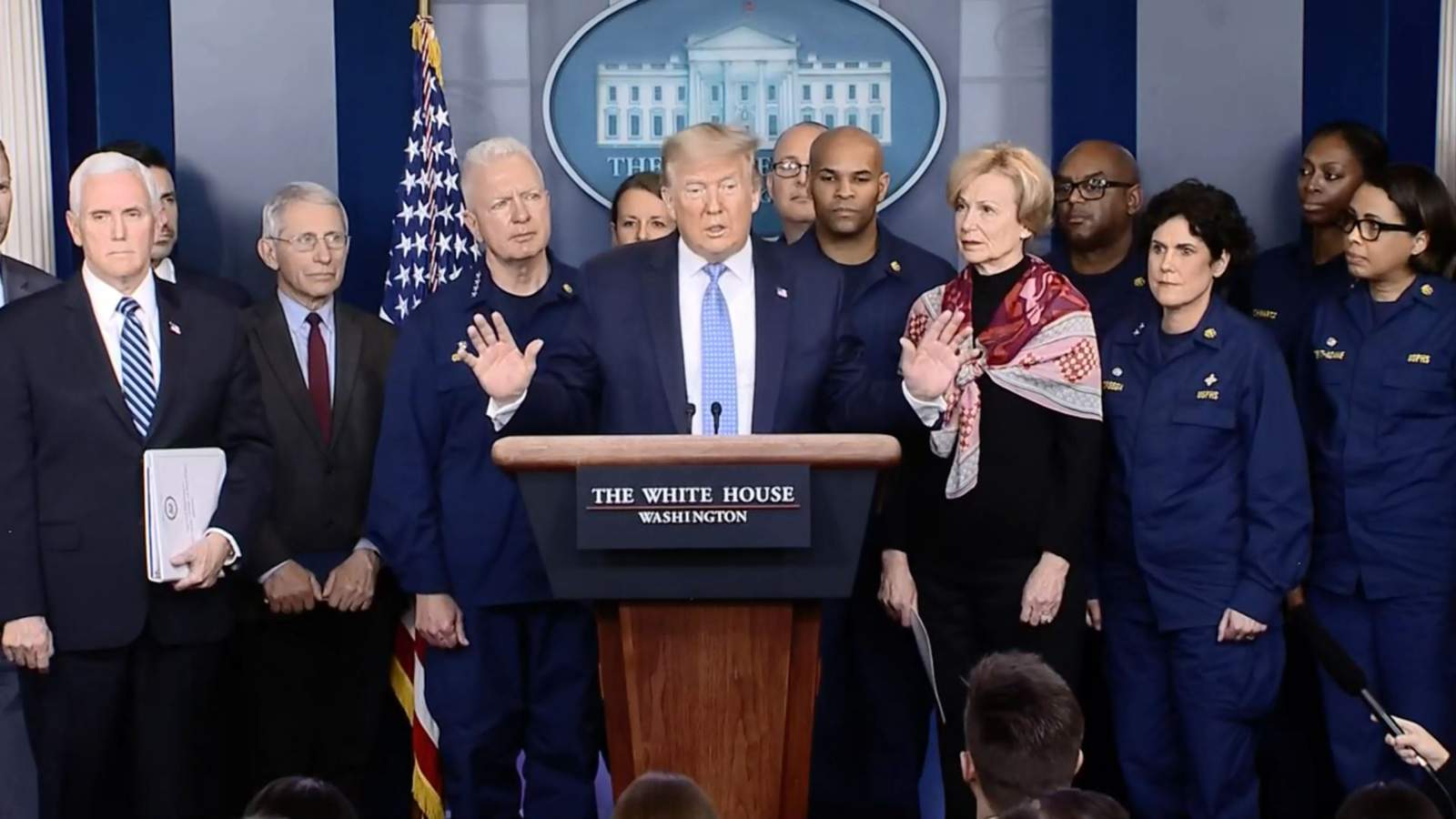
Bottom line: It is normal for the US government to develop its own disease testing under CDC. Experts in CDC are typically very good at it. But in the case of coronavirus, the US government developed a flawed test, creating lengthy delays in testing and in parallel left obstacles in place that would have shortened the delay. Meanwhile, U.S. government officials have repeatedly misled the public and policy makers. In total, more than 8 weeks were lost due to policy failure. This post explains and documents this remarkable policy failure.
View original post 1,625 more words
14 Apr 2020 Leave a comment
I’ve been doing a bit more digging into the data on COVID-19 deaths and some of the different ways to chart the progression of the new coronavirus. Mostly I’m just catching up with thinking already done by others, but hopefully this will still be interesting.
On Saturday I tweeted a link to a handy (if grim) tool produced by ‘Our World In Data’, which allows anyone to draw their own charts. I illustrated this with a simple chart of the total number of reported deaths per million people for a selection of European countries, including the UK (pasted below). On this metric alone, the UK is currently performing less badly than some of its peers – but also worse than some others.
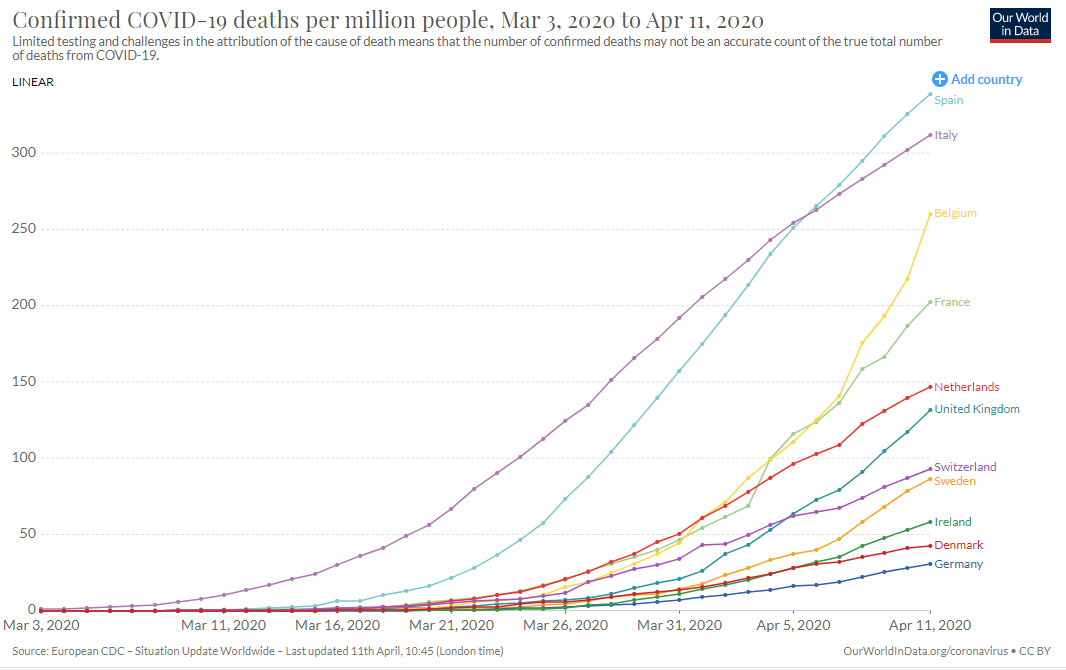
Of course, this isn’t a competition, and there is a tragedy behind every number. But I still think it’s worth asking why such large differences exist and whether this…
View original post 1,459 more words
14 Apr 2020 Leave a comment
The Treasury this morning released a report to the Minister of Finance offering several scenarios for how the economy might develop over the next few years. Before getting into the substance, there are a few points worth noting:
View original post 1,539 more words
13 Apr 2020 Leave a comment
Ross McKitrick has an engaging presentation of the Hockey Stick Debate presented on April 4, 2005. Here is the abstract:
The hockey stick debate is about two things. At a technical level it concerns a well-known study that characterized the state of the Earth’s climate over the past thousand years and seemed to prove a recent and unprecedented global warming. I will explain how the study got the results it did, examine some key flaws in the methodology and explain why the conclusions are unsupported by the data. At the political level the emerging debate is about whether the enormous international trust that has been placed in the IPCC was betrayed. The hockey stick story reveals that the IPCC allowed a deeply flawed study to dominate the Third Assessment Report, which suggests the possibility of bias in the Report-writing process. In view of the massive global influence of IPCC Reports…
View original post 43 more words
13 Apr 2020 Leave a comment
The Great Surge, Steven Radelet, 2015

The proportion of countries living in extreme poverty has fallen from 42% in 1993 to juts 17% in 2011. The opening of China accounts for a large share of the change, but the fall also affects dozens of countries in every region of the world (sample of 109 developing countries with population greater than 1 million is considered)
People in developing countries have incomes today that are nearly double those of their parents 2 decades ago.
People born in developing countries live 1/3 longer than they did 20 years ago.
In 1980, only half of the girls enrolled and completed primary education. Today 4 out 5 are.
In 1983, 17 countries had democracies. By 2013 the number had tripled to 56.Violence decline sharply. Since 1980, incidence of civil war in developing countries has been cut by half. Battle deaths in war have…
View original post 1,654 more words
12 Apr 2020 Leave a comment
His career spanned the regimes of Louis XVI, the years of the French Revolution, Napoleon, Louis XVIII, and Louis-Philippe. Those he served often distrusted Talleyrand but, like Napoleon, found him extremely useful. The name “Talleyrand” has become a byword for crafty, cynical diplomacy.
Every era has them, the operators, the scoundrels, the opportunists. Turbulence breeds these people. One of history`s most interesting operators was Talleyrand, who through a combination of political savvy, advantageous connections, unscrupulousness, intelligence, and being in the right place at the right time, held positions of authority in the ancien regime, Revolutionary government, the Napoleonic government, and the Bourbon Restoration. Eventually, he became so good that he made people believe that France could not be governed without him.

Charles Maurice de Talleyrand-Périgord was born to an aristocratic family in Paris in 1754. He was born with a congenital leg ailment, which prohibited him from entering the army, so he entered the priesthood. Not the priesthood priesthood with all that celibacy and poverty and everything, but the aristocratic priesthood with good food and congenial ladies. He would eventually, through family connections become the agent-general of the Clergy, the political representative of…
View original post 529 more words
12 Apr 2020 Leave a comment

 Last Sunday, the Queen spoke to the nation in a rare televised address. The speech was widely praised, and several other European monarchs have made similar attempts to connect with the public. Bob Morris and Robert Hazell argue that her intervention demonstrates the value of an apolitical head of state that remains compatible with modern democracy.
The British Queen’s address to the nation on Sunday, April 5 evoked huge interest, respect and widespread appreciation. Nearly 24 million people in the UK watched her deliver the four-minute speech, which paid tribute to National Health Service and other key workers, thanked people for following government rules to stay at home and promised ‘we’ll meet again’.
Her words were greeted with almost universal praise from politicians, press and the public alike. But what made it so special? Who advises the Queen on such occasions? And what does it tell us about the monarchy…
View original post 1,261 more words
Celebrating humanity's flourishing through the spread of capitalism and the rule of law
Celebrating humanity's flourishing through the spread of capitalism and the rule of law
Celebrating humanity's flourishing through the spread of capitalism and the rule of law
Celebrating humanity's flourishing through the spread of capitalism and the rule of law
Celebrating humanity's flourishing through the spread of capitalism and the rule of law
Celebrating humanity's flourishing through the spread of capitalism and the rule of law
Celebrating humanity's flourishing through the spread of capitalism and the rule of law
A History of the Alt-Right
Econ Prof at George Mason University, Economic Historian, Québécois
Celebrating humanity's flourishing through the spread of capitalism and the rule of law
Scholarly commentary on law, economics, and more
Beatrice Cherrier's blog
Celebrating humanity's flourishing through the spread of capitalism and the rule of law
Celebrating humanity's flourishing through the spread of capitalism and the rule of law
Celebrating humanity's flourishing through the spread of capitalism and the rule of law
Why Evolution is True is a blog written by Jerry Coyne, centered on evolution and biology but also dealing with diverse topics like politics, culture, and cats.
Celebrating humanity's flourishing through the spread of capitalism and the rule of law
A rural perspective with a blue tint by Ele Ludemann
DPF's Kiwiblog - Fomenting Happy Mischief since 2003
Celebrating humanity's flourishing through the spread of capitalism and the rule of law
The world's most viewed site on global warming and climate change
Tim Harding's writings on rationality, informal logic and skepticism
A window into Doc Freiberger's library
Let's examine hard decisions!
Commentary on monetary policy in the spirit of R. G. Hawtrey
Thoughts on public policy and the media
Celebrating humanity's flourishing through the spread of capitalism and the rule of law
Politics and the economy
A blog (primarily) on Canadian and Commonwealth political history and institutions
Reading between the lines, and underneath the hype.
Economics, and such stuff as dreams are made on
"The British constitution has always been puzzling, and always will be." --Queen Elizabeth II
Celebrating humanity's flourishing through the spread of capitalism and the rule of law
Celebrating humanity's flourishing through the spread of capitalism and the rule of law
WORLD WAR II, MUSIC, HISTORY, HOLOCAUST
Undisciplined scholar, recovering academic
Celebrating humanity's flourishing through the spread of capitalism and the rule of law
Res ipsa loquitur - The thing itself speaks
In Hume’s spirit, I will attempt to serve as an ambassador from my world of economics, and help in “finding topics of conversation fit for the entertainment of rational creatures.”
Researching the House of Commons, 1832-1868
Articles and research from the History of Parliament Trust
Reflections on books and art
Posts on the History of Law, Crime, and Justice
Celebrating humanity's flourishing through the spread of capitalism and the rule of law
Exploring the Monarchs of Europe
Cutting edge science you can dice with




Recent Comments