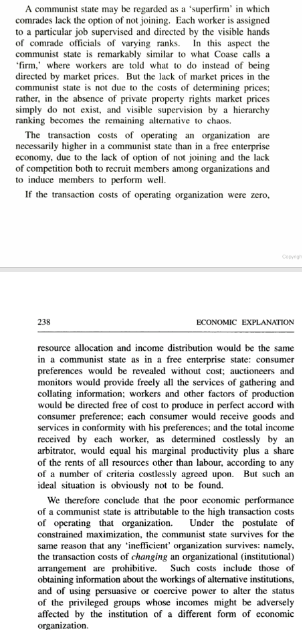
Steven N.S. Cheung on the Communist economy
29 Mar 2020 Leave a comment
in applied price theory, comparative institutional analysis, economics of information, history of economic thought, law and economics, Marxist economics, property rights, Public Choice, Ronald Coase, theory of the firm


Five Lessons for America from the European Fiscal Crisis
29 Mar 2020 Leave a comment

I’ve written about the fiscal implosion in Europe and warned that America faces the same fate if we don’t reform poorly designed entitlement programs such as Medicare and Medicaid.
But this new video from the Center for Freedom and Prosperity, narrated by an Italian student and former Cato Institute intern, may be the best explanation of what went wrong in Europe and what should happen in the United States to avoid a similar meltdown.
I particularly like the five lessons she identifies.
1. Higher taxes lead to higher spending, not lower deficits. Miss Morandotti looks at the evidence from Europe and shows that politicians almost always claim that higher taxes will be used to reduce red ink, but the inevitable result is bigger government. This is a lesson that gullible Republicans need to learn – especially since some of them want to acquiesce to a tax hike as…
View original post 341 more words
Coronavirus crisis doesn’t mean Corbyn was right
29 Mar 2020 Leave a comment
One of the reasons for the sharemarket fall is revised payoffs from investments because of high public debt and higher taxes. This massive borrowing has to be paid back sooner or later.
The current Labour Party finance minister in his emergency package page specific praise to both his National Party and Labour Party predecessors as finance ministers for insisting that the public debt be in the longer term no more than 20%. This fiscal conservatism means that New Zealand can borrow quite a lot but still have some reasonable prospect of paying it back without raising taxes much.

Given how trendy it is to blame ‘capitalism’ for all the world’s other ills, from wars to climate change, it’s no surprise that some have been quick to pin the current crisis on the failures of free markets too. Many have also used the need for unprecedented government intervention as evidence that the state should play a much bigger role in normal times as well. This is, to put it as politely as I can, rather disingenuous.
Let’s start by slaying a couple of strawmen. First, even the fiercest critics of the ‘nanny state’ would agree that public health cannot be left entirely to the markets. As Chris Snowdon has explained, the risk of a great many deaths from coronavirus is a textbook example of serious negative externalities that can only be dealt with by collective action. This is uncontroversial.
Second, most economists, whatever their leanings, would agree that…
View original post 768 more words
Climatists Fail to Coerce Exxon and Chevron
29 Mar 2020 Leave a comment


Another skirmish ends in activist defeat, as reported in Pension and Investments Exxon, Chevron given OK to dismiss shareholder climate proposal. Excerpts in italics with my bolds.
The Securities and Exchange Commission granted requests by Chevron Corp. and Exxon Mobil Corp. to again reject a shareholder proposal calling for reports on how the companies are addressing climate change goals. Similar proposals filed last year were also allowed to be excluded for Exxon after its challenge.
A document on the agency website noted briefly that SEC staff agreed March 20 with requests by company officials to exclude proposals from a group of shareholders, including the Church of England and As You Sow, asking if the companies will join other oil and gas companies in taking steps to align with the Paris Agreement goal of net-zero emissions by 2050, and calling for reduction targets, long-term business plans and other details.
“That…
View original post 1,120 more words
A Romantic and Political European Comedy: The Break Up
29 Mar 2020 Leave a comment
One reason the stock market is crashing his revised expectations about payoffs from investments in businesses because of much higher public debt crowding out in supply of investment funds and the looming prospect of higher taxes to repay all the emergency borrowing
There are several reasons why I’m glad that there are Europeans.
From a serious perspective, the decentralized and competitive states of Europe gave us great gifts such as the rule of law, the enlightenment, and the industrial revolution.
From a policy perspective, today’s Europe gives us examples of policies to emulate and policies to avoid (and also confusing mish-mashes of good and bad policies).
And from a comedic perspective, it’s generally still okay to make fun of Europeans – even if it (gasp!) involves stereotypes.
- Such as this cartoon involving Greece.
- And this terrorism-alert humor from the U.K.
- The French get mocked in this cartoon.
- Here’s a video showing that Der Fuehrer is unhappy about the downgrade.
- We have some very funny maps showing how various countries view their European counterparts.
- And, for those who like dark humor, this list of European leaders denying that the fiscal crisis…
View original post 116 more words
New Zealand and the Great Depression
29 Mar 2020 Leave a comment

It is a trifle unsettling to check out the Geonet pages, notice the large cluster of continuing aftershocks around “25kms east of Seddon”, and then to realise that looking out my window I can more or less see that spot. It surprises me quite how much damage and disruption Wellington has already had despite being several hundred kilometres from Culverden and the site of Sunday night’s major quake.
US politics and a good book make worthwhile distractions.
I’ve just been reading The Broken Decade: Prosperity, Depression and Recovery in New Zealand 1928-39, by the local historian Malcolm McKinnon. It is, as far as I’m aware, the first substantial scholarly history of the depression years in New Zealand.
The Great Depression was a tough time for many people in many countries, New Zealand not excluded.
Whereas for the UK, the fall in real per capita GDP wasn’t much larger than the…
View original post 1,776 more words
Coronavirus: Do socialists understand socialism?
29 Mar 2020 Leave a comment
in applied price theory, applied welfare economics, Austrian economics, comparative institutional analysis, constitutional political economy, development economics, economic history, economics of bureaucracy, economics of information, economics of regulation, entrepreneurship, growth disasters, growth miracles, income redistribution, industrial organisation, law and economics, liberalism, libertarianism, Marxist economics, Public Choice, public economics, rentseeking, survivor principle Tags: economics of pandemics
Waiting at the church: Why Callaghan failed to call the 1978 general election
29 Mar 2020 Leave a comment
War Declared: Wind Power Push Pits New York Governor Against The People
28 Mar 2020 Leave a comment


Nothing invokes rage and fury in rural communities like a wind farm comprising dozens and sometimes hundreds of 300 tonne, 200m high monsters.
In Germany, locals have expressed their opposition in no uncertain terms by voting 25 to 1 against a giant wind project proposed for their patch of paradise:
And elsewhere, grassroots opposition to the subsidy-sucking wind industry has never been healthier and more active., New York State, is no exception.
20 years into the 21st century, you’d be forgiven for thinking that we’d left fascist dictators in the 20th century. Then along comes Andrew Cuomo, New York’s wind power obsessed Governor. Instead of listening to his constituents, he’s determined to gag them and ride roughshod over them.
Sherri Lange reports in with the latest from the battle front in New York State.
New York’s Cuomo vs. the Grassroots on Wind & Solar
Master Resource
Sherri Lange
View original post 1,573 more words
Don’t fret, folks – Hone’s sweet with the mayor so long as he sets up checkpoints and doesn’t mount road blocks
28 Mar 2020 Leave a comment

Hobson’s Choice spokesman Don Brash (a former leader of the National and ACT Parties) is not alone in challenging the justification for tribes claiming to have closed roads to protect their people against Covid.
Deputy Prime Minister and New Zealand First leader Winston Peters – his remarks apparently ignored by other media – told Waatea News unofficial tribal militia throwing up checkpoints were more likely to hinder than help the Covid-19 response.
He was interviewed at a time when hapu and iwi on the East Coast were organising such road-blocks and Hone Harawira was arranging checkpoints on roads into the far north.
Peters said the government didn’t need Harawira to ring-fence Kaitaia.
“That’s what the Government is seeking to do now. That’s why there’s a lockdown. That’s why they’re saying don’t travel. That’s why the Government is saying stay at home, look after each other.
“If you ring-fence Kaitaia, it…
View original post 1,108 more words
Hornsdale Power Reserve: calculating oneself rich
28 Mar 2020 1 Comment

In Flanders, we have the expression “calculating yourself rich”. It means presenting one’s case in a too optimistic way that doesn’t accord with reality. This can for example be done by only counting the positives or by making overly optimistic assumptions. Both can result in an end result that is far too optimistic. Therefor “calculate” yourself rich instead of “being” rich. It is not real wealth, it is fully dependent on the tricks used in the calculation.
This expression popped up in my mind when I read an article about the blessings of grid sized battery storage (see previous post). To recap: two advocates for solar and wind claimed that batteries could replace natural gas power plants for peaking and gap-filling. Reading the linked article, it became clear that it had nothing to do with the claims made by the two advocates. The subject of the linked article described how…
View original post 970 more words
Two congresspeople, including AOC, threaten to delay passage of stimulus bill
28 Mar 2020 Leave a comment

I’ve pretty much written off Republicans, but among us Democrats there’s one annoying snake in the grass, a snake who goes by the monicker of AOC. Truly, I am amazed at the number of people who admire her, and even suggest she’d make a good president. I see her as having some good positions. and is generally on the right side of issues (even though her solutions are often ludicrous), but someone who’s not that bright, and is following a script laid out by the Justice Democrats, who recruited her to run for Congress. I also believe she’s an anti-Semite and somewhat of a narcissist—as well as a social-media “influencer” along the lines of Trump. And now she (along with a Republican in the House) is threatening passage of the stimulus bill (see also here).
Passage of largest ever American relief bill could be delayed.
With many lawmakers scattered…
View original post 323 more words
Review: “Forgotten Royal Women: The King and I”, by Erin Lawless
28 Mar 2020 Leave a comment

For my last-but-one Women’s History Month post, I’m so excited to share my review of Erin Lawless’ book Forgotten Royal Women: The King and I, which Pen & Sword Books kindly sent me a copy of to review. A positive in the craziness that the world is going through right now (and I sincerely hope that you, your families and friends are all safe and well at this uncertain time) is that isolation has meant for me lots of reading time. The month of March became, more than I expected when I set myself a Women’s History Month theme of Reading Women, a month of reading women: about women’s history, female authors I hadn’t read before and women’s studies. And this included this lovely, entertaining book about the royal women you might not have heard of before, and a window into their stories.
Lawless opens with Catherine…
View original post 962 more words
Accession of Charles I, King of England, Scotland and Ireland.
28 Mar 2020 Leave a comment

Charles I (19 November 1600 – 30 January 1649)[a] was King of England, King of Scotland, and King of Ireland from March 27, 1625 until his execution in 1649.
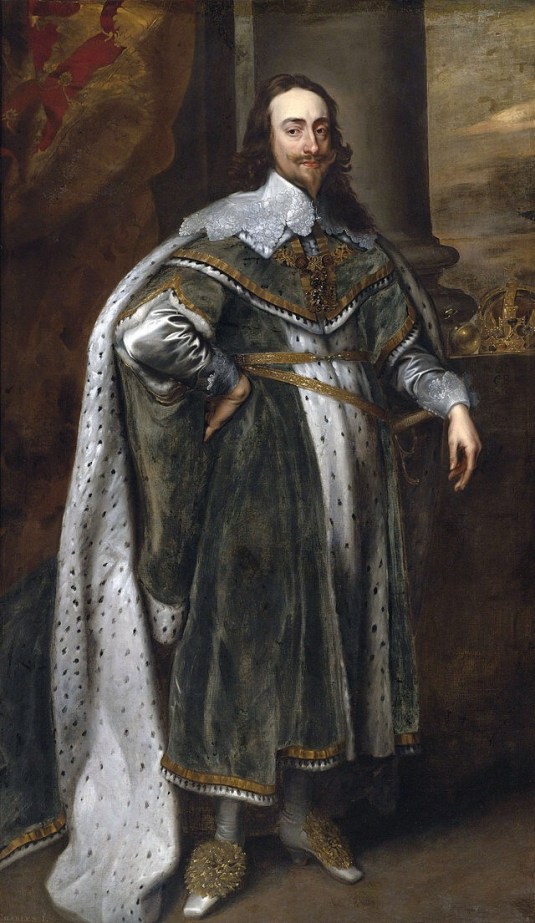
Charles was born into the House of Stuart as the second son of King James VI of Scotland, but after his father inherited the English throne in 1603 (as James I), he moved to England, where he spent much of the rest of his life. He became heir apparent to the three kingdoms of England, Scotland and Ireland in 1612 on the death of his elder brother Henry Frederick, Prince of Wales. An unsuccessful and unpopular attempt to marry him to the Spanish Habsburg princess Maria Anna culminated in an eight-month visit to Spain in 1623 that demonstrated the futility of the marriage negotiations. Two years later he married the Bourbon princess Henrietta Maria of France, the youngest daughter of Henri IV…
View original post 302 more words


Recent Comments