Coordinated Work Schedules and the Gender Wage Gap @women_nz
09 Jan 2020 Leave a comment
in applied price theory, discrimination, econometerics, economics of education, gender, human capital, labour economics, labour supply, occupational choice Tags: gender wage gap
Rent Control Does Not Make Housing More Affordable
09 Jan 2020 Leave a comment
in applied price theory, applied welfare economics, economics of bureaucracy, economics of education, income redistribution, industrial organisation, law and economics, politics - New Zealand, politics - USA, property rights, Public Choice, rentseeking, urban economics Tags: offsetting behaviour, rent control, The fatal conceit, unintended consequences
Why Sweden ended its negative interest rate experiments
09 Jan 2020 Leave a comment

Sweden ended its negative rate policy recently. Bernanke recently spoke on how consequences of negative interest rates have not been that bad.
Daniel Lacalle gives an Austrian school perspective:
Negative rates are a huge transfer of wealth from savers and real wages to the government and the indebted. A tax on caution. They are the destruction of the perception of risk that always benefits the most reckless. The bailout of the inefficient.
Central banks ignore the effects of demography, technology, and competition on inflation and the growth of consumption, credit, and investment, and with the wrong policies they generate new bubbles that become more dangerous than the previous ones. The next bubble will again increase the fiscal imbalances of the countries. When central banks present themselves as the agents that will reverse the effect of technology and demographics, they will be creating a greater risk and bubble.
View original post 223 more words
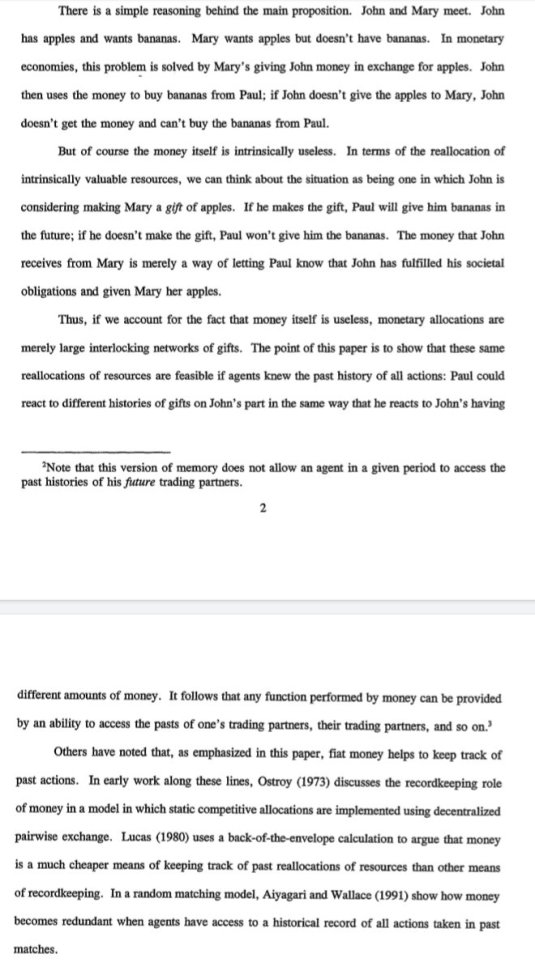
A simple explanation of money
08 Jan 2020 Leave a comment
in applied price theory, economic history, financial economics, macroeconomics, monetary economics, property rights Tags: theory of money
TIM FLANNERY’S Bizarre Globalist Rant
08 Jan 2020 Leave a comment

PROFESSIONAL climate alarmist, Tim Flannery was head of Australia’s Climate Commission. For his $180,000, three day, part-time working week, he made decisions that affected billions of dollars of Australian taxpayers money.
A MUST WATCH! And, ask yourself one question while viewing: Would you want this freak show in charge of your hard-earned? …
See more Flannery :
Do we need a written constitution?
08 Jan 2020 Leave a comment

 Prior to the general election, several of the parties’ manifestos called for the creation of a codified constitution for the UK. In December, the Constitution Unit hosted an event to debate the merits and downsides of such an exercise. Harrison Shaylor summarises the discussion.
What did the 2019 Liberal Democrat election manifesto and the Brexit Party’s ‘Contract with the People’ (from the same election) have in common? Both advocate the need for a written constitution in the UK. So too did the Green Party manifesto, and that of the Alliance Party of Northern Ireland. Meg Russell took part in a discussion on a written constitution in The Briefing Room on Radio 4 in September, and on 28 November, the Constitution Unit held its own event entitled ‘Do we need a written constitution?’. Two distinguished law professors – Sionaidh Douglas-Scott of Queen Mary University of London…
View original post 1,710 more words
New paper : Technological Diffusion News
08 Jan 2020 Leave a comment

 I posted on my “current work” page a new paper “Technological Diffusion News, A comment on “Whither News Shocks?” by Barsky, Basu & Lee” It is forthcoming in the NBER Macroeconomics Annual 2014, Volume 29
As written in the abstract,
Barsky, Basu, and Lee [2014] are proposing to identify a technological news shock as the innovation in the expectation of TFP at a fixed horizon in the future that does not affect TFP on impact. In response to this shock, consumption typically rises following good news, but investment, consumer durables purchases and hours worked typically fall on impact. Noticing that this shock indeed moves TFP after one period, I propose ways to identify a technological diffusion news. By diffusion news, I mean that TFP is not affected in the short to medium run but permanently increases. In response to such a shock, the economy does display an aggregate boom…
View original post 20 more words
New version : Putting the Cycle Back into Business Cycle Analysis
08 Jan 2020 Leave a comment
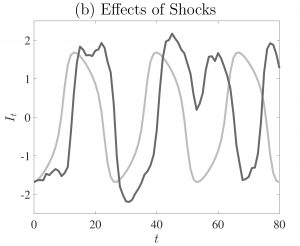 I have posted on my “current work” page a (very) updated version of a paper with Paul Beaudry and Dana Galizia “Putting the Cycle Back into Business Cycle Analysis“. As written in the abstract,
Are business cycles mainly a response to persistent exogenous shocks, or do they instead reflect a strong endogenous mechanism which produces recurrent boom-bust phenomena? In this paper we present new evidence in favor of the second interpretation and, most importantly, we highlight the set of key elements that influence our answer to this question. In particular, when adopting our most preferred estimation framework, we find support for the somewhat extreme notion that business cycles may be generated by stochastic limit cycle forces; that is, we find support for the notion that business cycles may primarily reflect an endogenous propagation mechanism buffeted only by temporary shocks. The three elements that tend to favor…
View original post 82 more words
David Friedman at Libertopia 2010 on Future Imperfect
08 Jan 2020 Leave a comment
in applied price theory, comparative institutional analysis, constitutional political economy, economic history, economics of crime, economics of education, economics of information, economics of regulation, entrepreneurship, industrial organisation, international economics, law and economics, property rights
New York Times tells Democrats how to regain the White House
08 Jan 2020 Leave a comment

All of us who identify as Democrats or liberals are biting our nails about this November’s elections. Can Trump possibly win again? I go back and forth on this, but lately am more optimistic that, because of the impeachment proceedings and Trump’s unhinged behavior about Iran and international affairs in general, the Democrats have a good shot at getting the White House this year—and maybe even (but probably not) the Senate. I’m confident they’ll keep the House of Representatives, but of course the Presidency is also important in a way that the Congress is not: the Prez chooses Supreme Court nominees, and if the nominees are young their influence could last decades—or longer. And we all know that Ruth Bader Ginsburg, a left-leaning Justice, probably won’t keep her seat through another Trump administration. The brave woman is hanging in there, but she’s made of flesh.
The article below, by two…
View original post 1,267 more words
THE Great Global Warming “Pause”
07 Jan 2020 2 Comments

BETWEEN the start of 1997 and the end of 2014, average global surface temperature stalled. This 18-year period is known as the global warming “pause” or “hiatus” and has been the subject of much research and debate in peer-reviewed scientific journals.
THE rise in global temperatures that alarmed climate campaigners in the 1990’s had slowed so much that the trend was no longer statistically significant. This despite one-third of Man’s entire influence on climate since the Industrial Revolution occurring since February 1997.
THE pause took a pause during the 2015/16 super El Niño which was the strongest such event in recorded history and helped to make 2015 and 2016 the warmest years in the modern warm period. However, 2017 witnessed the biggest drop in global temps in recorded history, seen across most data sets, bringing temps back inline with 1997-2014 averages, rendering “the pause” alive and well, to date.
THERE…
View original post 3,088 more words
Lies, Damned Lies, and Statistics
07 Jan 2020 Leave a comment

By Cassie Watson; posted 11 December 2019.
As the current election campaign draws to a close amid increasingly shrill claims and counterclaims, I am reminded of a saying that, while common today, appears to have originated around the time of a much earlier election campaign.[1] In early July 1892 remarks made by “Mr Balfour” — presumably Arthur Balfour MP (1848–1930), then Leader of the House of Commons — were cited by fellow Tories in relation to the three categories of untruths alleged to be inherent in Gladstonian speeches about Irish Home Rule: “lies, damned lies, and statistics.”[2] While the possibility of (another) minority government is one route to pursue regarding this observation,[3] I am more interested in the statistics part of Balfour’s quotation, as the collection, analysis and interpretation of historical data are among the main methodologies utilised by criminal justice historians. The saying itself is now…
View original post 1,859 more words
This date in history: January 6,1540. Marriage of Anne of Cleves and King Henry VIII of England.
07 Jan 2020 Leave a comment

Anne of Cleves (1515 – 16 July 1557) was queen consort of England from January 6 to July 9, 1540 as the fourth wife of King Henry VIII.

Anne was born in 1515, on either September 22, or more probably June 28. She was born in Düsseldorf, the second daughter of Johann III of the House of La Marck, Duke of Jüliich-Cleves, and Berg. Johann III was also Count of Mark, and Ravensberg. Johann held the titles Duke of Jüliich, Berg and Count of Ravensberg jure uxoris which means by right of his wife Maria, Duchess of Julich-Berg (1491–1543).
Anne’s mother Maria of Jülich-Berg (August 3, 1491 – August 29, 1543) was born in Jülich, the daughter of Wilhelm IV, Duke of Jülich-Berg and Sibylle of Brandenburg, a daughter of Elector Albrecht III Achilles of Brandenburg (1414–1486) from his second marriage to Anna (1436–1512), daughter of the Elector Friedrich II…
View original post 1,346 more words


Recent Comments