
Richard Epstein on the cost of discrimination
30 Dec 2019 Leave a comment
in applied price theory, Austrian economics, discrimination, economics of information, industrial organisation, politics - USA, property rights, Public Choice, survivor principle Tags: sex discrimination
The 1619 Project: Historians versus the New York Times
30 Dec 2019 Leave a comment

There’s no doubt that America has been marked in a big way, with many people still marginalized, by the presence of slavery in our history. I see this every week in Chicago, America’s most segregated city, where (except for Hyde Park, where I live), white and black communities are largely separated, with the latter having poorer schools, deficient government services, and, of course, lower incomes. This cannot be understood without apprehending the context in which black people came to America: as slaves.
And so I applaud the New York Times‘s “1619 Project”, described in Wikipedia and whose contents are at the NYT link just below. Its goal is to educate Americans about the legacy of slavery in America, and to produce materials to supplement secondary school history curricula. This is timely and needed: for example, a Southern Poverty Law Center survey showed this:
Only 8 percent of high…
View original post 1,949 more words
Did We Evolve the Capacity for Sustained Growth?
29 Dec 2019 Leave a comment

NOTE: The Growth Economics Blog has moved sites. Click here to find this post at the new site.
I posted a few pieces (here and here) recently on genetics and growth. The Economist even picked up on Justin Cook’s work on lactose tolerance and development. Justin’s work on both lactose and the HLA system are about very specific genes, while the other research I mentioned is about genetic heritability of certain behaviors associated with growth, without specifying any particular genes.
There is another line of research on evolution and growth pioneered by Oded Galor and Omer Moav. They propose that natural selection over different types of individuals could have led to the onset of sustained economic growth. In particular, they focus on selection over preferences for the quantity and quality of kids. This is very much the second kind of research I mentioned above; it does not identify…
View original post 1,045 more words
Taking stock: Top mythbusting posts of 2019
29 Dec 2019 Leave a comment

Media Myth Alert directed attention in 2019 to the appearance of well-known media-driven myths, those prominent tales about and/or by the news media that are widely believed and often retold but which, under scrutiny, dissolve as apocryphal or wildly exaggerated.
Here’s a look back at the year’s five top posts at Media Myth Alert which, in late October, marked its 10th anniversary. The Washington Post figured in three of the year’s top posts.
■Impeachment hearings prompt media references to heroic-journalist myth of Watergate (posted November 27): It doesn’t take much for journalists to conjure the heroic-journalist myth of Watergate. It’s a trope that’s readily invoked but often too good to check out.
An almost-predictable by-product of the impeachment hearings conducted late in the year by the House of Representatives Intelligence Committee were media references to the myth that the Post’s reporting brought down
View original post 2,227 more words
Q&A Why So Many Climate Skeptics
29 Dec 2019 1 Comment

An extensive and documented reply is given at Quora from John Walker, former Laboratory Medical Director/Pathologist (1984-2011). Excerpts in italics with my bolds.(red text is link)
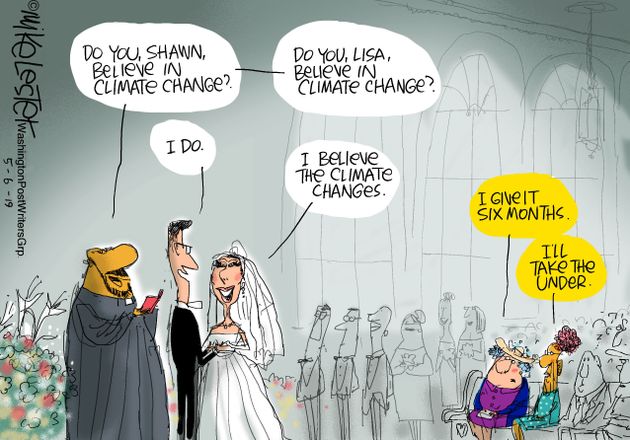
There are very few individuals who are skeptical that the climate changes. But there are millions and millions of individuals (and growing), who are quite skeptical that human emissions of CO2 are causing apocalyptic global warming, including many scientists, climate scientists, Nobel Laureates, and other highly educated individuals.
The reason for this is multi-factorial and very voluminous. The following presents condensed summaries of 12 of the reasons that so many individuals have become highly skeptical of the theory of CAGW. Even though it is rather long, it represents only a small portion of the information, studies and references engendering skepticism of this unproven assemblage of hypotheses. Most…
View original post 2,242 more words

How Climate Talk Got Crazy
28 Dec 2019 Leave a comment

Dr. Arnd Bernaerts in a recent article provides the historical context necessary to get our bearings straight despite today’s overheated, bizarre media-drenched tirades.
As he explains, climate has always been particular and personal, not global or objective. And that has led us into our current impasse, unable to talk productively about weather and climate. It is as though we can not come to grips with the climate issue because our very language and terminology is itself a prior problem preventing any progress. In brief, the terms “weather” and “climate” are loaded with emotion, but not with clear, definitive scientific meaning. IOW plenty of connotation (heat) and very little denotation (light). Dr. Bernaerts faults scientists for failing to develop a rational framework for discovery and research, and instead opting for an actiivist agenda which benefits from the ambiguity and misrepresentation.
The article is Weather and climate are everyday slang words and…
View original post 793 more words
Could Priests Claim Sanctuary in Medieval England?
27 Dec 2019 Leave a comment

Posted by Sara M. Butler, 16 May 2019.
 A more familiar gang of medieval outlaws: Robin Hood, Will Scarlet, and Little John.
The Folvilles of Ashby-Folville (Leics.) played a key role in persuading me to devote my life to researching crime in medieval England. As an undergraduate, reading Edward Stones’ 1957 study of the infamous crime family opened my eyes to the medieval common law’s broad potential for manipulation and creative application of the laws.[1] For those of you unfamiliar with the family, their story comes across as a medieval rendering of Mario Puzo’s The Godfather, with a little bit of Butch Cassidy and the Sundance Kid thrown in for good measure. John de Folville, lord of Ashby-Folville, fathered seven sons. Only one of the seven, John the younger, led the typical life of the medieval gentry, obtaining appointments as commissioner of array and keeper of…
View original post 2,567 more words
Sky News Arabia blames Israel for Jewish exodus from Arab lands
27 Dec 2019 Leave a comment

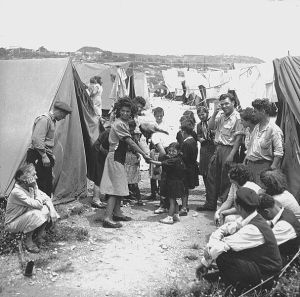 This is the fourth in a series of posts by CAMERA Arabic (part 1, part 2, part 3) showing how Arabic language news networks, including those affiliated with Western media outlets, frame the topic of Jews who originate from or live in the Middle East and North Africa, by attempting to distinguish between ‘loyal’ Jews and ‘treacherous’ Zionists. (All translations, emphasis and in-bracket remarks are by CAMERA Arabic unless otherwise specified. Almost all links lead to English websites, unless no reliable translation was found.)
In previous posts we sought to reveal how some Arabic-speaking journalists and commentators frame the existence (or more commonly, lack thereof) of Jewish communities in Arab states. Through an analysis of three news items, originating in Egypt and Tunisia, we demonstrated that they approached this volatile topic in the following ways:
- Labeling Jews from Arab states, in the pejorative, as “Zionists” or…
View original post 2,208 more words
The vanity and vulgar pride of intellectuals
27 Dec 2019 Leave a comment

Hoover Institution Senior Fellow Dr. Thomas Sowell published a book entitled Intellectuals and Society. In his book, Sowell examines a group of people who influence public policy, debates and other institutions. The talk Dr. Sowell gives in this video goes into elements of his book. It includes discussion of some of the personalities profiled in it along with a look at President Barack Obama.
Dr. Sowell also discusses environmentalists too as they are very much intellectuals in that they think they are the enlightened ones who know what is best for everyone else. The only difference is that environmentalists can back their words up with activism in order to make you do their bidding. Not only is the road to hell, as Dr. Sowell quips, paved with Ivy League degrees but hell on Earth is achieved by people thinking they know what is best for others.
Thomas Sowell Interview: “The Vision of the Anointed”
27 Dec 2019 Leave a comment
Think Tank host Ben Wattenberg converses one-on-one with author Thomas Sowell about his (then) new book, The Vision of the Anointed, which argues that the assumptions and beliefs of America’s liberal elite have created thirty years of disaster. This book can be seen as a precursor to Intellectuals and Society.
In his book, Sowell states: “Whether the issue has been overpopulation, Keynesian economics, criminal justice or natural resource exhaustion, a key assumption is that the public is so irrational that the superior wisdom of the anointed must be imposed to avert disaster. The anointed do not simply happen to have a disdain for the public. Such disdain is an integral part of their vision, for the central feature of that vision is preemption of the decisions of others.”
Top Guardian pieces in 2019 denying antisemitism in Corbyn’s Labour Party
26 Dec 2019 Leave a comment

Before providing examples of Guardian op-eds, cartoons and letters that obfuscated, covered for or excused Jeremy Corbyn’s well documented record of aiding, abetting and, at times, personally engaging in antisemitism, let’s begin with some numbers:
- 87 – The percentage of British Jews who believe Corbyn is personally antisemitic.
- 47 – The percentage of British Jews who would have seriously considered leaving the UK if Corbyn became prime minister.
- 6 – The percentage of Jewish voters who said they would even consider voting for Corbyn.
- 39 – The percentageof all Britons who believe Corbyn is antisemitic.
- 1 – The number of British political parties, other than Corbyn’s Labour, that have been investigated by the Equality and Human Rights Commission – the public body responsible for the enforcement of non-discrimination laws in England, Scotland and Wales – for institutional racism. (That other party was the far-right British National Party)
View original post 361 more words
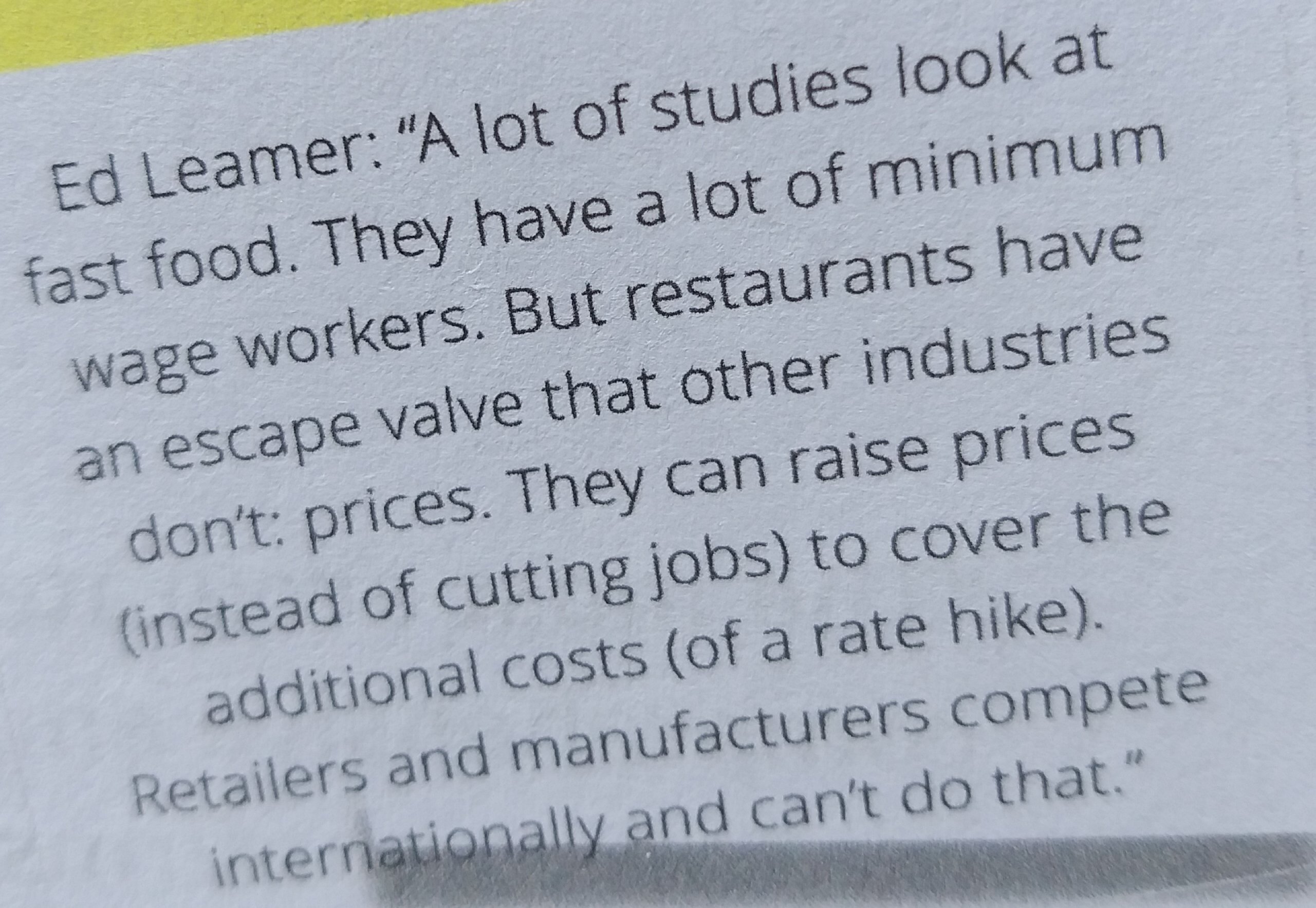
Sample selection bias and @Fightfor15 @AOC @BernieSanders @SenWarren
26 Dec 2019 Leave a comment
in applied price theory, econometerics, industrial organisation, international economics, labour economics, labour supply, minimum wage, politics - USA, survivor principle Tags: data mining, sample selection bias


Recent Comments