Industrial Devolution: Renewables Obsession Leaves German Industry Crushed By Rocketing Power Prices
21 Dec 2019 Leave a comment


No country went harder and faster with its renewable obsession than Germany. The rocketing power prices that inevitably followed are crushing its once thriving industries, including motor manufacturers such as Mercedes-Benz.
The idea that a critical input cost to manufacturing can be tripled without affecting profitability and employment is, as any student of that dismal science, economics might tell you, a nonsense.
Francis Menton takes a look at what happens when renewable energy rent seekers and eco-loons take control of energy policy, and with it the economic policy that underlies the success of any modern, industrial economy. Germany’s included.
Contrast Of Climate And Energy Policies, And Economic Results, In The U.S. And Germany
Manhattan Contrarian
Francis Menton
6 December 2019
If you are reading your normal diet of “mainstream” press, you are getting hit with a constant barrage of climate alarm, together with a near total boycott on any good…
View original post 1,053 more words
ExxonKnew While NYAGsClueless
21 Dec 2019 Leave a comment

 At Real Clear Energy is a good reflection on the collapsed climate legal crusade by three NYAGs Exxon and Evidence 101 by John S. Baker, Jr. Excerpts in italics with my bolds.
The problem for all these attorney generals is that states have no jurisdiction over climate change. Whatever one thinks about climate change, the climatic phenomena know no borders. If anything should be done about climate change, it is properly committed to the federal government.
Untroubled by these fundamental facts, current New York Attorney General Letitia James nevertheless charged ExxonMobil with fraud in misleading investors regarding the threat posed to the company by the costs allegedly associated with by climate change. New York State’s notoriously broad and vague Martin Act.
In the court of (elite) public opinion, ExxonMobil had already been found guilty. For three years prior to trial, the Attorney General’s office claimed that ExxonMobil was clearly…
View original post 589 more words
Climate Crisis, No! Energy Poverty.
21 Dec 2019 Leave a comment

Energy and Poverty are obviously tied together.
“Access to cleaner and affordable energy options is essential for improving the livelihoods of the poor in developing countries. The link between energy and poverty is demonstrated by the fact that the poor in developing countries constitute the bulk of an estimated 2.7 billion people relying on traditional biomass for cooking and the overwhelming majority of the 1.4 billion without access to grid electricity. Most of the people still reliant on traditional biomass live in Africa and South Asia.
The relationship is, in many respects, a vicious cycle in which people who lack access to cleaner and affordable energy are often trapped in a re-enforcing cycle of deprivation, lower incomes and the means to improve their living conditions while at the same time using significant amounts of their very limited income on expensive and unhealthy forms of energy that provide poor and/or…
View original post 675 more words
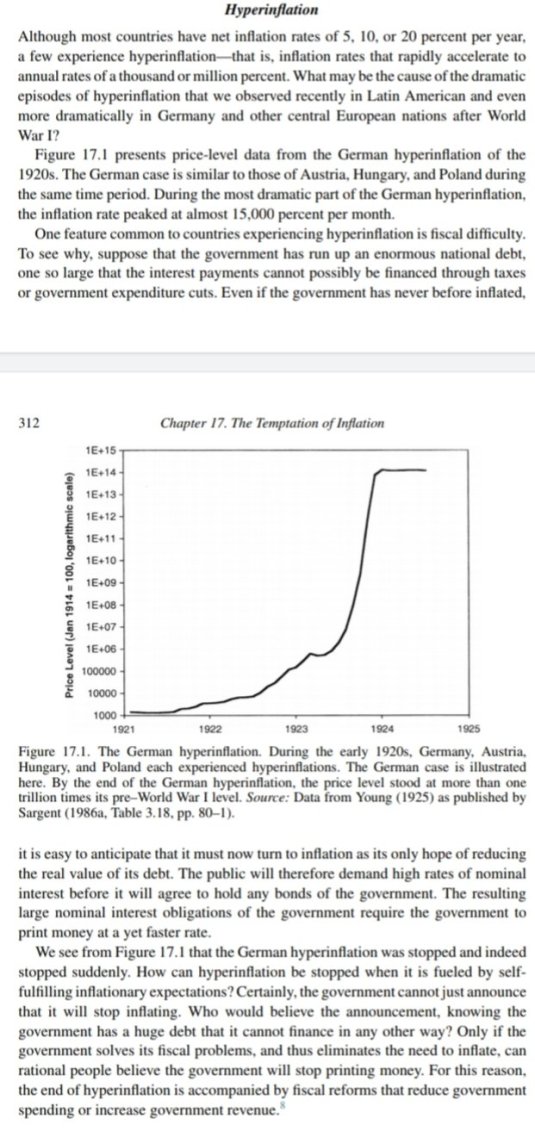
Champ and Freeman on hyperinflation as always and everywhere a fiscal phenomenon
21 Dec 2019 Leave a comment
Losing a job for believing that biological sex is immutable
21 Dec 2019 Leave a comment

An astonishing decision from an Employment Tribunal in the UK has ruled that it is acceptable to dismiss an employee because of their view that sex is biological and immutable (unable to be changed). In a preliminary ruling in Forstater v CGD Europe (18 Dec 2019; Case No 2200909/2019, Employment Judge Tayler) this view was found to be “incompatible with human dignity and [the] fundamental rights of others” (para [84]), and hence not a protected “belief” for the purposes of a claim of “belief”-based discrimination under the UK Equality Act 2010. While this case is not based on a religious belief, it brings into sharp focus a number of issues connected with religious beliefs and the workplace.
View original post 2,920 more words
Killer-App: Offshore Wind Turbines Wiping Out Entire Bird Species
20 Dec 2019 Leave a comment
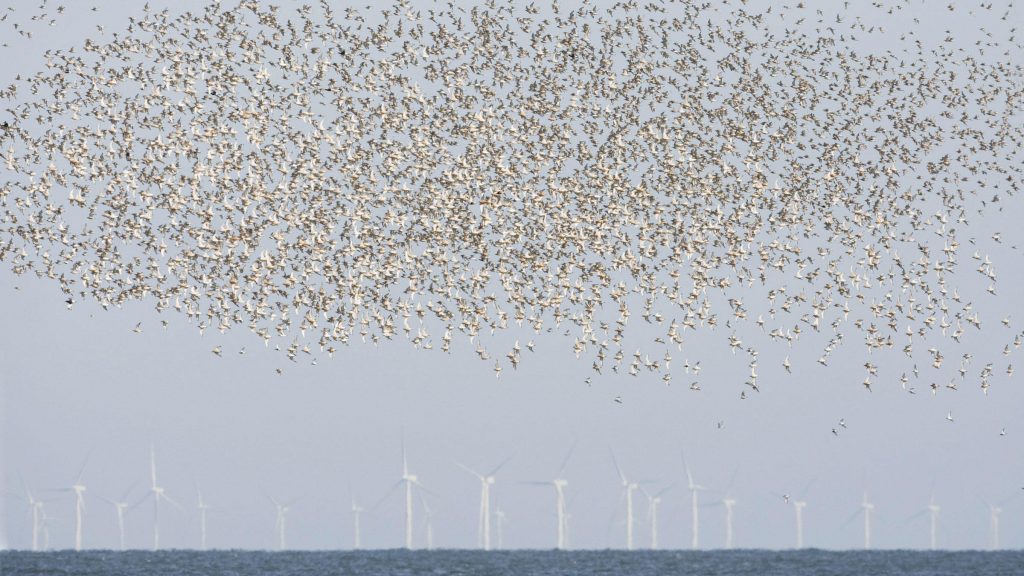
While Greta frets about global incineration and mass extinctions, the wind industry is doing a very fine job of extinguishing millions of birds and bats, every year. Indeed, entire species are under threat, including Europe’s Red Kite and Tasmania’s Wedge Tailed Eagle.
More generally, there’s a wave of avian carnage wherever the wind industry plies it subsidy-soaked trade; and offshore is no exception.
As Jason Endfield details below, the offshore wind industry is exacting a phenomenal toll on a whole range of seabirds in the waters surrounding Britain.
Isle Of Man Seabird Populations Plummet As Wind Farms Overwhelm The Irish Sea
Jason Endfield Blog
Jason Endfield
21 June 2019
Herring Gulls are down 82%, European Shag down 51%, Razorbills down 55%. The list goes on….
* The world’s biggest offshore wind farm is just a few miles away.
* Isn’t there a conspicuous connection?
The Isle Of Man wildlife…
View original post 685 more words
The biology of male aggression, and why it’s not all “socialization”
20 Dec 2019 Leave a comment

While I’ve long been a critic of evolutionary psychology, I’m not stupid or woke enough—unlike some bloggers I won’t name—to dismiss the entire field as worthless. While it’s hard to test whether some behaviors in our species have evolved by natural selection, there are degrees of confidence we can get, and predictions one can make, to judge the likelihood that these behaviors are indeed “darwinian.” While nobody argues that behaviors like preferring your own children over others aren’t products of natural selection, there are those who claim that behavioral differences between men and women are not—and in fact cannot—be based on genes installed in our species by natural selection.
The two sex differences I find most evolutionarily convincing involve human sexual behavior—in particular the observation that males tend to be relatively indiscriminate in choosing someone to mate with, while females are pickier—and the fact that males are more aggressive…
View original post 1,973 more words
Norway Names Controversial Climate Change Skeptic As New Oil Minister
20 Dec 2019 Leave a comment

 Norwegian oil platform, North sea [image credit: Wikipedia]
Sounds like a woman of much commonsense, then. Of course any perceived deviation from climate alarmist orthodoxy translates as ‘controversial’ in much of the media.
Norway appointed on Wednesday a skeptic on wind power and climate change as its new oil minister who will oversee oil and gas drilling and wind turbine installations on and offshore Western Europe’s largest oil producer, reports OilPrice.com.
Sylvi Listhaug of the right-wing Progress Party was appointed Minister of Petroleum and Energy on Wednesday, replacing Kjell-Børge Freiberg who was “honourably discharged from his office,” the Norwegian government said.
Listhaug is taking over one of the most important ministries which oversees one of Norway’s top exports—oil and gas—as well as the government’s majority stake in energy giant Equinor.
View original post 147 more words
Guardian op-ed: ‘false’ antisemitism charges against Corbyn used to stifle debate
20 Dec 2019 9 Comments

A Guardian op-ed defending Bernie Sanders from charges that he’s abettedantisemitism, “Accusing Bernie Sanders of antisemitism? That’s a new low”, Dec. 18, by Kate Aronoff, contributing writer to The Intercept, includes the following claim:
For [those] on the right that have jumped on the [Sanders is antisemitic] bandwagon, though, details don’t really matter. Sanders, an avowed democratic socialist, simply belongs to an opposing political camp with opposing values. Like the attacks against Corbyn abroad and Ilhan Omar at home, those now being lobbed at Sanders aren’t about defeating antisemitism so much as using it as a narrative device to undermine a worldview that offends them. Sanders’s solidarity with Palestinians suffering under occupation is not an affront to Jews but to the right’s propaganda that looking out for their best interest means a blanket, unquestioning support for whatever the Israeli government happens to be doing, which at the…
View original post 180 more words
Why didn’t Canada have a Banking Crisis?
19 Dec 2019 Leave a comment

The structure and performance of financial systems is path dependent. The relative stability of the Canadian banks in the recent crisis compared to the United States, where the recent crisis originated in the shadow banking system and spread to the universal banks, in our view reflected the original institutional foundations laid in place in the early 19th century in the two countries. The Canadian concentrated banking system that had evolved by the end of the twentieth century had absorbed the key sources of systemic risk—the mortgage market and investment banking—and was tightly regulated by one overarching regulator. In contrast the relatively weak and fragmented U.S. banking system that had evolved since the early nineteenth century, led to the rise of securities markets, investment banks and money market mutual funds combined with multiple competing regulatory authorities. The consequence was that the systemic risk that led to the crisis of…
View original post 1,039 more words
Caste barriers still play a big role in India’s economic choices
19 Dec 2019 Leave a comment

Nice piece as always by Niranjan.
The lively office book club will later this month discuss a searing essay by B.R. Ambedkar. That gave me a welcome reason to once again read Annihilation Of Caste, which was published after a scheduled speech by Ambedkar in Lahore was cancelled by the organizers of a conference on social reforms because, in Ambedkar’s own words, “the views expressed in the speech would be unbearable to the conference”. The essay brims with insights, which is the default status for almost everything Ambedkar wrote. Each reading of Annihilation Of Caste leaves the reader with something new to think about.
One part of the essay that never fails to resonate with me is this: “[The] Caste System is not merely division of labour. It is also a division of labourers. Civilized society undoubtedly needs division of labour. But in no civilized society is division of labour…
View original post 242 more words
When It’s Politically Beneficial, Democrats Support Huge Tax Breaks for the Rich
19 Dec 2019 Leave a comment
Crazy Bernie and Pocahontas want to introduce all these great big new taxes on the rich but at the same time the Democratic -controlled house passes a bill reintroducing income tax deductions at the federal level for state income taxes for the rich

Based on rhetoric, the Democratic Party is committed to a class-warfare agenda.
They want higher income tax rates, higher capital gains taxes, higher Social Security taxes, higher death taxes, a new wealth tax, and many other tax hikes that target upper-income taxpayers.
There are various reasons why they push for these class-warfare tax hikes.
- They want more revenue to finance bigger government.
- They think it’s politically advantageous to create social discord.
- They are envious and resentful of successful people.
I don’t pretend to know which factor dominates.
But that’s not important because I want to make a different point. Notwithstanding all their rhetoric, Democrats are sometimes willing to shower rich people with tax breaks.
The Wall Street Journalexposes the left’s hypocrisy in the fight over the deduction for state and local taxes.
Democrats have…grown more concentrated in the richest parts of the country…
View original post 618 more words


Recent Comments