English test for Immigrants? At least it isn’t Gaelic!

Jangari's avatarmatjjin-nehen

Australia, or, more specifically, the ever-infuriating John Howard, wants to impose a test of proficiency in English as a requirement for citizenship (he also wants to test ‘Australian Values’, but the idea is just too ludicrous to spend any more time on).

I remembered reading Mike Carlton’s take on the concept of language proficiency tests in Australian history and stumbled upon a particular case that I thought must have been a joke. Alas, it turns out to be factual.

Australia’s immigration policy while Howard’s hero, Robert Menzies was Attorney General, included a clause (section 3(a) of the Immigration Act of 1901) that immigrants and visitors could be subject to a dictation test in an unspecified European language. If you don’t believe me, here‘s a facsimile of the act itself.

This wasn’t used much, it seems, but in 1934, an anti-fascist, anti-war Czech intellectual by the name of Egon Kisch…

View original post 509 more words

Liberal NY Times writer condemns woke Democrats

whyevolutionistrue's avatarWhy Evolution Is True

Timothy Egan is a liberal op-ed columnist for the New York Times, and has the credentials to prove it, including a share in the Times’s Pulitzer Prize for its series “How Race is Lived in America”. (He also has a National Book Award for nonfiction for his 2009 book The Big Burn: Teddy Roosevelt and the Fire that Saved America.)

It would be hard, then, for leftists to dismiss Egan as an alt-righter or white supremacist, though I suppose that, as he was born in 1954, he could be denigrated as a “boomer.” (That, of course, is ageism.) But I suppose they’ll try, as is always the case when somebody writes a piece like Egan’s latest for the NYT (click on the screenshot below):

The exemplar of someone who’s turned off by “insufferable wokeness” is Egan’s sister, who works cleaning toilets at Wal-Mart:

No matter how…

View original post 984 more words

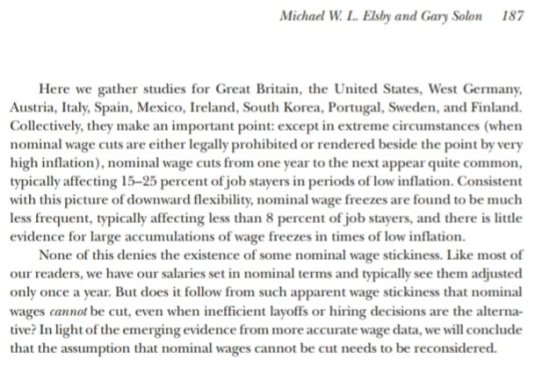
Pay slip data shows wage cuts are common

From https://www.aeaweb.org/articles?id=10.1257/jep.33.3.185

Chaebols and firm dynamics in the Republic of Korea

Amol Agrawal's avatarMostly Economics

Philippe Aghion, Sergei Guriev and Kangchul Jo in this piece:

View original post

Worried about droughts? Embrace water markets

Jonathan Wood's avatarFREEcology

In the last few years, California experienced a long, severe drought. It was extremely  painful, but not as painful as it might have been because California has water markets that helped the water flow to those who needed it most. Strengthening and expanding water markets could have furthered reduced this pain.

Courtesy of Jose Manuel Suarez

Yet in Water Deeply, environmental activist Gary Wockner bemoans that so many environmentalists are embracing markets to resolve environmental conflicts. His critique says more about the growing schisms between environmentalists than the merits of water markets.

Wockner offers three criticisms of water markets: (1) they commoditize water; (2) he hasn’t seen a quantified analysis of whether they are successful, under a test that he has devised but does not articulate; and (3) they, along with other free market environmental reforms, are pushing environmentalists away from his preferred model of lobbying and litigation (political…

View original post 889 more words

If the goal is to guide human action, environmental markets work better than indecipherable regulations

Jonathan Wood's avatarFREEcology

One of the greatest strengths of free market environmentalism approaches to environmental problems is that they facilitate the development of new information about the environment and provide an effective means for people to act on that information. Where there’s a market for some environmental benefit, the people who value it have a strong incentive to discover more information about it and, thanks to the price signal, others can act on that new knowledge without having to know it themselves.

For instance, suppose a plucky environmentalist discovers that a farmer’s practices reduce water quality to a distant stream through a complex hydrological process. If there’s a cost effective substitute or a means of mitigating its effects on the stream, the environmentalist can pay the farmer to change his behavior. If the price is right, the farmer will change his behavior without having to understand the complex process by which his…

View original post 602 more words

History of Styles and Titles Part III: Hanover to Windsor.

liamfoley63's avatarEuropean Royal History

The kingdoms of England and Scotland were formally united into a single Kingdom of Great Britain in 1707 by the Act of Union. Queen Anne consequently assumed the title “Queen of Great Britain, France and Ireland, Defender of the Faith, etc.”. It remained in use until 1801, when Great Britain and Ireland combined to become the United Kingdom. George III used the opportunity to drop both the reference to France and “etc.” from the style. It was suggested to him that he assume the title “Emperor”, but he rejected the proposal. Instead, the style became “King of the United Kingdom of Great Britain and Ireland, Defender of the Faith”.

IMG_0671
King of the United Kingdom of Great Britain and Ireland, Defender of the Faith

In 1876 “Empress of India” was added to Queen Victoria’s titles by the Royal Titles Act 1876, so that the Queen of the United Kingdom, the ruler…

View original post 464 more words

Image

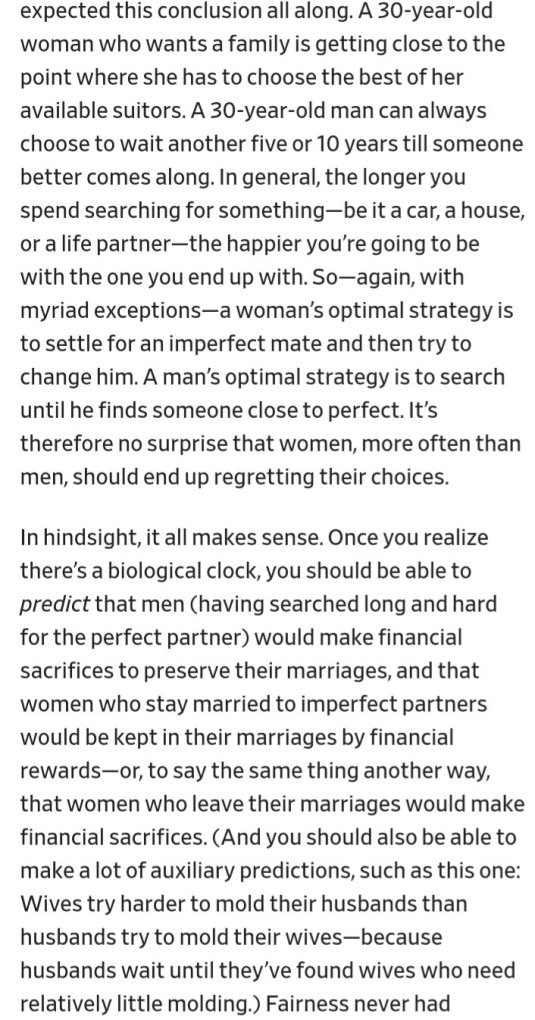
Why Men Pay To Stay Married and women nag

From Steven Landsburg https://slate.com/culture/2000/12/why-men-pay-to-stay-married.html

Maldives To Open Five New Underwater Airports This Year

Supreme Court wades back into the murky Clean Water Act

Jonathan Wood's avatarFREEcology

Since the 1980s, Maui County’s wastewater treatment plant has discharged millions of gallons of recycled water into groundwater. Over several months, this pollution migrates to the ocean where it affects the health of coral reefs. Under the Clean Water Act, any addition of any pollutant from any point source to a navigable water requires a costly and time-consuming permit. Yet the county has never obtained a permit, believing that the conveyance of the pollution by groundwater rather than a pipe rendered the permit requirement inapplicable.

This week, the Supreme Court confronted the question whether a permit is required. But, if the oral argument is any indication, the answer is anything but clear. And that opaqueness raises significant concerns about how pollution can be addressed effectively while also giving fair notice to property owners. Although the Court’s consideration was limited to the statute as it exists today, the debate…

View original post 1,007 more words

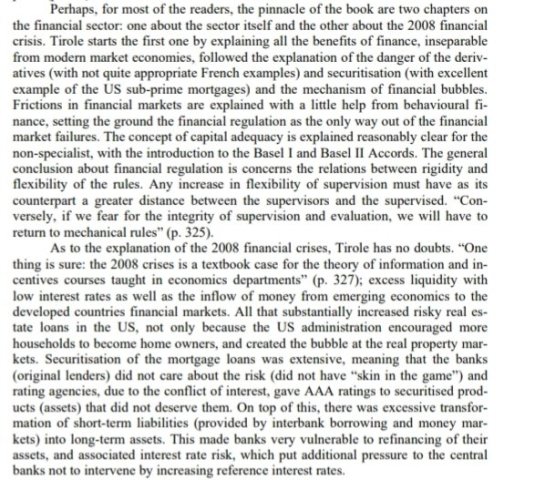
Tirole on the #GFC as a textbook financial crisis

Image

Jeff King and Stephen Tierney: The Constitution Committee Reports on the European Union (Withdrawal Agreement) Bill

Constitutional Law Group's avatarUK Constitutional Law Association

The European Union (Withdrawal Agreement) Bill will make no further progress before the general election. The Bill is however of potentially huge constitutional significance, and a new government could well look to pass it quickly. It was therefore imperative that it be subjected to parliamentary scrutiny in the short period between its forestalled second reading on 22 October and Parliament’s dissolution on 6 November.

On this basis the House of Lords Constitution Committee on Tuesday published an interim report on the Bill. The Committee makes clear that it does not pass judgement on the policy issues in the Bill or those related to the United Kingdom’s withdrawal from the European Union (EU) more broadly. But such is its complexity that it sees value in both explaining the purpose and effect of the Bill and in exploring at this stage the technical legal challenges that the Bill seeks to address.

The…

View original post 2,226 more words

Impeachment

Paul Seaward's avatarReformation to Referendum: Writing a New History of Parliament

I is for impeachment, a parliamentary prosecution in which classically the lower House of the legislature acts to present the alleged malefactor for trial, and the upper House sits in judgement. 

Much has been heard about the procedure in recent years, first because of its deployment in Brazil against the President, Dilma Rousseff, resulting in her removal from office in August 2017, and secondly because of the much-discussed (but remote) possibility of impeachment proceedings against President Donald Trump in the United States. In both the latter cases, impeachment has been embedded within a written constitution and recognised procedures. Although the origins of impeachment lie in English politics, impeachments were highly unusual, and always subject to intense political and legal argument about procedure and fairness. In almost each case the procedures were reinvented and argued over (a summary of the procedure here reasonably explains the broadly outlines, but conveys a rather…

View original post 2,061 more words

The Exclusion Parliaments

Paul Seaward's avatarThe History of Parliament

This blog from Paul Seaward, British Academy/Wolfson Research Professor at the History of Parliament Trust, is part of our Named Parliaments series. He explores the so-called exclusion crisis of the late seventeenth century. You might also be interested in Paul’s recent blog on the Cavalier Parliament.

Three short Parliaments – those that assembled in March 1679, in October 1680, and March 1681 – are collectively referred to as the ‘Exclusion’ Parliaments, for they were dominated by the issue of the exclusion from the throne of Charles II’s heir, his brother, James, Duke of York. The astonishing revelation that York had undergone conversion to the Roman Catholic faith – confirmed in 1672, but widely known well before – was the central element in a political crisis that destabilised the English government for much of the rest of Charles II’s reign. The issue of how England’s Protestant church could be…

View original post 966 more words

Legislating Homosexuality: Codification, Empire and the Commonwealth

History of Parliament's avatarThe History of Parliament

The final blog in our trio for LGBT+ History Month comes from our Public Engagement Officer, Sammy Sturgess. She considers how nineteenth century legal reform in the British Empire impacted the regulation of homosexuality and its Commonwealth legacy…

2019 is the 70th anniversary of the Commonwealth so
it seems appropriate to consider the legacy of British colonial-era legislation
on Commonwealth nations. Specifically, given that it’s LGBT+ History Month,
here we’ll discuss the nineteenth century codification of law and how this
related to homosexual offences in the British Empire and continues to affect
the lives of LGBTI+ people in the Commonwealth today.

2018 saw the legacy of British colonial-era legislation relating to the criminalisation of homosexuality take centre stage in the press on more than one occasion. In April 2018 Trinidad and Tobago declared that section 13 and 16 of their Sexual Offences Act which related to male…

View original post 1,001 more words

Previous Older Entries Next Newer Entries

Coordination Problem

Celebrating humanity's flourishing through the spread of capitalism and the rule of law

Libertarian Land

Celebrating humanity's flourishing through the spread of capitalism and the rule of law

Arin’s Substack

Celebrating humanity's flourishing through the spread of capitalism and the rule of law

David Andolfatto

Celebrating humanity's flourishing through the spread of capitalism and the rule of law

Monetary Non-Neutrality

Celebrating humanity's flourishing through the spread of capitalism and the rule of law

Reason Magazine

Celebrating humanity's flourishing through the spread of capitalism and the rule of law

Coyote Blog

Celebrating humanity's flourishing through the spread of capitalism and the rule of law

Thoughts from the North

Celebrating humanity's flourishing through the spread of capitalism and the rule of law

Fardels Bear

A History of the Alt-Right

Vincent Geloso

Econ Prof at George Mason University, Economic Historian, Québécois

Bassett, Brash & Hide

Celebrating humanity's flourishing through the spread of capitalism and the rule of law

Truth on the Market

Scholarly commentary on law, economics, and more

The Undercover Historian

Beatrice Cherrier's blog

Matua Kahurangi

Celebrating humanity's flourishing through the spread of capitalism and the rule of law

Temple of Sociology

Celebrating humanity's flourishing through the spread of capitalism and the rule of law

Velvet Glove, Iron Fist

Celebrating humanity's flourishing through the spread of capitalism and the rule of law

Why Evolution Is True

Why Evolution is True is a blog written by Jerry Coyne, centered on evolution and biology but also dealing with diverse topics like politics, culture, and cats.

NoTricksZone

Celebrating humanity's flourishing through the spread of capitalism and the rule of law

Homepaddock

A rural perspective with a blue tint by Ele Ludemann

Kiwiblog

DPF's Kiwiblog - Fomenting Happy Mischief since 2003

The Dangerous Economist

Celebrating humanity's flourishing through the spread of capitalism and the rule of law

Watts Up With That?

The world's most viewed site on global warming and climate change

The Logical Place

Tim Harding's writings on rationality, informal logic and skepticism

Doc's Books

A window into Doc Freiberger's library

The Risk-Monger

Let's examine hard decisions!

Uneasy Money

Commentary on monetary policy in the spirit of R. G. Hawtrey

Barrie Saunders

Thoughts on public policy and the media

Liberty Scott

Celebrating humanity's flourishing through the spread of capitalism and the rule of law

Point of Order

Politics and the economy

James Bowden's Blog

A blog (primarily) on Canadian and Commonwealth political history and institutions

Science Matters

Reading between the lines, and underneath the hype.

Peter Winsley

Economics, and such stuff as dreams are made on

A Venerable Puzzle

"The British constitution has always been puzzling, and always will be." --Queen Elizabeth II

The Antiplanner

Celebrating humanity's flourishing through the spread of capitalism and the rule of law

Bet On It

Celebrating humanity's flourishing through the spread of capitalism and the rule of law

History of Sorts

WORLD WAR II, MUSIC, HISTORY, HOLOCAUST

Roger Pielke Jr.

Undisciplined scholar, recovering academic

Offsetting Behaviour

Celebrating humanity's flourishing through the spread of capitalism and the rule of law

JONATHAN TURLEY

Res ipsa loquitur - The thing itself speaks

Conversable Economist

In Hume’s spirit, I will attempt to serve as an ambassador from my world of economics, and help in “finding topics of conversation fit for the entertainment of rational creatures.”

The Victorian Commons

Researching the House of Commons, 1832-1868

The History of Parliament

Articles and research from the History of Parliament Trust

Books & Boots

Reflections on books and art

Legal History Miscellany

Posts on the History of Law, Crime, and Justice

Sex, Drugs and Economics

Celebrating humanity's flourishing through the spread of capitalism and the rule of law

European Royal History

Exploring the Monarchs of Europe