CofC Adam Smith Week 2018 – Dr. Lynne Kiesling
09 May 2018 Leave a comment
in applied price theory, comparative institutional analysis, economics of regulation, history of economic thought, industrial organisation
Guardian publishes antisemitic letter which calls for a boycott of Israel.
09 May 2018 Leave a comment

 That pig at a Roger Waters concert (jpost.com)
It seems the Guardian wants to shut down all social and cultural life in Israel. Last week it published an article which accused the Jewish state of “sportswashing” its reputation by hosting the Giro d’Italia‘s first leg, irrespective of the fact that Israel had obviously been invited to host it!
Implicit in the accusation of “sportswashing” is the historical antisemitic trope of “dishonest Jews” manipulating the world via unethical business practice.
This antisemitic trope has reared its ugly head yet again today with the Guardian publishing a letter by artists. The letter is about the Seret International Film Festival currently underway in London. The letter states:
“Art, media and culture are being employed to give an apparently acceptable face to a brutal reality.”
Again there’s the implicit notion of “dishonest Jews” manipulating others in an unethical manner.
View original post 345 more words
My favourite Brad Delong quote for #Marx200 #Marx2018 @SenSanders
09 May 2018 Leave a comment
in applied price theory, comparative institutional analysis, economic history, economics of bureaucracy, Marxist economics, Public Choice

Investment, Productivity, Capital Taxation, and Worker Compensation
09 May 2018 1 Comment

I was a big fan of the lower corporate tax rate in last year’s tax bill, largely because I want a better investment climate, 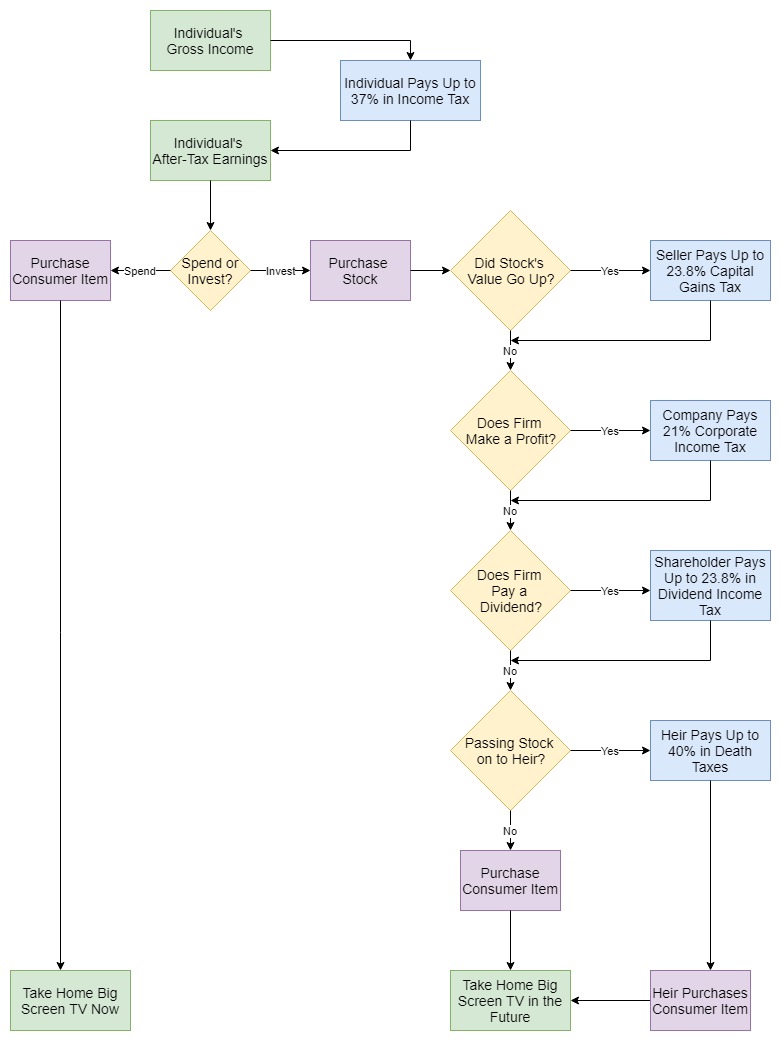 which then will lead to higher productivity and rising wages.
Simply stated, the current tax code (as shown in the chart) has a very harsh bias against income that is saved and invested.
Anything that can be done to reduce the magnitude of this “double taxation” will lead to better economic performance.
Now that the lower corporate tax rate has been implemented, there’s a debate about whether it is having desirable affects.
In this CNBC debate, I explain that stock “buybacks” and employee bonuses are positive short-run results, but that I’m much more interested in the potential long-run benefits.
As with all brief interviews, it’s difficult to share a lot of information. My main goal was to point out that there’s nothing…
View original post 932 more words
Study: Environmentalists Could Kill Millions Of People in Poor Countries
09 May 2018 Leave a comment

Pursuing so-called green energy initiatives may force poor people in developing countries to remain in their conditions, including continuous exposure to pollution, which results in shorter life spans. That is the conclusion of a policy analysis issued by the Global Warming Policy Foundation (GWPF) on Friday.
Since environmentalists have pushed for policies based on human-induced climate change, environmentalist groups, like Greenpeace, have supported efforts to halt developmental project abroad and even methods of transport for oil and gas (like pipelines) in an attempt to halt the use of fossil fuels.
As impractical as it may be, the GWPF study states that the result of the green movement’s Keep It in The Ground campaign would result in more human deaths by pollution. By halting the production and use of fossil fuels developing countries would be unable to progress which depreciates higher standards of living and reduced carbon emissions.
The activists belonging…
View original post 147 more words
Is Labour’s Loss Capital’s Gain? @MarjaLubeck @_chloeswarbrick
09 May 2018 Leave a comment
in applied price theory, labour economics, politics - New Zealand, unions
At a Parliamentary select committee this morning, a Labour and a Green MP were convinced that the labour’s falling share of GDP was evidence of rising profits to capital because of a loss of union bargaining power.
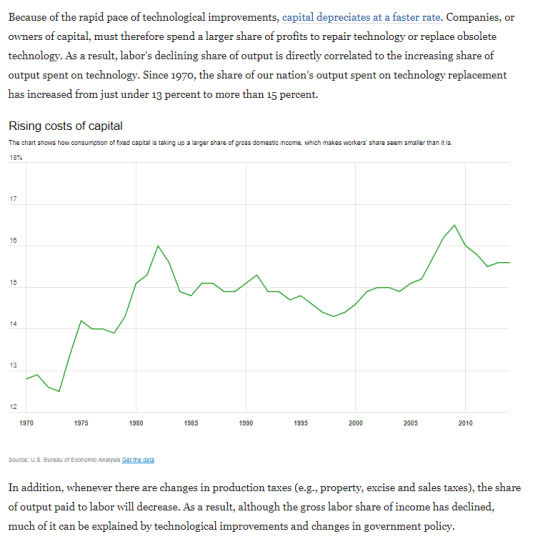
Instead, in the USA, where the data is best analysed, this decline in the gross labour share is a statistical illusion bought on by a greater part of GDP going to depreciation of ICT equipment which depreciates faster than in the past. The decline in the gross labour share does not mean the capitalists are sharing more of the total left. As Benjamin Bridgman said
US labor share has been falling since the 1970s. I show that it has not fallen as much once items that do not add to capital, depreciation and production taxes, are netted out. Recent net labor share is within its historical range, whereas gross share is at its lowest level. This effect holds for other high-income economies. The overall picture is no longer one of unprecedented, globally declining labor share. Using gross share as a proxy for net share can give misleading results. US gross share and inequality are correlated, whereas net share, the correct measure, is not.
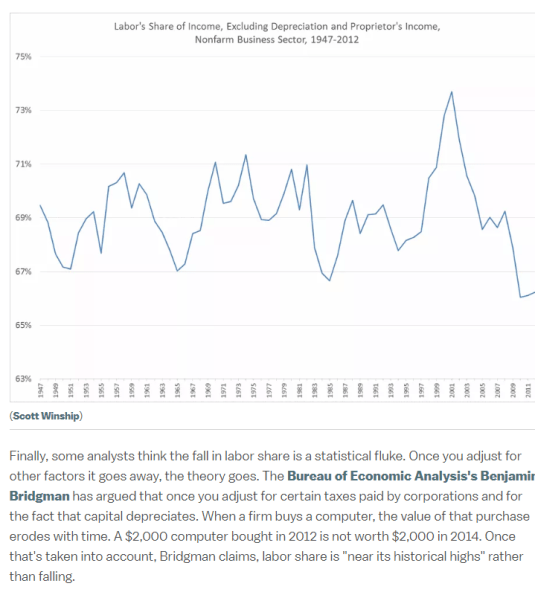
From https://www.vox.com/2015/1/8/7511281/labor-share-income
Employment Relations Amendment Bill kills incentive to join unions? @charles_finny @EricCrampton @oneforthedr
09 May 2018 Leave a comment
in applied price theory, labour economics, politics - New Zealand, unions
The only reason I joined a union at the Department of Labour was pay rises under the collective agreement were conditional upon union membership. They even ran a membership drive every time they negotiated a rise. Indeed, I might have joined up after the first of those membership drives.
I wish the Employment Relations Amendment Bill was in effect back then because it would have saved me a couple of hundred dollars a year. I would have started on the union wage at least and had no obligation to join the union to benefit from all the conditions they negotiated in the past. The amending bill inserts a new clause that says with regard to individual employment agreements that
No term or condition of employment may be expressed to alter automatically after the 30-day period in a way that makes it inconsistent with the collective agreement.
This new amendment requires all employees to start on the collective agreement terms for the first 30 days of their employment. You always start on the union rates. In the past, people could opt in to the union agreement. Now they can opt out but can keep all the benefits of that union agreement while not having to pay a union membership fee.
There is no incentive to join the union because nothing they offer you in terms of pay is conditional on continuing union membership. No employer offers less than the union pay and may wish to offer more to particularly appealing recruits without passing that pay rise on to the rest of the workforce.
I would join the union in the future if they delivered a pay rise that was not available to those on individual employment agreements. But I have no incentive to join the union prior to that time. I can keep my money.
Cartels usually want the cartel price to extend to all in the industry. Unions are different because they must collect fees from employees to pay their rent and meet their payroll. They need to have members to survive because unions are funded by membership fees. For them, compulsory union membership is all about the cash.
The unions seem to want to head in the same direction as France where about 10% of the French workforce are members are unions despite 90% of workers being covered by collective agreements. I do not know how French unions pay their bills because no one has an incentive to join a union if the union pay and conditions apply anyway.
If I was an employer, I would point out to an employee that they have no need to join the union because they already get all the union conditions and should save their money until the union delivers something more than they have now.
Unions want this amendment as a way of winning members. It backfires because the union conditions of employment are not conditional on union membership so no one has any reason to join the union unless they deliver more in the future. Save your union fee until you get something concrete in return for it in the future.
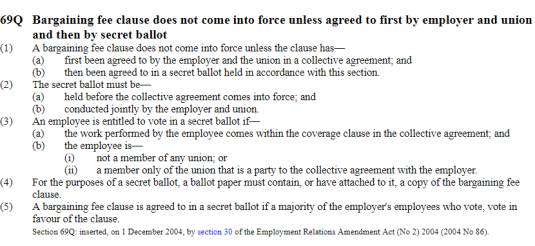
Unions can collect bargaining fees provided a workplace agrees to it in a secret ballot under the current law. I would certainly vote against a bargaining fee in that secret ballot.
The 2017 Labour Party manifesto does go on about the need for union won wage rises to be passed on to everyone in the industry. I am all for that if I was in that industry especially if I do not have to pay any union fees to get the pay rise.
Why join a union if none of its current benefits are conditional on union membership? Wait until they offer you something specific in the future before you part with your union fee. What have you done for me lately is the decision rule.
If unions want to unionise a new workplace, just wait and see whether they deliver a pay rise before joining them. Freeride for as long as you can. There is no incentive for new employees to join that union until they win another pay rise.
Maybe I should have delayed posting this until after the Bill was passed so that there is no time for last-minute amendments. But then again, the unions have blocked me on Twitter so maybe they will never find out.
Discrimination and Disparities with Thomas Sowell
09 May 2018 Leave a comment
in applied price theory, discrimination, economic history, economics of education, economics of regulation, human capital, labour economics, labour supply, occupational choice, poverty and inequality Tags: Thomas Sowell
Friedman Forum: The Glass Ceiling, Featuring Marianne Bertrand
09 May 2018 Leave a comment
in applied price theory, discrimination, gender, labour economics, labour supply, managerial economics, occupational choice, organisational economics, personnel economics Tags: gender wage gap, glass ceiling
TV: The Great War (BBC)
08 May 2018 Leave a comment

9 March 2012
In 1964 the BBC produced a major documentary series about The Great War, feted with prizes and widely seen as the precursor to ITV’s landmark World At War. I toyed with buying the box set off Amazon but it’s a surprising £60 and I suspected would join all the other half-watched box sets in the cupboard.
Whereupon I discovered the whole thing is available free on YouTube! Just search for the titles of each episode, as listed on Wikipedia.
Having watched 23 episodes I’m struck by a) just how much footage seems to exist of specific events and b) the cumulative effect of hearing just a few pieces of classical music over and again: the brooding opening of Shostakovitch’s 11th symphony, the most intense parts of his 5th and 7th symphonies; the titanic opening chords of Vaughan Williams’ Sinfonia Antarctica (occasional snippets of his pastoral…
View original post 35 more words
1848: Year of Revolution by Mike Rapport (2008)
08 May 2018 Leave a comment
1848 became known as ‘the year of revolutions’ and ‘the springtime of nations’ because there was political turmoil, fighting and unrest right across Europe resulting in ministries and monarchies being toppled and new nation states proclaimed.
Causes
The underlying causes were agricultural, economic and demographic.
1. Agricultural failure
From 1845 onwards grain harvest across Europe were poor and this was exacerbated when the ‘fallback crop’, potatoes, were hit by a destructive ‘blight’. The result of the potato blight in Ireland is estimated to have been one and a half million deaths, but right across Europe peasants and small farmers starved, often to death. Hence the nickname for the decade as a whole, ‘the Hungry Forties’.
2. Economic downturn
Food shortages combined with an economic downturn resulting from overproduction, particularly in the textile industry, which saw textile workers and artisans thrown out of work in all Europe’s industrialised areas, the north…
View original post 4,578 more words
BBC journalist Tweets inaccurate portrayal of Gaza riots
08 May 2018 Leave a comment

As anyone who has been following the ‘Great Return March’ agitprop will be aware, the six weekly instalments (to date) of that publicity stunt organised by Hamas and other terror groups in the Gaza Strip have included stone-throwing, shooting and tyre burning, the use of petrol bombs, incendiary kites and IEDs, attempts to sabotage the border fence and attempts to infiltrate Israeli territory.
The phrase ‘largely peaceful’ is therefore hardly the most accurate term that could be chosen to describe the pre-planned actions of the Palestinian rioters, some of whom have already been shown to have links to terror groups.
However, that was exactly the term used by the United Nations Children’s Fund – UNICEF – in a statement put out on May 4th.
“Over the past five weeks, five children were killed and hundreds were injured in largely peaceful protests in Gaza.”
Despite at least one…
View original post 107 more words
5 Reasons “Social Justice” Should be Rejected
08 May 2018 Leave a comment

While there are some notable similarities between classical liberalism and contemporary liberalism (or progressivism), it has become increasingly obvious that the differences between two philosophies are growing ever larger.
This is in large part due to the fact that progressives, particularly at universities and in coastal cities, have embraced, to seemingly an extreme degree, political correctness and cultural Marxism in the form of feminism, social justice, and race and gender based identity politics.
Now, these social justice oriented philosophies do have legitimate concerns and often do produce ideas that may improve our society. But generally, the “good” beliefs and ideas coming from the social justice movement are almost universally recognized already. Simultaneously, the worst parts about social justice ideology are almost entirely exclusive to it.
For example, nearly everyone accepts that many women and minorities will face certain social pressures and barriers to their success that most whites or men will rarely if ever face. The social justice left…
View original post 1,233 more words
Which Nation Has the Most Per-Capita Government Spending on Healthcare: France, Italy, the United States, Sweden, Canada, Greece, or the United Kingdom?
08 May 2018 2 Comments
What government spends the most on health care?
- Is it Canada or the United Kingdom, which are famous (or, if these stories are any indication, infamous would be a better description) for single-payer healthcare systems?
- Is it Sweden, the home of the cradle-to-grave welfare state?
- Or France, the land of the world’s most statist people?
- How about Italy or Greece, nations that have spent themselves into fiscal crisis?
Nope, nope, nope, and nope.
The United States spends more money, on a per-capita basis, than any of those countries. Here’s a chart from a Forbes analysis prepared by Doug Holtz-Eakin and Avik Roy.

There are three big reasons why there’s more government-financed healthcare spending in the United States.
1. Richer nations tend to spend more, regardless of how they structure their healthcare systems.
2. As you can see at the 1:18 mark of this video, the United…
View original post 474 more words


Recent Comments