Liberland 2018 conference talk by David Friedman “Reputational enforcement online”
02 May 2018 Leave a comment
in applied price theory, David Friedman, economics of crime, law and economics
Gary Libecap: Global environmental externalities, property rights, and public policy
02 May 2018 Leave a comment
in applied price theory, comparative institutional analysis, economics of regulation, environmental economics, law and economics, property rights, Public Choice Tags: common property, externalities, tragedy of the commons, transaction costs
‘The Guardian View’ on the Gaza protests: one of their worst editorials on Israel ever
02 May 2018 Leave a comment

The distortions, falsehoods and smears in an official Guardian editorial published on April 22 are numerous, and in fact begin in the headline:
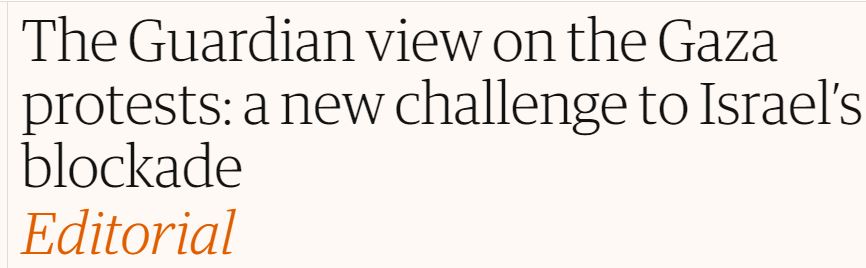
Contrary to the headline’s claim, the protests were never about Israel’s partial blockade, but about the supposed ‘right of return’ – that is, the non-existent right of millions of Palestinian descendants of refugees from ’48 to “return” to Israel – thus the name of the event: “The Great Return March”.
The editorial opens:
This weekend the United Nations Middle East peace envoy asked: “How does the killing of a child in #Gaza today help #peace? It doesn’t! It fuels anger and breeds more killing.” Nickolay Mladenov was right to be outraged. He tweeted after a Palestinian teenager was shot in the head apparently by Israeli army snipers while peacefully protesting near a border fence. The Israeli government at first dismissed calls for an investigation, only to…
View original post 1,421 more words
Clause 11: the Schleswig-Holstein question of the EU Withdrawal Bill
02 May 2018 Leave a comment


Today, the House of Lords will continue its scrutiny of the EU (Withdrawal) Bill by discussing Clause 11, which provides that the power to amend retained EU law in areas currently devolved to Edinburgh, Cardiff and Belfast would transfer from Brussels to Westminster, rather than to the relevant devolved body. Jim Gallagher discusses how the UK and Scottish governments are at odds over this issue and offers some potential solutions to a dispute that has now been referred to the UK Supreme Court.
The current dispute between the Scottish and UK governments is increasingly coming to resemble the Schleswig-Holstein question, in that almost no-one really understands this technical, legal issue, but it has produced some apocalyptic rhetoric. Nicola Sturgeon has said it could ‘demolish’ devolution. Having competing pieces of legislation seeking to preserve EU law after Brexit is said to be a ‘constitutional crisis’. This hyperbole favours alliteration…
View original post 1,430 more words
Environmentalists: Clean Energy Just as Bad as Dirty Energy
02 May 2018 Leave a comment

A Maine power company has offered to build a power transmission line so the state of Massachusetts can obtain power from a hydroelectric utility company in Quebec, Canada. This being done to stick to the Massachusetts Republican Governor’s carbon footprint reduction campaign.
There is one tiny problem: environmentalists with the Natural Resources Defense Council and the Conservation Law Foundation oppose the project.
Not only do environmentalists oppose fossil fuels, they also end up opposing their own schemes in order to cut back on greenhouse gasses. Environmentalist renewable energy schemes are not only inadequate for our energy needs, but Big Green will also oppose facilities that utilize alternate power sources, like hydroelectricity.
Environmentalists are not only anti-industry and anti-civilization and but are also pushing renewable energy in order for them to profit from them and to eventually destroy energy markets in order to drive industrialized countries into a new…
View original post 2 more words
David Friedman (2018) on market failure
01 May 2018 Leave a comment
in applied price theory, comparative institutional analysis, David Friedman, law and economics
‘The Guardian View’ on the Gaza protests: one of their worst editorials on Israel ever
01 May 2018 2 Comments

The distortions, falsehoods and smears in an official Guardian editorial published on April 22 are numerous, and in fact begin in the headline:
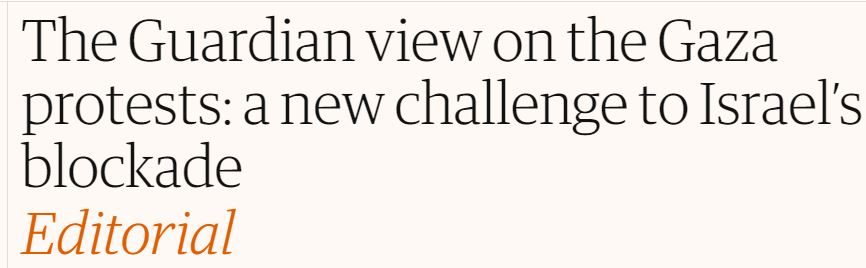
Contrary to the headline’s claim, the protests were never about Israel’s partial blockade, but about the supposed ‘right of return’ – that is, the non-existent right of millions of Palestinian descendants of refugees from ’48 to “return” to Israel – thus the name of the event: “The Great Return March”.
The editorial opens:
This weekend the United Nations Middle East peace envoy asked: “How does the killing of a child in #Gaza today help #peace? It doesn’t! It fuels anger and breeds more killing.” Nickolay Mladenov was right to be outraged. He tweeted after a Palestinian teenager was shot in the head apparently by Israeli army snipers while peacefully protesting near a border fence. The Israeli government at first dismissed calls for an investigation, only to…
View original post 1,419 more words
Income Inequality: The Role of Markets & Government (Sam Peltzman and Bruce Meyer)
01 May 2018 Leave a comment
in applied price theory, applied welfare economics, economic history, labour economics, labour supply, poverty and inequality, Sam Peltzman
Myths about FuelWatch
30 Apr 2018 1 Comment

Watching the discussion on my previous posts on FuelWatch, I can see that there are many myths being perpetuated. I thought I’d list them here.
View original post 648 more words
Renewables Rip-Off: Despite $4 Billion in Annual Subsidies, Wind & Solar Delivers a Trivial 2% of Australia’s Power Demand
30 Apr 2018 Leave a comment


In any bargain, those stumping up their own cash, tend to ask what they’re getting in return. When it comes to the billions in subsidies thrown at windmills and solar panels, the answer is: not much.
Including domestic, rooftop solar annual subsidies to wind and solar add up to a staggering $4 billion. The cost of which is added directly to retail power bills. The greatest government mandated rort in the history of the Commonwealth, started in 2001 and runs until 2031.
Now, the value minded might forgive the scale and duration of that forced ‘largesse’, if there were a commensurate increase in the output said to be drawn from nature’s wonder fuels, sunshine and breezes. Except, as David Bidstrip points out, the combined contribution of wind and solar generation to Australia’s energy demand remains risible, and little more than a rounding error.
Money for nothing
Catallaxy Files
David…
View original post 834 more words
USA ranked 45th for press freedom by @RSF_en despite no defamation suits for public figures, the 1st Amendment and more newspapers, magazines and social media than you can poke a stick at
30 Apr 2018 Leave a comment
in applied price theory, economics of media and culture, industrial organisation, survivor principle

Armen Alchian and George Stigler both argued that realised profits are the criterion by which the market process selects survivors: those who realise positive profits survive and will grow their market share; those who suffer losses will eventually disappear unless they improve themselves. The surviving media outlets will be those firms that anticipated or adapted fastest to the current and future demands of their readers and viewers.
Any media bias is likely to be slightly to the centre-left for the following reasons:
-
Young women tend to be one of the most marginal groups of news consumers (i.e., they are the most willing to switch to activities besides reading or watching the news).
-
Young women often make more of the consumption decisions for the household so advertisers will pay more to reach this group.
-
Since young women tend to be more centre-left, on average, a news outlet may want to slant its coverage that way. Media sell space to advertisers and tailor the way they cover politics to gain more readers and viewers.
Puglisi and Snyder found that:
- Using endorsements of state-level initiatives and referendums, newspapers are located almost exactly with the median voter – the average voter – in their home states.
- Newspapers are moderate relative to interest groups and political parties.
- Although newspapers exhibit some variation in their ideological position, they tend to be much closer to the median voter than most interest groups.
- Newspapers appear to be more liberal than voters on social and cultural issues such as gay marriage, but tend to be more conservative on economic issues such as the minimum wage.
- On average, the news and editorial sections have almost identical partisan positions.
Positive profits accrue to media outlets that are better at serving their readers and viewers than their competitors. Their lesser rivals will lose money, exhaust their retained earnings and fail to attract further investor support.
Serious under-estimates if you ask me. No revealed preference
28 Apr 2018 Leave a comment
in applied price theory, applied welfare economics, economics of information Tags: revealed preference
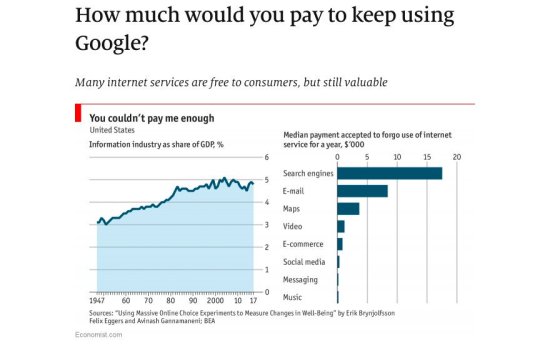
With friends @nzprocom @moturesearch commenting like this, a zero carbon economy policy won’t survive to face its enemies
28 Apr 2018 Leave a comment
in applied price theory, applied welfare economics, economics of bureaucracy, energy economics, environmental economics, global warming, politics - New Zealand, Public Choice Tags: climate alarmism



Recent Comments