Which is worse? The tax or regulation?
30 Nov 2016 Leave a comment
in applied price theory, economics of regulation, Public Choice, public economics Tags: tax incidence theory
How Don Lavoie Changed the Debate about Socialism and Central Planning
30 Nov 2016 Leave a comment
in applied price theory, comparative institutional analysis, constitutional political economy, development economics, economic history, entrepreneurship, history of economic thought, Marxist economics, Public Choice
Are markets efficient? Eugene Fama (yes!) and Richard Thaler (no!) debate
30 Nov 2016 Leave a comment
in applied price theory, behavioural economics, entrepreneurship, financial economics Tags: active investing, efficient markets hypothesis, Eugene Fama, passive investing
What incentive do people have to save?| Franco Modigliani
30 Nov 2016 Leave a comment
in applied price theory, financial economics Tags: permanent income hypothesis
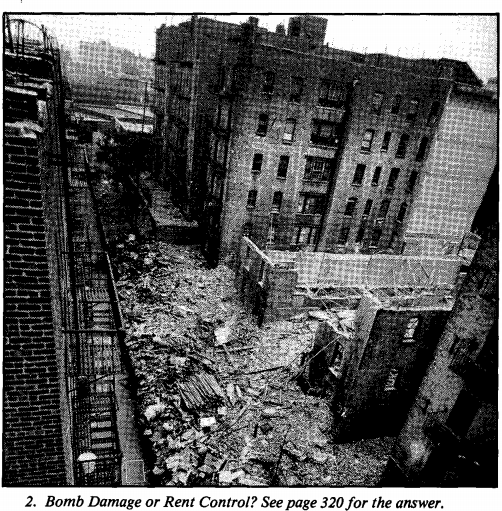
Bomb damage or rent control?
28 Nov 2016 Leave a comment
in applied price theory, economics of regulation, Public Choice


Adam Smith: How His Great Idea Made Us Rich – Deirdre McCloskey
26 Nov 2016 Leave a comment
in applied price theory, comparative institutional analysis, constitutional political economy, growth miracles, history of economic thought Tags: Deirdre McCloskey, The Great Enrichment, The Great Fact
Johan Norberg vs. Naomi Klein and The Shock Doctrine
25 Nov 2016 Leave a comment
in applied price theory, development economics, economic history Tags: Naomi Klein, The Great Fact
O-Ring model
18 Nov 2016 Leave a comment
in applied price theory, development economics, human capital, industrial organisation, labour supply
The key role of housing costs in disaster recovery @ericcrampton @JordNZ #nzeq
16 Nov 2016 Leave a comment
in applied price theory, economic history, economics of natural disasters, economics of regulation, politics - New Zealand, politics - USA, urban economics Tags: land supply, land use planning, NYMBYs, RMA, zoning
The evidence abroad after earthquakes, hurricanes, flooding, tornados, and wartime bombing is that for growing cities, disasters, including carpet bombing and atomic bombs, are only temporary set-backs with few long-run economic and population consequences. A few years after a disaster, these cities even recover the industries they had before their calamities.
For growing cites, the loss of housing and other destruction does not affect the underlying demand from workers and businesses to be at the location. Florida has prospered despite over twenty hurricanes striking since 1988 and five of the six most damaging Atlantic hurricanes of all time striking since 1988.
Cities that are already in decline drop down onto an even faster downward population and economic trend after a major natural disaster. A large scale destruction of housing takes away the one compensating feature of these declining cities, which was cheap housing.
Housing prices in declining cities are usually well below construction costs. Low living costs partly offset the relative lack of local economic opportunity in these cities. New Orleans is an example of a declining city that did not recover fully from a disaster for this reason.
After Hurricane Katrina, New Orleans had much higher costs of housing because of flood damage but there were limited local economic opportunities to attract back old and new residents. About 20 per cent of the Katrina evacuees did not return.
Natural disasters be they earthquakes or hurricanes turn declining cities and towns from a dump with cheap housing to a dump with expensive housing. They can be a killer blow.
The main policy enabler of growing cities in the USA has been the avoidance of land use regulations that raise housing costs. Over the past 20 years, the fastest growing U.S. regions have not been those with the highest income or most attractive climates.
Flexible housing supply is the key determinant of regional growth. Land use regulations drive housing supply and determine which regions are growing. A regional approach to enabling increases in land and housing supply might reduce the tendency of many localities to block new construction.
Post-disaster co-operation: The voluntary provision of weakest-shot public goods
16 Nov 2016 Leave a comment
in applied price theory, economics of natural disasters, public economics Tags: economics of alliances, free riding, post-disaster cooperation, public goods, weakest shot public goods
After a natural disaster, both the economic and social fabric and the survival of individual employers each become weakest-shot public goods. The provision of these public goods temporarily depend by much more than is usual on the minimum individual contributions made – the weakest shots made for the common good. The supply of most public goods usually is not dependent on the contributions of any one user.
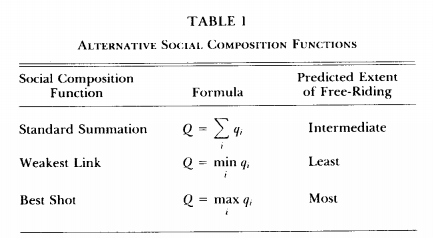
The classic example of a weakest shot public good by that brilliant applied price theorist Jack Hirschleifer is a dyke or a levee wall around a town. It is only as good as the laziest person contributing to its maintenance on their part of the levee. Vicary (1990, p. 376) lists other examples:
Similar examples would be the protection of a military front, taking a convoy across the ocean going at the speed of the slowest ship, or maintaining an attractive village/landscape (one eyesore spoils the view).
Many instances of teamwork involve weak-link elements, for example moving a pile of bricks by hand along a chain or providing a theatrical or orchestral performance (one bad individual effort spoils the whole effect.)
Most doing the duty is essential to the survival of all after a natural disaster. The alliances we call societies and the firm, normally not in danger of collapse, are threatened if there is a natural disaster. In these highly unusual circumstances, alliance-supportive activities, greater cooperativeness and self-sacrifice become an important public good.
In normal periods when threats are small, what social control mechanisms that are in place are sufficient and there is no need for exceptional behaviour and self-sacrifice.
Everyone has an interest in the continuity of the economic and social fabric and the survival of their employers in times of adversity. Individual contributions to these national and local public goods become much more decisive after a natural disaster.
In normal times people behave in a conventionally cooperative way because individually they find it profitable to do so. There is some slippage around the edges and there are social control mechanisms to deter illegal conduct and supply public goods.
As the threat to the social and economic fabric grows after a natural disaster, eventually the social and economic balance may hang by a hair. When this is so, any single person can reason that his own behaviour might be the social alliance’s weakest link. International military and political alliances also rise and fall on this weakest link basis.



Recent Comments