@CarlyFiorina says it all on action to fight global warming @jamespeshaw @AndrewLittleMP @garethmorgannz
24 Oct 2015 Leave a comment
in applied price theory, comparative institutional analysis, energy economics, environmental economics, global warming, Public Choice, rentseeking Tags: 2016 presidential election, climate alarmists, expressive voting, free riding, game theory, global warming, international public goods, rational ignorance, rational irrationality
Why does Housing New Zealand pay dividends? @chrishipkins @metiria
23 Oct 2015 Leave a comment
in applied price theory, economics of bureaucracy, financial economics, industrial organisation, managerial economics, organisational economics, politics - New Zealand
The current controversy over payment of dividends by Housing New Zealand is misplaced because of the subtle connections between payment of dividends and greater value for money.
By paying dividends, the investment priorities of Housing New Zealand are subject to additional ministerial scrutiny. Its capital program is scrutinised in greater detail by the Cabinet because ministers must fund it against competing bids across the entire budget and parliamentary scrutiny process.
Each budget bid is championed by a minister, each of whom must make their case every year against all-comers. This annual competition for a central pool of capital filters out lower value investment bids.
If dividends were not paid but were instead retained as free cash flows in the agency, there would be less ministerial scrutiny of Housing New Zealand because it would have a smaller role in annual budget rounds. Ministers and the Parliament sit up and pay attention when money is to be spent, as they should, and the larger is the sum in the budget, the more attention is paid to value for the money sought. Funding projects with retained dividends may reduce ministerial and parliamentary scrutiny.
Payment of dividends does not reduce the ability of Housing New Zealand to engage in new capital spending. If the dividends were not paid, the amount of new capital spending from budget appropriations would be reduced dollar for dollar.
@oxfamnz @GreenpeaceNZ Further evidence of mass kidnappings of principled environmentalists – indoor pollution version
23 Oct 2015 Leave a comment
in applied price theory, applied welfare economics, development economics, economics of regulation, environmental economics, health economics Tags: expressive voting, indoor air pollution
4.3 million die every year. Indoor air pollution is the least reported problem of the world. bit.ly/1BfMiZg https://t.co/yZRcl9vWoa—
Max Roser (@MaxCRoser) October 22, 2015

The deadliest environmental problem today is indoor air pollution — killing 4 million a year. vox.com/2014/9/15/6150…http://t.co/xtwLRfkVF2—
Vox Maps (@VoxMaps) June 11, 2015
@BernieSanders @HillaryClinton drug price controls will shorten lives
21 Oct 2015 Leave a comment
in applied price theory, applied welfare economics, economics of regulation, entrepreneurship, health economics, politics - USA Tags: 2016 presidential election, creative destruction, drug lags, entrepreneurial alertness, innovations, intellectual property, patents and copyright, price controls
Drug price controls have populist appeal, but patients are the ones they would hurt the most bit.ly/1X3e742 http://t.co/ulXuGHLSld—
Manhattan Institute (@ManhattanInst) October 17, 2015
German, French and Italian real housing prices since 1975
19 Oct 2015 Leave a comment
in applied price theory, applied welfare economics, economic history, economics of regulation, rentseeking, urban economics Tags: France, Germany, housing affordability, housing prices, Italy, land supply, land use planning, zoning
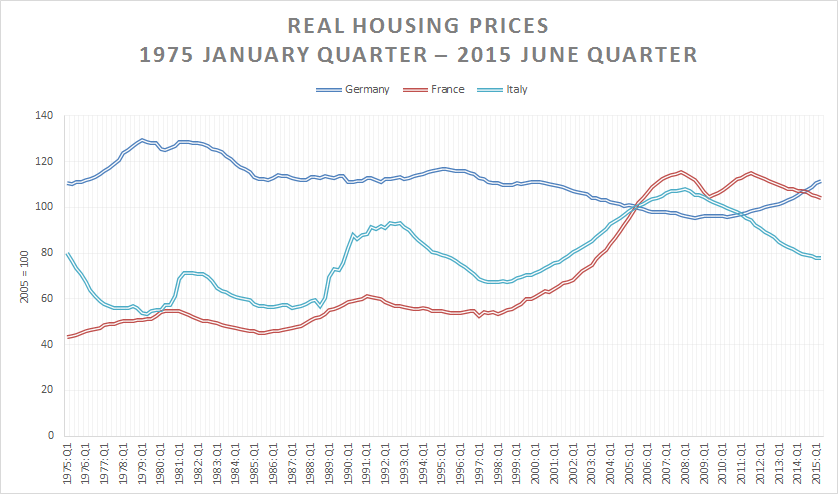
Source and notes: International House Price Database – Dallas Fed June 2015; nominal housing prices for each country is deflated by the personal consumption deflator for that country.
British and Irish real housing prices since 1975
18 Oct 2015 Leave a comment
in applied price theory, applied welfare economics, economic history, economics of regulation, urban economics Tags: British politics, housing prices, Ireland, land supply, land use planning, zoning
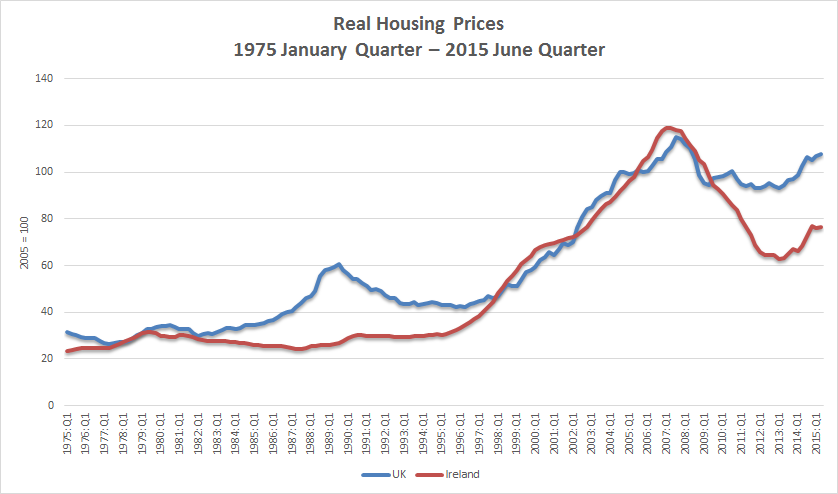
Source and notes: International House Price Database – Dallas Fed June 2015; nominal housing prices for each country is deflated by the personal consumption deflator for that country.
Taxation as a % of GDP in Australia and NZ and New Zealand’s Lost Decades
18 Oct 2015 1 Comment
in applied price theory, applied welfare economics, economic growth, economic history, politics - New Zealand, public economics
Revenue is a percentage of GDP has always been higher in New Zealand as compared to Australia for as far back as data is available. Tax revenue grew by a third as a percentage of GDP between 1965 and 1989 in New Zealand with a sharp spike from 1984 onwards. The growth in tax revenues as percentage of Australian GDP was smoother rather than spikes such as in the mid-1980s in New Zealand.
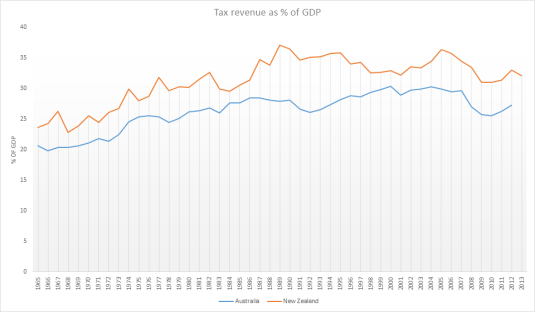
Data extracted on 18 Oct 2015 02:10 UTC (GMT) from OECD.Stat.
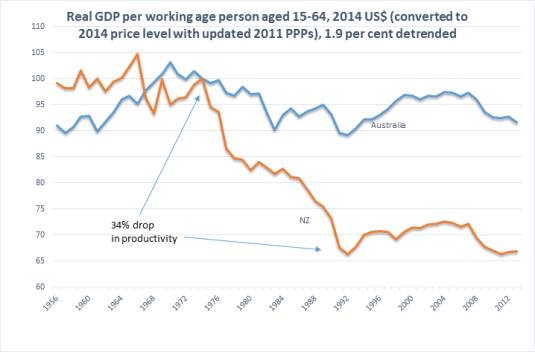
Interestingly, this faster growth in the New Zealand tax revenues as a percentage of GDP coincided with the two lost decades of New Zealand growth between 1974 and 1992. Furthermore, the chart below shows that an emerging recovery in labour productivity in the early 1980s stalled when tax revenues started growing again as a percentage of New Zealand GDP.
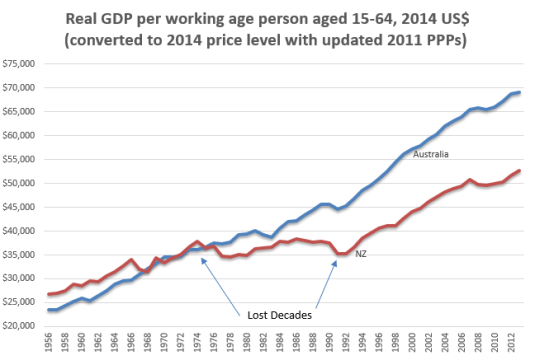
Source: Computed from OECD StatExtract and The Conference Board. 2015. The Conference Board Total Economy Database™, May 2015, http://www.conference-board.org/data/economydatabase/
Between 1974 and 1992, New Zealand lost 34% and productivity against trend of 1.9%. In the chart below, a flat line is growth at a rate equal to the trend rate of growth for the USA in the 20th century which is 1.9%. A falling line indicates growth at less than 1.9% for the year. A rising line means growth in excess of 1.9% for the year. The chart below confirms what the chart above says. Productivity stopped falling in the early 1980s then started falling rapidly at the same time that tax revenues spiked as percentage of GDP in the early 1980s.
Source: Computed from OECD StatExtract and The Conference Board. 2015. The Conference Board Total Economy Database™, May 2015, http://www.conference-board.org/data/economydatabase/
in the above chart, Australia had pretty steady growth since about 1970. There is a productivity slowdown in the 1970s and above-average growth as the economy recovered from the Keating recession in the early 1990s. The so-called mining boom is hardly noticeable in Australia’s trend growth rate.
Behind on my homeopathic blogging
18 Oct 2015 Leave a comment
in applied price theory, economics of information, economics of media and culture, economics of regulation, health economics Tags: consumer fraud, homeopathy, quackery, Quacks
Will high marginal tax rates and redistribution fix inequality?
18 Oct 2015 Leave a comment
in applied price theory, applied welfare economics, entrepreneurship, human capital, labour economics, occupational choice, politics - USA, poverty and inequality Tags: Gini coefficient, rational irrationality, taxation and entrepreneurship, taxation and human capital, taxation and labour supply, taxation investment
@nzlabour @metiria It’s impossible to build affordable housing
17 Oct 2015 2 Comments
in applied price theory, economics of regulation, politics - New Zealand, Public Choice, rentseeking, urban economics Tags: land supply, land use planning, New Zealand Greens, New Zealand Labour, RMA, zoning
The Labour Party and the Greens both plan to build 100,000 affordable houses as a way of offsetting soaring housing prices in Auckland and other New Zealand cities. These plans were announced in the 2014 Election in New Zealand.
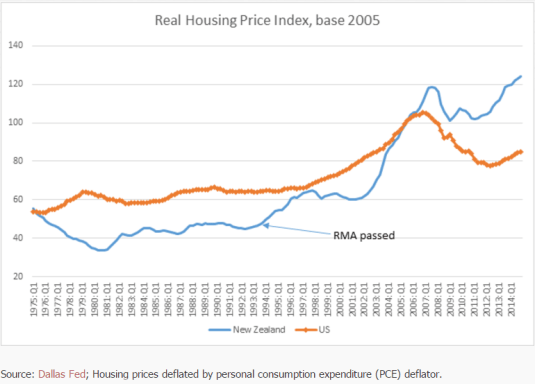
A trite but insurmountable objection to the proposal to build 100,000 affordable houses is there are no plans to increase the supply of land. That would require RMA reform which both Labour and the Greens oppose. They oppose RMA reform partly for ideological reasons and partly to cultivate middle-class home owner votes.
Unless there is an increase in the supply of land in Auckland and the other New Zealand cities, the government under the plans of the Labour Party and the Greens are building houses the private sector would have built anyway but for the government bought from the same new supply of land released every year by local councils.
The proposals of Labour and the Green to build affordable houses simply changes the identity of who builds the same number of new houses in New Zealand. There is no net increase in this supply of houses so there will not be any improvement in housing affordability.
If the supply of land were to be increased through RMA reforms, there be no need to for the government to build the houses. This is because the market will take care of building the houses on the additional land released by local councils if there is a demand for them and they’re obviously is.
Attempts by a Labour and Green Government to build affordable houses is no more than displace the efforts of private developers to supply houses but in configurations more closely aligned with market demand in terms of the quality and size of the house.
Another insurmountable but still minor objection to supplying 100,000 affordable houses is Friedman’s second law of economics: you can’t give anything away for free because people will queue up for access.
If the government is selling cheap houses to ordinary families, people change that circumstances to make themselves more eligible for the house, which presumably will be targeted by income. Easiest way to do that is to fund a low income family member such as a student to buy the house and sell it to you. Alternatively, you could make an advanced of them against their inheritances as a way of them buying a house.
The classic New Zealand example of the inability to give anything away for free was the introduction of school zoning. People now pay hundreds of thousands of dollars more for a house if it is in a favourable school zone.
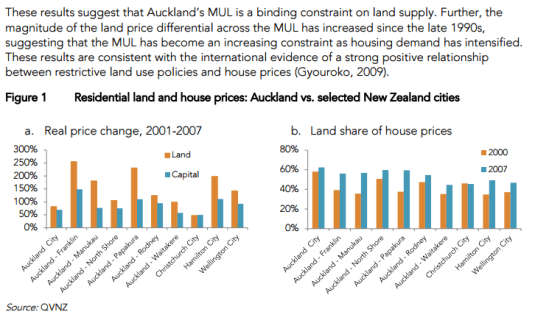
A more serious objection that can never be overcome is as soon as the lucky ordinary family buys the affordable house, they will renovate it to the proper standing reflecting the underlying value of the land. Affordable houses under the plans of the New Zealand Labour Party and the Greens is to build a cheap house on expensive land in Auckland. Land in Auckland is 60% of the price of a house. Land use to be 40% of the value of the house in Auckland.

Source: New Zealand Productivity Commission (2013).
Plenty of people are in the game of home renovation; some do it as a full-time occupation. They buy an old rundown house on good land and a good location and renovate the house to match the value of the underlying land and location.
The possibility of subsequent renovation to the cheap house on the good land is the death knell of any attempt to sell affordable housing in Auckland or the other New Zealand cities where house prices are spiralling upwards because of restrictions on the supply of land.
Building 100,000 affordable houses were simply present 100,000 renovation opportunities to entrepreneurs. The families who are lucky enough to be first to buy the affordable house will get a marvellous windfall. There will be no long-term impact on the price of land in Auckland because you can’t give anything away for free. Any undervalued good as quickly resold at a profit by budding entrepreneurs after renovating the house to bring it up to market standard given the value of the underlying land.
If the Labour Party and the Greens want more affordable housing, they must support RMA reforms that will increase the supply of land. They won’t do out of sheer political expediency. Labour and the Greens want to win the votes of disgruntled National party voters who already own homes.
Why isn’t everyone on a zero hours contract?
15 Oct 2015 Leave a comment
in applied price theory, economics of regulation, labour supply, occupational choice, organisational economics, personnel economics
I was chatting with a friend in the pub the other night about the proliferation of contractors in New Zealand in the government sector. It was observed that many of them simply perform the jobs of employees and bring no special skills for them but are very expensive to hire. They are paid a premium because that they are supposedly hired on short notice for short periods of time to fill gaps. They are paid a premium for their availability and willingness to leave on short notice without fuss.
I had no experience of contractors in Australia. If a gap needed to be filled within an agency quickly, you went to a manager higher up the hierarchy. The decision was made then to reallocate through secondments staff from another part of the agency from an area that was less busy than normal at the moment. In the interim, staff are recruited to fill any gap that is anything more than short-term with the secondments filling the gap until the recruits arrive.
Will you ask @WoodhouseMP to end zero-hour contracts for good? They're unfair and wrong. nzlp.nz/0hrspk http://t.co/IB8rm0gu6w—
New Zealand Labour (@nzlabour) April 09, 2015
The conversation then turned to the issues as to why any employees are guaranteed a minimum number of hours or continuity of employment. Why isn’t everyone on a zero hours contract and only come in when they are needed and are paid accordingly.
We've had 900+ submissions on the Employment Standards Legislation Bill so far. Submit here: responses.psa.org.nz/subesl20150916… http://t.co/XzIiiMYgOD—
(@NZPSA) September 24, 2015
The reason for long-term employment agreements with fixed hours and weekly wages irrespective of how busy the business is arises from the fixed costs of employment, and the costs of search and matching in the labour market.
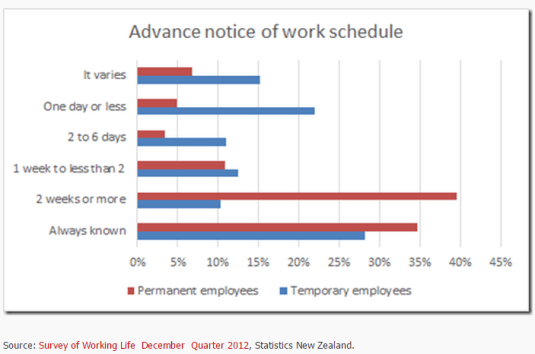
The difference between zero hours contracts and permanent employment may be a overstated. Advance notice of work schedules is always known only to a minority of temporary and permanent employees in New Zealand. There is not much difference between that advance notice between temporary and in permanent employees.
Critics overplay their hand if they suggest that somehow workers a very much disadvantaged and employers are holding all the cards. Job turnover and recruitment problems are a serious cost to a business. Workers will not sign contracts, such as zero hours contracts or casual work contracts if they are not to their advantage.
The question that must always be asked is why do people who are deemed competent to vote and drive cars sign zero hours contract? What is in it for them? David Friedman asked this question about the economics of restraint of trade agreements for employees:
…the employer who insists on an employee signing a non- competition agreement will find that he must pay, in additional wages or other terms of employment, the cost that the agreement imposes upon the employee, as measured by the employee and revealed in his actions. It follows that the employer will insist on such an agreement only if he believes that its value to him is greater than its cost to the employee… The contract is designed, after all, with the objective of getting the other party to sign it. If I am designing the contract and offering it to many other parties, that may put me in a position to commit myself to insisting on terms that give me a large fraction of the benefit that the contract produces. But it is still in my interest to maximize the size of that net benefit-which I do by only insisting on terms that are worth at least as much to me as they cost the other party.
Critics overplay their hand if they suggest that somehow workers are very much disadvantaged and employers are holding all the cards. Job turnover and recruitment problems are a serious cost to a business. Workers will not sign zero hours contracts if they are not to their advantage.
Unless labour markets are highly uncompetitive with employers having massive power over employees, employers should have to pay a wage premium if zero-hour contracts are a hassle for workers.
The fixed costs of employment are such that you shouldn’t expect zero-hour contracts: you’ll typically do better with one 40-hour worker over two 20-hour workers because of these costs. Zero hour contracts would be most likely in jobs with low recruitment costs and where specialised training needs are low. Workers with low fixed costs of working will move into the zero-hour sector while those with higher fixed costs would prefer lower hourly rates but more guaranteed hours. Again, read lower here as meaning relative to what they could elsewhere earn.
This is what 1599 submissions against the Employment Standards Legislation Bill looks like. http://t.co/WrkGpIiOP2—
(@NZPSA) October 06, 2015
Most workers, the majority of workers are on conventional employment agreements. They work five days a week, 40 hours a week for a fixed pay.
Anyone I know who decides to work as a contractor expects to be paid much more than a conventional employee. They command a large premium for not having certainty of hours and ongoing employment. The same goes for any job that is particularly risky, has unsocial hours or involves weekend work or anything else that departs from the standard working week. All these jobs command a wage premium.
Employers incur fixed costs of employment when they recruit and train new employees. These recruits must be expected to stay long enough to work sufficient hours for the firm to expect to recover these investments [Oi (1962, 1983a, 1990), Idson and Oi (1999), Hutchens (2010), Hutchens and Grace-Martin (2006)].
These costs are fixed costs because they do not vary with how many hours the employee works or with how long an employee stays with their employer. On-going supervision, office space and other overheads can increase with the number of employees, not the hours they work per week. These fixed employment costs must be recouped over the expected job tenure of the employee with the firm.
Employers will not hire an additional worker unless they anticipate recovering the costs of doing do including fixed employment costs and other overheads.
Hiring one more worker for 40 hours per week is cheaper than hiring two workers to work 20 hours per week each. These two part-timers would about double the recruitment and training costs to secure the same total additional supply of hours worked per week. Profits are a small share of the revenue earned on selling the output of each worker.
Zero hour contracts would be most likely in jobs with low recruitment costs and where specialised training needs are low. Workers with low fixed costs of working will move into the zero-hour sector while those with higher fixed costs would prefer lower hourly rates but more guaranteed hours. Again, read lower here as meaning relative to what they could elsewhere earn.
The literature on the economics of the fixed costs of work arose out of the economics of retirement and the economics of the labour supply of married women, and in particular of young mothers. This literature was attempting to explain why older workers, or young mothers either worked a minimum number of hours, or not at all.
Fixed costs of working constrain the choices that employees make about how many hours and days that are worthwhile working part-time. For employees, the fixed costs of going to work limit the numbers of days and number of hours per day that a worker is willing to work part-time. The timing costs of working at scheduled times and a fixed number of days per week can make working fewer full-time days, rather than fewer hours per day less disruptive to the leisure and other uses of personal time.
The fixed costs of working induced older workers to retire completely, and young mothers to withdraw from the workforce for extended periods of time, unless these workers worked either full-time or enough hours part-time each day and through the week to justify the costs of commuting and otherwise disrupting their day and week.
There are fixed costs to workers and employers finding each other as a suitable job match. They commit to a long-term relationship rather than risk that good job match dissolving and they are not able to recruit the fixed cost of initially finding such a good match.
Employers choose not to lay off workers during recessions because they want to retain their job specific human capital and recoup the fixed costs of employing them. If the employer lets them go in a downturn that is mild, they risk having to spend considerable money on finding our suitable replacement down the road.
It’s costly for employers to lose good employees. It’s equally costly for them to find good employees and quickly lose them again because they are unhappy or not as well-paid as elsewhere. There is much to be made on both sides of the employment relationship through long-term relationships. That’s why not everyone is on a zero-hours contract.
Zero hours contract doesn’t make it any cheaper for an employer to find a suitable recruit then train that recruit. A wage premium must be paid to induce the would-be recruit to prefer that working arrangement with no fixed hours over the others available to them including staying in their existing job.
Regulation of zero hours contracts will deny workers the option of higher wages by accepting uncertain hours. Hundreds of thousands of New Zealanders already work on employment agreements where there hours are not fixed but a variable on relatively short notice.

FA Hayek on competition as a discovery procedure
11 Oct 2015 Leave a comment
in applied price theory, Austrian economics, entrepreneurship, F.A. Hayek Tags: competition is a discovery procedure, creative destruction, entrepreneurial alertness, market process, market selection, The meaning of competition


Recent Comments