
HT: antidismal.blogspot via cafehayek
Celebrating humanity's flourishing through the spread of capitalism and the rule of law
10 Jul 2014 2 Comments
in applied price theory, applied welfare economics, entrepreneurship, industrial organisation, market efficiency, survivor principle, technological progress Tags: entrepreneurship, innovation, Walmart
HT: antidismal.blogspot via cafehayek
08 Jul 2014 Leave a comment
in applied price theory, applied welfare economics, comparative institutional analysis, David Friedman, economics of information, economics of regulation, entrepreneurship, industrial organisation, labour economics, law and economics, managerial economics, market efficiency, Milton Friedman, personnel economics, politics - New Zealand, Ronald Coase Tags: adverse selection, asymmetric information, blackboard economics, moral hazard, occupational regulation, screening, signalling
There are at least 98 regulated occupations in New Zealand covering about 20% of the workforce. In 2011, this amounts to 440,371 workers. The skills that are regulated range across all skill sets and many occupations:
There are 32 different governing Acts that regulated occupations in New Zealand with 55% of the workers subject to occupational regulation are employed in just five occupations:
The Health Practitioners Competency Assurance Act 2003 regulates 22 occupations and a total of 89,807 workers. The next best is the 10 occupations regulated by the Health and Safety in Employment Act 2002 which regulates an unknown number of occupations. The Civil Aviation Act 1990 regulates eight occupations and 19,095 workers, the Building Act 2004 regulates seven occupations and 21,101 workers and the Maritime Transport Act 1994 regulates six occupations and 20,500 workers. 12 of the regulated occupations are regulated under laws passed since 2007.
The purpose of occupational regulation is to protect buyers from quacks and lemons – to overcome asymmetric information about the quality of the provider of the service.
Adverse selection occurs when the seller knows more than the buyer about the true quality of the product or service on offer. This can make it difficult for the two people to do business together. Buyers cannot tell the good from the bad products on offer so many they do not buy to all and withdraw from the market.
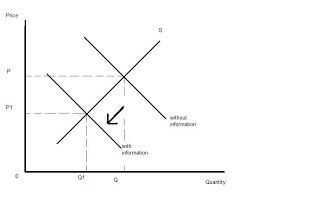
Goods and services divide into inspection, experience and credence goods.
The problem of adverse selection over experience and credence goods present many potentially profitable but as yet unconsummated wealth-creating transactions because of the uncertainty about quality and reliability.
Buyers are reluctant to buy if they are unsure of quality, but if such assurances can be given in a credible manner, a significant increase in demand is possible.
Any entrepreneur who finds ways of providing credible assurances of the quality of this service or work stands to profit handsomely. Brand names and warranties are examples of market generated institutions that overcome these information gaps through screening and signalling.
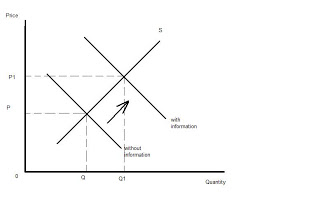
Screening is the less informed party’s effort, usually the buyer, to learn the information that the more informed party has. Successful screens have the characteristic that it is unprofitable for bad types of sellers to mimic the behaviour of good types.
Signalling is an informed party’s effort, usually the seller, to communicate information to the less informed party.
The main issue with quacks in the labour market is whether there are a large cost of less than average quality service, and is there a sub-market who will buy less than average quality products in the presence of competing sellers competing on the basis of quality assurance. This demand for assurance creates opportunities for entrepreneurs to profit by providing assurance.
David Friedman wrote a paper about contract enforcement in cyberspace where the buyer and seller is in different countries so conventional mechanisms such as the courts are futile in cases where the quality of the good is not as promised or there is a failure to deliver at all:
Public enforcement of contracts between parties in different countries is more costly and uncertain than public enforcement within a single jurisdiction.
Furthermore, in a world where geographical lines are invisible, parties to publicly enforced contracts will frequently not know what law those contracts are likely to fall under. Hence public enforcement, while still possible for future online contracts, will be less workable than for the realspace contracts of the past.
A second and perhaps more serious problem may arise in the future as a result of technological developments that already exist and are now going into common use. These technologies, of which the most fundamental is public key encryption, make possible an online world where many people do business anonymously, with reputations attached to their cyberspace, not their realspace, identities
Online auction and sales sites address adverse selection with authentication and escrow services, insurance, and on-line reputations through the rating of sellers by buyers.
E-commerce is flourishing despite been supposedly plagued by adverse selection and weak contract enforcement against overseas venders.
In the labour market, screening and signalling take the form of probationary periods, promotion ladders, promotion tournaments, incentive pay and the back loading of pay in the form of pension investing and other prizes and bonds for good performance over a long period.
In the case of the labour force, there are good arguments that a major reason for investments in education is as a to signal quality, reliability, diligence as well as investment in a credential that is of no value the case of misconduct or incompetence. Lower quality workers will find it very difficult if not impossible to fake quality and reliability in this way – through investing in higher education.
In the case of teacher registration, for example, does a teacher registration system screen out any more low quality candidates for recruitment than do proper reference checks and a police check for a criminal record.
Mostly disciplinary investigations and deregistrations under the auspices of occupational regulation is for gross misconduct and criminal convictions rather than just shading of quality.
Much of personnel and organisational economics is about the screening and sorting of applicants, recruits and workers by quality and the assurance of performance.
Alert entrepreneurs have every incentive to find more profitable ways to manage the quality of their workforce and sort their recruitment pools.
Baron and Kreps (1999) developed the recruitment taxonomy made up of stars, guardians and foot-soldiers.
Stars hold jobs with limited downside risk but high performance is very good for the firm – the costs of hiring errors for stars such as an R&D worker are small: mostly their salary. Foot-soldiers are employees with narrow ranges of good and bad possible outcomes.
Guardians have jobs where bad performance can be a calamity but good job performance is only slightly better than an average performance.
Airline pilots and safety, compliance, finance and controller jobs are all examples of guardian jobs where risk is all downside. Bad performance of these jobs can bring the company down. Dual control is common in guardian jobs.
The employer’s focus when recruiting and supervising guardians is low job performance and not associating rewards and promotions with risky behaviours. Employers will closely screen applicants for guardian jobs, impose long apprenticeships and may limit recruiting to port-of-entry jobs.
The private sector has ample experience in handling risk in recruitment for guardian jobs. Firms and entrepreneurs are subject to a hard budget constraints that apply immediately if they hire quacks and duds.
Blackboard economics says that governments may be able to improve on market performance but as Coase warned that actually implement regulatory changes in real life is another matter:
The policy under consideration is one which is implemented on the blackboard.
All the information needed is assumed to be available and the teacher plays all the parts. He fixes prices, imposes taxes, and distributes subsidies (on the blackboard) to promote the general welfare.
But there is no counterpart to the teacher within the real economic system
Occupational regulation comes with the real risk of the regulation turning into an anti-competitive barrier to entry as Milton Friedman (1962) warned:
The most obvious social cost is that any one of these measures, whether it be registration, certification, or licensure, almost inevitably becomes a tool in the hands of a special producer group to obtain a monopoly position at the expense of the rest of the public.
There is no way to avoid this result. One can devise one or another set of procedural controls designed to avert this outcome, but none is likely to overcome the problem that arises out of the greater concentration of producer than of consumer interest.
The people who are most concerned with any such arrangement, who will press most for its enforcement and be most concerned with its administration, will be the people in the particular occupation or trade involved.
They will inevitably press for the extension of registration to certification and of certification to licensure. Once licensure is attained, the people who might develop an interest in undermining the regulations are kept from exerting their influence. They don’t get a license, must therefore go into other occupations, and will lose interest.
The result is invariably control over entry by members of the occupation itself and hence the establishment of a monopoly position.
Friedman’s PhD was published in 1945 as Income from Independent Professional Practice. With co-author Simon Kuznets, he argued that licensing procedures limited entry into the medical profession allowing doctors to charge higher fees than if competition were more open.
Data Source: Martin Jenkins 2012, Review of Occupational Regulation, released by the Ministry of Business, Innovation and Employment under the Official Information Act.
07 Jul 2014 Leave a comment
in applied price theory, labour economics, minimum wage, Public Choice Tags: Free to Choose, Milton Friedman, minimum wage
07 Jul 2014 Leave a comment
in applied price theory, income redistribution, politics - New Zealand, Rawls and Nozick Tags: difference principle, income distribution, John Rawls, Maori economic development, Pasifika economic development
An urban legend in New Zealand is that income inequality is going from bad to worse.
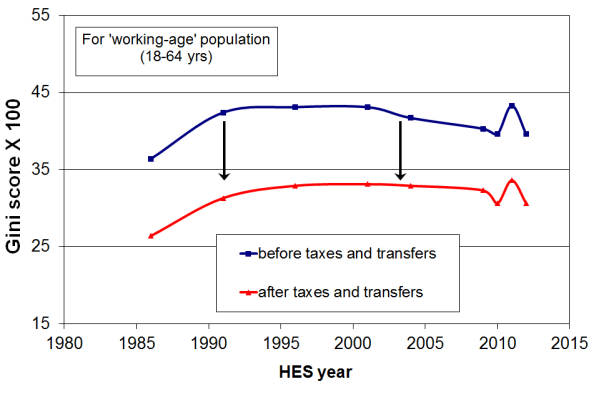
Since the mid 1990s to around 2011 there was a small net fall in New Zealand’s income inequality trend line in the graph for the Gini coefficient for the income distribution for New Zealand shows. inequality in New Zealand is similar to that in Australia, Ireland, Canada and Japan.

Source: Ministry of Social Development (2014)
Taxes and transfers have reduced inequality in New Zealand when measured by Gini coefficients, but the trend is been relatively stable for many years.
Source: Ministry of Social Development (2014)
Rawls pointed out that behind the veil of ignorance, people will agree to inequality as long as it is to everyone’s advantage. Rawls was attuned to the importance of incentives in a just and prosperous society. If unequal incomes are allowed, this might turn out to be to the advantage of everyone. Robert Nozick said that:
Political philosophers must now either work within Rawls’s theory or explain why not.
The groups that have been doing best in New Zealand have been Maori and Pasifika. In real terms, overall median household income rose 47% from 1994 to 2010; for Maori, this rise was 68%; for Pacific, 77%!

Source: Ministry of Social Development (2014)
The large improvements in Māori incomes since 1992 were based on rising Māori employment rates, fewer Māori on benefits or zero incomes, more Māori moving into higher paying jobs, and greater Māori educational attainment (Dixon and Maré 2007).
Maori unemployment reached a 20-year low of 8 per cent from 2005 to 2008. Labour force participation by Maori increased from 45% in the late 1980s to about 62% in the last few years.
Most of the remaining income disparities between Māori and non-Māori flow from differences in educational attainment and demographic and socio-economic characteristics including household composition (Chapple 2000; Maani 2004; Dixon and Maré 2007).
How much of the massive increases in incomes over the last 20 years spread throughout the entire community are you willing to give up for a little more equality? How much of your income will you donate to charity to lead the way?
.
07 Jul 2014 Leave a comment
in applied price theory Tags: Bill Allen

If we do not have all of everything we want, there is a problem of rationing. This is the major corollary of scarcity. An individual cannot escape the requirement for "economizing." How shall he disburse his limited income?
The very impersonality of the pricing mechanism, which the advocate of freedom should consider an asset, does not appeal to the compassionate person determined to do good.
Thus we find widely advocated processes of rationing, founded not on each person bidding in the open market on the basis of his own scale of priorities, but on direct disposal of goods and services by some public authority on the basis of what the authority somehow decides are the relative "needs" of the members of the community…
The Smythean scheme [rationing by prices] achieves a number of desirable results.
First, the rationing is done with a minimum cost in time and inconvenience. Paying a price in terms of money, i.e., generalized purchasing power, is neater (although not necessarily smaller in the estimation of everyone) than paying in terms of a specific resource, in this case, the energy required in arising early and groping to the parking lot by moonlight. That, as Smythe has often said, is why money was invented.
Second, a dispensing bureaucracy—suffering the temptations of frail men, guided by arbitrary and often nebulous criteria, and subject to no rewards for efficiency or penalties for inefficiency—is avoided.
Third, there is upheld the basic principle that those who get (in this case, the parking spaces) shall pay. Fourth, there is upheld the equally basic principle that gifts and rewards are best given in generalized purchasing power.
Bill Allen
05 Jul 2014 Leave a comment
in applied price theory, applied welfare economics, entrepreneurship, liberalism, technological progress Tags: The Great Enrichment, The Great Fact
from Would You Give Up The Internet For 1 Million Dollars? – YouTube via Luke Froeb.
04 Jul 2014 Leave a comment
in applied price theory, applied welfare economics Tags: monopoly, rent seeking, Tullock

Monopolisation has resulted in a higher price being paid (Pm not Pc) and the quantity bought (Qm not Qc) has been reduced. Part of the consumer surplus triangle has been shifted to producers as excess profits but part of it is totally lost to society as shown by the reduction in output from Qc to Qm.
The monopolised industry may result in more efficient production techniques and lowered costs. The net welfare gain or loss to the total economy is the difference between the red and blue areas.

Tullock’s (1967) argument is that if a successful monopolist can extort the excess profits from his customers such as through a government licence giving them a monopoly, such a large prize is worth the investment of up to an equivalent amount of resources equal to the capitalised value of the future monopoly profits.

Rational entrepreneurs should be willing to invest resources in attempts to form a monopoly until the marginal cost equals the properly discounted marginal return. Under certain assumptions (see Posner 1975) the competitive outlays to establish a monopoly will exactly equal the present value of the profit rectangle.

The Tullock rectangle may have to be added to the Harberger triangle when calculating the potential loss of welfare associated with monopoly.
04 Jul 2014 Leave a comment
in applied price theory, liberalism Tags: evolution of cooperation, experimental economics, game theory

Experiments in psychology and economics find that in market societies all over the world, a substantial fraction of individuals will be fair in anonymous interactions and will punish unfairness more.
In the dictator game , when played by participants in industrialized societies, the dictators gave away nearly half the prize — a division that probably sounds fair.

As for the noble savage, not corrupted by civilization and symbolising humanity’s innate goodness.what they do in the dictator game: hunter- gatherers, foragers, pastoralists and subsistence farmers were much less willing to share the prize, apparently because they didn’t feel an obligation to someone they didn’t know.

Success in the market correlates with the following characteristics:
Being nice and not too clever or too tricky becomes ingrained to success in market societies so that is why in market societies people are fair in the dictator game as a matter of course.
Why drop your standards because some silly experiment by psychologists? After all, you may have future dealings with members of the experiment, and even if you don’t, such as in anonymous computer-based experiments of interaction, you don’t want risk picking up bad habits just to please a psychologist.
Adam Smith, in his study of religion, noticed was that religious sects with stricter codes of honesty and intense mutual monitoring by co-congregants for the slightest moral lapses proliferated in cities. Many successful businessmen belonged to these strict religions. These highly religious businessmen were successful in their businesses because they were looked upon by the public as reliable trading partners in a time of weak law enforcement.
Smith viewed participation in religion as a rational device by which individuals enhanced the value of their human capital.These businessmen did not know that this was profit maximising but the businessmen with religious backgrounds slowly gained market share over rivals that had less efficient ways of communicating both their reliability and that their personal honesty was under daily scrutiny.
Ethnic minorities are advantaged in the same way in business. Because of their extensive social interactions with each other because of their language, religious practices and inter-marriage, the costs of bad business behaviours are much higher due to the risk of social ostracism by everyone you know. This greater trustworthiness gives them a cost advantage in the marketplace even though they may be unaware of its source.
04 Jul 2014 Leave a comment
in applied price theory, development economics, growth disasters Tags: Russian jokes
When Stalin was in office, he once noted that there were mice in his study and complained to President Kalinin about this.
The President thought for a moment and suggested, "Why don’t you put up a sign reading ‘Collective Farm’? Half the mice will die of hunger and the other half will run away."
Celebrating humanity's flourishing through the spread of capitalism and the rule of law
Celebrating humanity's flourishing through the spread of capitalism and the rule of law
Celebrating humanity's flourishing through the spread of capitalism and the rule of law
Celebrating humanity's flourishing through the spread of capitalism and the rule of law
Celebrating humanity's flourishing through the spread of capitalism and the rule of law
Celebrating humanity's flourishing through the spread of capitalism and the rule of law
Celebrating humanity's flourishing through the spread of capitalism and the rule of law
Celebrating humanity's flourishing through the spread of capitalism and the rule of law
Celebrating humanity's flourishing through the spread of capitalism and the rule of law
A History of the Alt-Right
Econ Prof at George Mason University, Economic Historian, Québécois
Celebrating humanity's flourishing through the spread of capitalism and the rule of law
Scholarly commentary on law, economics, and more
Beatrice Cherrier's blog
Celebrating humanity's flourishing through the spread of capitalism and the rule of law
Celebrating humanity's flourishing through the spread of capitalism and the rule of law
Celebrating humanity's flourishing through the spread of capitalism and the rule of law
Why Evolution is True is a blog written by Jerry Coyne, centered on evolution and biology but also dealing with diverse topics like politics, culture, and cats.
Celebrating humanity's flourishing through the spread of capitalism and the rule of law
A rural perspective with a blue tint by Ele Ludemann
DPF's Kiwiblog - Fomenting Happy Mischief since 2003
Celebrating humanity's flourishing through the spread of capitalism and the rule of law
The world's most viewed site on global warming and climate change
Tim Harding's writings on rationality, informal logic and skepticism
A window into Doc Freiberger's library
Let's examine hard decisions!
Commentary on monetary policy in the spirit of R. G. Hawtrey
Thoughts on public policy and the media
Celebrating humanity's flourishing through the spread of capitalism and the rule of law
Politics and the economy
A blog (primarily) on Canadian and Commonwealth political history and institutions
Reading between the lines, and underneath the hype.
Economics, and such stuff as dreams are made on
"The British constitution has always been puzzling, and always will be." --Queen Elizabeth II
Celebrating humanity's flourishing through the spread of capitalism and the rule of law
Celebrating humanity's flourishing through the spread of capitalism and the rule of law
WORLD WAR II, MUSIC, HISTORY, HOLOCAUST
Undisciplined scholar, recovering academic
Celebrating humanity's flourishing through the spread of capitalism and the rule of law
Res ipsa loquitur - The thing itself speaks
In Hume’s spirit, I will attempt to serve as an ambassador from my world of economics, and help in “finding topics of conversation fit for the entertainment of rational creatures.”
Researching the House of Commons, 1832-1868
Reflections on books and art
Posts on the History of Law, Crime, and Justice
Celebrating humanity's flourishing through the spread of capitalism and the rule of law
Exploring the Monarchs of Europe


Recent Comments