https://twitter.com/famousquotenet/status/560649739541426176
Recent life expectancy improvements across Europe
13 Feb 2015 Leave a comment
in applied welfare economics, health economics, technological progress Tags: life expectancy, The Great Escape, The Great Fact

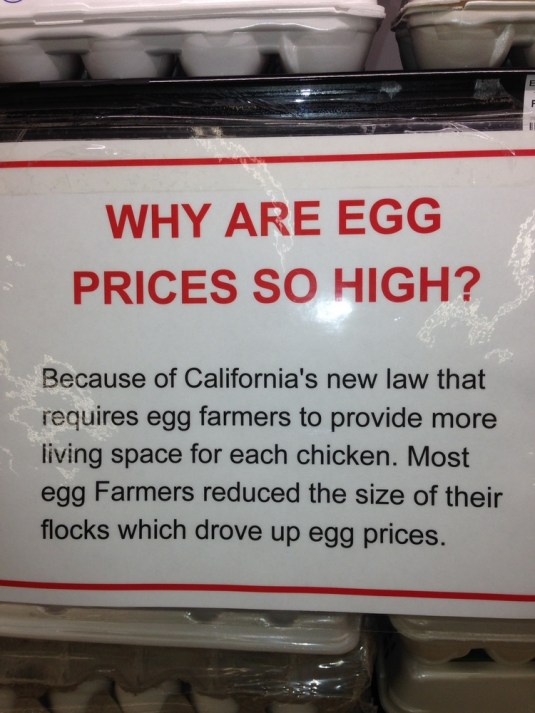
Prop 2’s Eventual Effect on California Egg Prices — Jayson Lusk
13 Feb 2015 Leave a comment
in applied price theory, applied welfare economics, economics of media and culture, economics of regulation Tags: Animal welfare


Competing visions of success – left and right
06 Feb 2015 Leave a comment
in applied welfare economics, entrepreneurship, human capital, labour economics, occupational choice, politics - New Zealand, politics - USA Tags: activists, distributive justice, do gooders, expressive voting, Leftover Left, poverty and inequality, rational ignorance, rational irrationality, top 1%
FA Hayek on the market as an engine of liberation, tolerance and social peace
06 Feb 2015 Leave a comment

A Report Card for Humanity: 1900-2050
06 Feb 2015 Leave a comment
in applied welfare economics, economic growth, health economics, technological progress Tags: The Great Enrichment, The Great Escape, The Great Fact


Why is NZ so hostile to foreign investment, 32nd in the Index of Economic Freedom 2015? USA is 66th!
02 Feb 2015 Leave a comment
in applied price theory, applied welfare economics, economics of media and culture, economics of regulation, international economics, politics - New Zealand Tags: bootleggers and baptists, foreign direct investment, foreign investment, free trade, Index of Economic Freedom
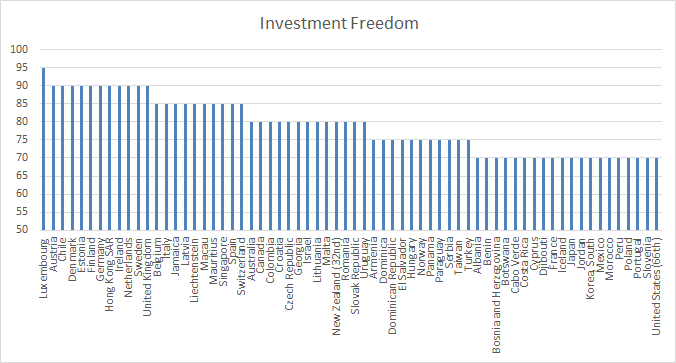
Source: 2015 Index of Economic Freedom
According to the Index of Economic Freedom 2015, in New Zealand
Foreign investment is welcomed, but the government may screen some large investments.
There was a major review of New Zealand foreign investment regulations about 10 years ago. The purpose of that review commissioned by the Labour government’s Minister of Finance, Dr Michael Cullen, was to deregulate the regulation of foreign investment in New Zealand.
At the time,under the Overseas Investment Act, the Minister of Finance could refuse permission to any investment. Australia’s current overseas investment regulations are the same. The federal treasurer may reject foreign investment proposals on the basis of an open-ended definition of national interest.
The last time that foreign investors had been refused permission to invest in New Zealand was in the early 1980s under then National Party Government Prime Minister Robert Muldoon. In a fit of pique, he refused permission to an Australian investor.
The revised foreign investment regulations limits the ability of government to reject foreign investors to narrow criteria such as the acquisition of sensitive land and large New Zealand companies. As part of this theme that foreign acquisitions of land was the main policy concern regarding foreign investment, the administration of the foreign investment regulations was moved out of a Overseas Investment Commission housed at the Reserve Bank of New Zealand to the very low key Land Information Office:
The Overseas Investment Office (OIO) assesses applications from overseas investors seeking to invest in sensitive New Zealand assets – being ‘sensitive’ land, high value businesses (worth more than $100 million) and fishing quota.
Naturally, subsequent to this genuine attempt by the Labour government of 10 years ago to deregulate foreign investment regulation, a number of investments have been refused since then often on the pretext that some part of the investment acquired sensitive coastal land door or rural land. The criteria for regulating foreign investment is as follows:
As regards the criteria relating to the relevant “overseas person”, the OIO needs to be satisfied that:
- the “overseas person” has demonstrated financial commitment to the investment; and
- the “overseas person” or (if that person is not an individual) the individuals with ownership and control of the overseas person (such as the shareholders and directors of the overseas purchaser):
- have the business experience and acumen relevant to that investment;
- are of good character; and
- are not prohibited from entering New Zealand by reason of sections 15 or 16 of the Immigration Act 2009 (e.g. persons who have been imprisoned for certain periods of time).
As regards the criteria relating to the particular investment, the OIO needs to be satisfied that the overseas investment will, or is likely to, benefit New Zealand (or any part of it or group of New Zealanders). When considering this, the OIO has a range of factors that it must consider (including, for example, whether the investment will create new job opportunities, introduce new technology or business skills, advance a significant Government policy or strategy, or bring other consequential benefits to New Zealand).
The New Zealand Initiative recently reviewed this criteria for regulating overseas investment into New Zealand and found that:
the report finds that the criteria for approval do not test the economic benefit to New Zealanders, where sensitive land is sold to an overseas person not intending to live in New Zealand indefinitely.
Indeed, the criteria are unambiguously hostile, even excluding the gain to a New Zealand vendor. This opens the way for the imposition of approval conditions that could impose net costs on New Zealanders given the regime’s potentially adverse effects on land values
The regulation of foreign investment in other countries is much more specific about what it is trying to achieve,as New Zealand Initiative also noted in its recent review:
New Zealand’s comprehensive screening regime accounts for our poor international ranking in the OECD’s FDI Regulatory Restrictiveness Index.
Most other countries focus their regimes more narrowly on national security considerations, often relating to particularly sensitive industries or sectors.
The main reason the public supports foreign investment regulation is because the public doesn’t like foreigners, and politicians pander to that xenophobia. If foreign investment is reduced, more of total investment spending has to be funded from domestic saving.

Access to foreign savings – trade in savings – allows investment to be made sooner, consumption to be smoothed over hiatuses such as recessions, and consumption to be bought forward in the light of better times such higher output and higher future incomes as because of foreign investment.The

The large national gains from foreign capital inflows is not part of that debate. A recent review of the gains from foreign capital inflows to New Zealanders found access to foreign saving led to national income per head, net of the servicing cost of foreign capital:
- average income gains of $2,600 per worker arising on a cumulative basis from capital inflow over the period 1996 – 2006; and
- growth in the value of New Zealand’s assets has greatly exceeded the rise in external liabilities to the extent that national wealth per head has risen by $14,000 in 2007 prices between 1996 and 2006.
You can’t let facts bugger a good story.
The foreign investment is in response to the high returns in the local market and the inflow of foreign capital will continue until local rates of return match those in other countries. Equalisation of risk-adjusted rate of returns is central to the operation of capital markets.
Stopping this process of equalisation of returns on capital through regulation only benefits the capitalists inside the country because the curbing of foreign investment stops rates of return falling to those overseas. Foreign investment regulation reduces the wages of New Zealand workers because they have less capital and fewer modern technologies to work with.
Fortunately, local capitalists can work in league with economic populists on the left and the right and the anti-foreign bias of the voting public to make it more difficult for foreign investors to come to New Zealand and drive down the profits of New Zealand capitalists. Who gains from that? As Paul Krugman said:
The conflict among nations that so many policy intellectuals imagine prevails is an illusion; but it is an illusion that can destroy the reality of mutual gains from trade.
The Left and Right approaches to poverty
01 Feb 2015 Leave a comment
in applied price theory, applied welfare economics, comparative institutional analysis, liberalism, poverty and inequality, welfare reform Tags: capitalism and freedom, Leftover Left, poverty and inequality, The Great Enrichment
The average American household was poorer in 2013 than it was in 1983 – Vox
31 Jan 2015 1 Comment
in applied welfare economics, population economics, poverty and inequality, technological progress Tags: Brad De Long, The Great Enrichment, The Great Escape, The Great Fact, time machines
/cdn0.vox-cdn.com/uploads/chorus_asset/file/3351202/vox-chart_net-worth-change-v2_1024.0.png)
US net worth rose considerably over that period, which is what you would expect to see.
Technology has improved and productivity increased, so society has a greater capacity for wealth building. America was also quite a bit older on average in 2013 than it was in 1983, so average wealth should have gone up.
But all of these gains went to the top 20 percent of the population. It’s worse than that, actually.
Over 100 percent of the gains went to the top 20 percent, because the bottom 60 percent of the population got poorer.
What does this claim by Matthew Yglesias exactly mean? He writes frequently on economics, so his editor must think he knows something about it.
http://t.co/0hEAL8X1kS—
EPI Chart Bot (@epichartbot) July 04, 2015
If 60% of the population got poorer as compared to 1983, they would be better off stepping into a time machine to go back to 1983. That is the only logical interpretation of this claim about 60% of the population. I owe this time machine thought experiment to Brad De Long.

Of course, going back to 1983, would involve giving up all products and services invented since then, and all product upgrades since then.
https://twitter.com/classicepics/status/561432237976322048
More importantly, for a good proportion of the population, they have become very sick or die immediately when they stepped out side of the Time Machine. This is because of shorter life expectancies in 1983 and the unavailability of a whole range of lifesaving medicines.

Am I just pedantic because I want access to crucial diabetic and other medications unavailable 30 years ago? No Internet, no cable, no international travel and no mobile phones.

In his original thought experiment, De Long asks how much you would want in additional income to agree to go back in time to a specific year. De Long was an economic historian examining the differences in living standards as compared to 1890 and 1990 and how that gap is greatly underestimated in economic statistics. De Long would have refused to go into the time machine to return to 1890 unless he could pack a very large bag to take with him:
I would want, first, health insurance: the ability to go to the doctor and be treated with late-twentieth-century medicines.
Franklin Delano Roosevelt was crippled by polio. Without antibiotic and adrenaline shots I would now be dead of childhood pneumonia.
The second thing I would want would be utility hookups–electricity and gas, central heating, and consumer appliances.
The third thing I want to buy is access to information–audio and video broadcasts, recorded music, computing power, and access to databases.
None of these were available at any price back in 1890.
The middle class has been shrinking for half a century because…
31 Jan 2015 Leave a comment
in applied welfare economics, politics - Australia, politics - New Zealand, politics - USA Tags: middle class stagnation, poverty and inequality
The New York Times passed over as quickly as it could the fact that up until the year 2000 the middle class was shrinking because more of them are moving into the upper middle class and the rich.

 Utopia, you are standing in it!
Recent Comments