Is Single Payer Right For America?
31 May 2017 Leave a comment
in applied price theory, applied welfare economics, health economics, politics - USA Tags: health insurance
#GarethMorgan wants sitting tenant laws
28 Apr 2017 Leave a comment
in applied price theory, applied welfare economics, economics of regulation, income redistribution, politics - New Zealand, Public Choice, rentseeking Tags: 2017 New Zealand election, offsetting behaviour, rent control, unintended consequences
Morgan wants to restrict the ability to evict tenants for reasons other than damage to the property and non-payment of rent. This includes not been able to evict a tenant on sale of the property.
We intend to change the regulations around residential tenancy law so leases make it far easier for a tenant to remain in the premises long term…
This will be achieved by restricting the conditions under which a landlord can evict a tenant to those of non-payment of rent or property damage. Sale of a property is not necessarily a legitimate reason for eviction. Tenants will be able to give 90 days notice.
That policy will make winding up of estates difficult. Houses will be have to be left vacant rather than rented while affairs are put in order. That is to name one of many flaws in a policy announced by a party that prioritises being different over been useful and right.
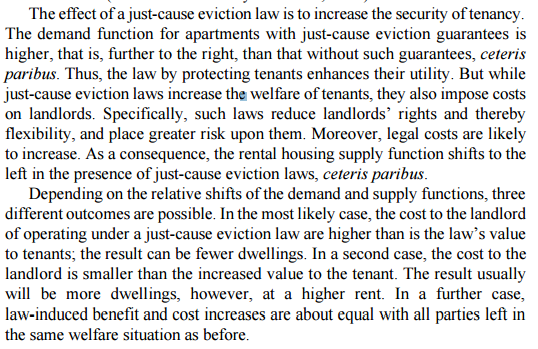
Source: RENTING Werner Z. Hirsch at encyclopedia of law and economics.
Australian global warming policies are well near optimal
24 Apr 2017 Leave a comment
in applied price theory, applied welfare economics, energy economics, environmental economics, global warming, politics - Australia, Public Choice, rentseeking Tags: climate alarmism, global warming
The UN Climate Panel Report found that the cost of not doing something is less than 2% of GDP in about 2070. The cost of doing something will likely be higher than 6% of GDP.
Making trouble again for @stevenljoyce for @TaxpayersUnion
21 Apr 2017 Leave a comment
in applied price theory, applied welfare economics, industrial organisation, international economics, politics - New Zealand, Public Choice, rentseeking, survivor principle Tags: picking winners

The Tragedy of the Commons
20 Apr 2017 Leave a comment
in applied price theory, applied welfare economics, comparative institutional analysis, economics of regulation, environmental economics Tags: public goods, tragedy of the commons
The Dutch disease for the benefit of #GarethMorgan @stevenljoyce
18 Apr 2017 1 Comment
in applied price theory, applied welfare economics, economic history, industrial organisation, international economics, politics - New Zealand, Public Choice, rentseeking, survivor principle Tags: Dutch disease, export subsidies, picking winners
I am putting in a Official Information Act request to see if anyone advise ministers that a export promotion target results in a matching increase in imports along with a large appreciation in the New Zealand dollar. Did New Zealand dodge the Dutch disease from this foolhardy export promotion policy? The Dutch Disease story is one of sectoral shifts.
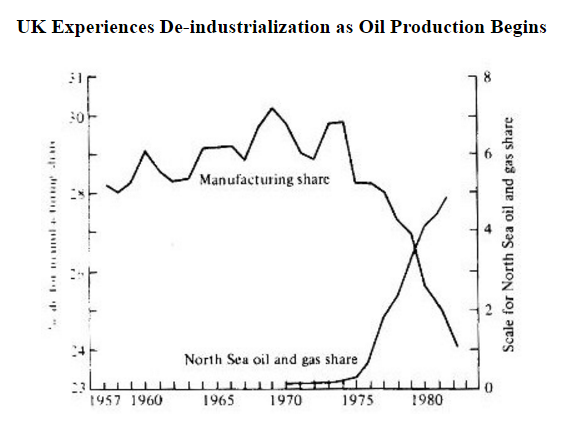
In the 1960s, with fixed exchange rates under the Bretton Woods system, the Netherlands discovered off-shore natural gas. As natural gas was extracted, it increased domestic income and spending. Investment was redirected toward the natural gas sector. Dutch wages and prices began to rise gradually. The Dutch guilder became overvalued in real terms, their industrial products became uncompetitive, and the manufacturing sector shrunk. This phenomenon of de-industrialization in the presence of rich natural resources was called the Dutch disease. They got natural gas but lost manufacturing.
In the late 1970s and early 80s, the UK experienced similar de-industrialization under a floating exchange rate regime. They discovered and exploited the North Sea oil fields. Since the global oil price was rising, the UK was expected to earn a great amount of foreign exchange in the future. But even before these earnings were realized, the British pound appreciated suddenly in both nominal and real terms. This damaged the British manufacturing sector.
Source: MF model – float
If there is an increasing demand for New Zealand exports if the Business Growth Agenda target of increasing New Zealand exports was successful, there is an increase in demand for New Zealand dollars to pay for these exports. This will result in an appreciation of the New Zealand dollar making imports cheaper. This will switch demand for New Zealand competing industries to these imports.
This process of currency appreciation and expenditure switching will continue until export match exports again. There is nothing wrong with an export boom as long as it is based on comparative advantage rather than subsidies.

Understanding the Climate Debate: The Lost Middle Ground
18 Apr 2017 Leave a comment
in applied welfare economics, energy economics, environmental economics, global warming Tags: carbon tax, carbon trading, climate alarmism

Climate economics: Optimal climate policy
11 Apr 2017 Leave a comment
in applied price theory, applied welfare economics, economics of regulation, energy economics, environmental economics, global warming Tags: carbon tax, carbon trading
Would @GetUp @SenSanders go back in Time Machine to their 1970s glory days?
27 Mar 2017 1 Comment
in applied price theory, applied welfare economics, development economics, economic history, growth miracles, politics - USA Tags: anti-market bias, Leftover Left, pessimism bias, The Great Enrichment, top 1%
18.1% of all children born on this planet in 1960 died before they had their fifth birthday ourworldindata.org/data/populatio… https://t.co/1FcIzAk88b—
Ninja Economics (@NinjaEconomics) December 28, 2015
A Graph for Pope Francis: If You Want to Help the Poor, You Should Embrace Capitalism. Exhibit A: See Chart http://t.co/yG1ixKZxrJ—
Mark J. Perry (@Mark_J_Perry) September 21, 2015


 Utopia, you are standing in it!
Recent Comments