I was delighted to share a stage with Prof Mario Rizzo, co-author of Escaping Paternalism and other fine works, at the IEA earlier this year. I never got around to posting the video, but here it is. Mario is an articulate critique of behavioural economics and “nudge” policies. I also mentioned his work on the slippery slope…
Mario Rizzo on behavioural economics
14 Sep 2025 1 Comment
in applied price theory, Austrian economics, behavioural economics
Emotions and Policy Views
07 Jul 2025 Leave a comment
in applied price theory, behavioural economics, economics of information, politics - Australia, politics - New Zealand, politics - USA
I would call this a story of negative emotional contagion: This paper investigates the growing role of emotions in shaping policy views. Analyzing social citizens’ media postings and political party messaging over a large variety of policy issues from 2013 to 2024, we document a sharp rise in negative emotions, particularly anger. Content generating anger […]
Emotions and Policy Views
Why the housing market imploded
29 Apr 2025 Leave a comment
in applied price theory, behavioural economics, economic history, economics of information, financial economics, global financial crisis (GFC), great recession, macroeconomics, monetary economics
In a recent paper, Christopher L. Foote, Kristopher S. Gerardi, and Paul S. Willen report (pdf): This paper presents 12 facts about the mortgage market. The authors argue that the facts refute the popular story that the crisis resulted from financial industry insiders deceiving uninformed mortgage borrowers and investors. Instead, they argue that borrowers and […]
Why the housing market imploded
Arctic Instincts? The Late Pleistocene Arctic Origins of East Asian Psychology
17 Mar 2025 Leave a comment
in applied price theory, behavioural economics, economic history Tags: cognitive psychology, evolutionary biology, evolutionary psychology
Highly speculative, but I found this of interest: This article explores the hypothesis that modern East Asian populations inherited and maintained extensive psychosocial adaptations to arctic environments from ancestral Ancient Northern East Asian populations, which inhabited arctic and subarctic Northeast Eurasia around the Last Glacial Maximum period of the Late Pleistocene, prior to back migrating southwards into East Asia in […]
Arctic Instincts? The Late Pleistocene Arctic Origins of East Asian Psychology
Book review: Hidden games
28 Jan 2025 Leave a comment
in applied price theory, behavioural economics, economics of information Tags: game theory

Game theory has a lot of real-world applications. I am never short of good examples to use when teaching game theory in my ECONS101 class. However, I can always use more examples. And so, I was really interested to read Hidden Games, by Moshe Hoffman and Erez Yoeli. The subtitle promises: “The surprising power of…
Book review: Hidden games
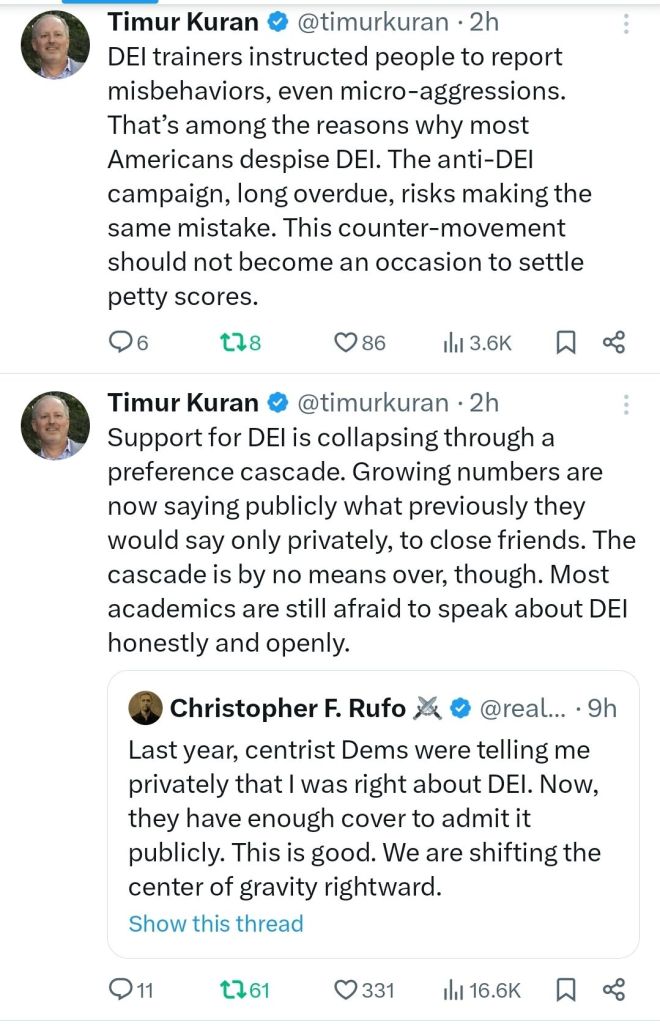
The DEI preference cascade
23 Jan 2025 Leave a comment
in applied price theory, behavioural economics, discrimination, economics of bureaucracy, economics of education, economics of information, economics of media and culture, economics of regulation, gender, labour economics, law and economics, liberalism, Marxist economics, politics - USA, property rights, Public Choice Tags: affirmative action, Age of Enlightenment, free speech, political correctness, racial discrimination, regressive left, sex discrimination

A Conversation with Gary Becker
10 Apr 2024 Leave a comment
in applied price theory, behavioural economics, comparative institutional analysis, discrimination, economic history, economics of education, economics of information, Gary Becker, gender, history of economic thought, human capital, labour economics, labour supply, occupational choice, poverty and inequality
Quotation of the Day…
01 Jan 2024 Leave a comment
in applied price theory, Austrian economics, behavioural economics, economic history, history of economic thought, human capital, industrial organisation, labour economics, labour supply, occupational choice Tags: capitalism and freedom, evolutionary psychology, The Great Enrichment
Tweet… is from my emeritus Nobel-laureate colleague Vernon Smith‘s splendid speech “Human Betterment Through Globalization,” delivered in September 2005 at the Irvington-on-Hudson then-headquarters of the Foundation for Economic Education: The challenge is that we all function simultaneously in two overlapping worlds of exchange. First, we live in a world of personal, social exchange based on…
Quotation of the Day…
You’re fooling yourself if you think you can land that plane
05 Dec 2023 Leave a comment
in behavioural economics, economics of education, economics of information, economics of media and culture, transport economics Tags: air accidents
Almost everyone has thought about it at least once. You’re on a plane, minding your own business when suddenly and unexpectedly, an announcement comes over your entertainment system that the pilots have been incapacitated and they are urgently looking for someone to land the plane. Would you put your hand up for this heroic task?…
You’re fooling yourself if you think you can land that plane
What Was Gary Becker’s Biggest Mistake?
15 Nov 2023 Leave a comment
in behavioural economics, economics of crime, Gary Becker, history of economic thought, law and economics

The econometrician Henri Theil once said “models are to be used but not to be believed.” I use the rational actor model for thinking about marginal changes but Gary Becker really believed the model. Once, at a dinner with Becker, I remarked that extreme punishment could lead to so much poverty and hatred that it could create blowback. Becker […]
What Was Gary Becker’s Biggest Mistake?
George Selgin – replace the Fed
07 Dec 2021 Leave a comment
in applied welfare economics, Austrian economics, behavioural economics, business cycles, economic history, global financial crisis (GFC), great depression, great recession, macroeconomics, monetarism, monetary economics Tags: monetary policy
Economic Growth in the Long Run: Artificial Intelligence Explosion or an Empty Planet? Ben Jones & Chad Jones
27 Nov 2021 Leave a comment
in applied price theory, applied welfare economics, behavioural economics, comparative institutional analysis, development economics, discrimination, economic growth, economic history, economics of education, economics of regulation, entrepreneurship, gender, growth disasters, growth miracles, history of economic thought, human capital, industrial organisation, labour economics, labour supply, law and economics, macroeconomics, occupational choice, population economics, poverty and inequality, property rights, public economics, survivor principle Tags: creative destruction, economics of fertility, endogenous growth theory
The Simpsons take on Social Justice Warriors
12 Oct 2021 Leave a comment
in behavioural economics, liberalism, libertarianism, Marxist economics, Public Choice, television Tags: free speech, political correctness, regressive left
George Stigler 50 Years Later: Part 2 – Advancing The Theory of Economic Regulation
05 Aug 2021 Leave a comment
in applied welfare economics, behavioural economics, comparative institutional analysis, economics of bureaucracy, economics of information, economics of regulation, history of economic thought, income redistribution, law and economics, Public Choice, rentseeking, Sam Peltzman
Recent Comments