

Further proof of the Only Nixon could go to China (mandatory sentencing reform) Theorem
12 Feb 2015 Leave a comment
in comparative institutional analysis, politics - New Zealand, politics - USA, Public Choice Tags: ACT party, decriminli, medical marijuana, Only Nixon could go to China, right to die, Tyler Cowen
Right-wing politicians can sometimes implement policies that left-wing politicians cannot, and vice versa under Cowen and Sutter’s only Nixon can go to China theorem:
The point is that politicians with a previous record of opposing a policy shift are often the only ones who can bring it about, because their policy support provides a credible signal of policy quality to the relevant interest groups who would otherwise oppose the policy.
Contemporary wisdom has it that only Nixon could go to China and make a deal because his decades of fierce anti-Communist stance gave him credibility with fellow conservatives and shielded him from any domestic attack.
Cowen and Sutter say that a policy could depend on information – on which policies or values everyone could potentially agree, or on which agreement is impossible.
Politicians, who value both re-election and policy outcomes, realise the nature of the issue better through inside and secret information and superior analytical skills (or access to those skills), whereas voters do not have access to such information base or skills.
Only a right-wing president can credibly signal the desirability of a left-wing course of action. A left-wing president’s rapprochement with China would be dismissed as a dovish sell-out. Nixon must be going to China because that is the best possible policy choice and he would never do so otherwise giving his previous record of firm anti-Communism.
Left-wing parties adopt right-wing policies because they are good ideas that will get them re-elected. Bob Hawke, Tony Blair, and Bill Clinton were centre-left economic reformers who can credibly signal the desirability of their economic reforms because of the brand name capital they invested in distributional concerns and protecting the poor.
Only right-wing Republicans such senators Rand Paul and Ted Cruz can introduce mandatory sentencing reform without been accused of being soft on crime. They must be doing it because it is right and just.
The same goes for marijuana decriminalisation, the decriminalisation of medical marijuana and right to die bills in the New Zealand Parliament.
Only a right-wing party, a party perceived as extreme right wing, and tough on crime such as the ACT party can introduce such bills and win a majority.
Although the ACT party is proudly and consistently socially liberal, the voting public does not perceive this and only sees it’s tough on crime image.
Taking advantage of that misperception will allow many National party MPs to vote for such bills introduced by the ACT party MP, David Seymour, without looking like a selling out to the Green Left who just want to smoke dope under the pretext of medical marijuana. Only ACT can win enough votes in the New Zealand Parliament to pass bills to decriminalised medical marijuana and allow the right to die.
Millennials Don’t Know What “Socialism” Means
11 Feb 2015 Leave a comment
in comparative institutional analysis, constitutional political economy, economics of media and culture, Marxist economics, politics - USA Tags: economics of socialism, rational ignorance, rational irrationality

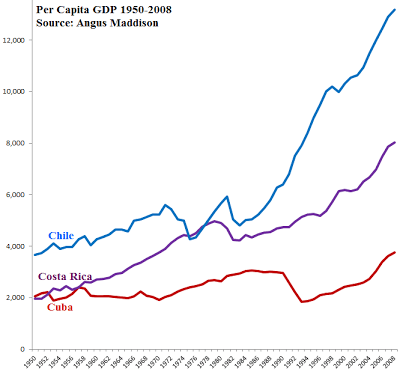
Economic Developement in Cuba compared
08 Feb 2015 Leave a comment
in comparative institutional analysis, development economics, growth disasters, growth miracles, politics - USA Tags: Chile, Costa Rica, Cuba
FA Hayek on the market as an engine of liberation, tolerance and social peace
06 Feb 2015 Leave a comment

Yes Prime Minister – The Department of Education and Science
03 Feb 2015 Leave a comment
in comparative institutional analysis, constitutional political economy, economics of education, economics of media and culture, TV shows Tags: Yes Prime Minister
Hayek Quotes of the Day
01 Feb 2015 Leave a comment
in comparative institutional analysis, constitutional political economy, F.A. Hayek, liberalism Tags: FA Hayek, the road to serfdom
These passages from The Road to Serfdom are my favourite from Hayek because of the allusion to the need to look at institutional solutions to problems and to be flexible about the relative merits of different institutions.
His metaphor of the gardener tending to his plants is great.
Another excellent metaphor of his of the role of public policy is that of a maintenance squad in a factory making sure everything was working well, although the maintenance squad really didn’t care what the factory was producing.

My Hayek exposure was mostly The Use of Knowledge in Society style stuff. I am just now reading The Road to Serfdom for the first time.
While his analysis of why markets work has always been wonderful, from what I can tell his political economy seems to echo that of a distinctly left-of-center economist by modern standards.
Probably nothing has done so much harm to the [libertarian] cause as the wooden insistence of some [libertarians] on certain rough rules of thumb, above all the principle of laissez-faire.
We must save capitalism from the unconstrained free-market. Is this Hayek or Robert Reich? Hayek makes repeated reference to the fact that it is only competition as a rough principle that is to be supported. Indeed, he goes on to say
The [proper] attitude of the [libertarian] towards society is like that of the gardener who tends a plant and in order to…
View original post 224 more words
The Left and Right approaches to poverty
01 Feb 2015 Leave a comment
in applied price theory, applied welfare economics, comparative institutional analysis, liberalism, poverty and inequality, welfare reform Tags: capitalism and freedom, Leftover Left, poverty and inequality, The Great Enrichment
Robert Lucas interview in Brazil, 2nd November 2012
24 Jan 2015 Leave a comment
in applied welfare economics, business cycles, comparative institutional analysis, development economics, economic growth, global financial crisis (GFC), great recession, growth disasters, growth miracles, inflation targeting, macroeconomics, monetarism, Robert E. Lucas Tags: Robert E. Lucas


Recent Comments