The hard left Daily Blog is so detached from power that it has forgotten that an effective opposition can slow governments down, sometimes to a dead stop. Stealing the opposition’s policies is a basic political skill.
Watching a third term government fight like a cornered animal against an effective opposition in with a good chance of winning the next election is an ugly sight for those who do not like the sight of blood. The current third term government in New Zealand is not particularly tired and certainly is not facing an effective opposition smelling victory at the next election.
This far left blog has little appreciation of the median voter theorem and the propensity of political parties that actually win power to position themselves closely to each other. For that reason, governments are hesitant to adopt policies that take them too far away from what the opposition might do in response and thereby win votes in the next election.
The hard left has little knowledge of this because it really participates in putting up an effective opposition to government policies. Little of what the hard left says appeals to the median voter so a National party government does not have to worry much about what are the hard left says in opposition to its policies. The high left opposing a policy changes few votes.
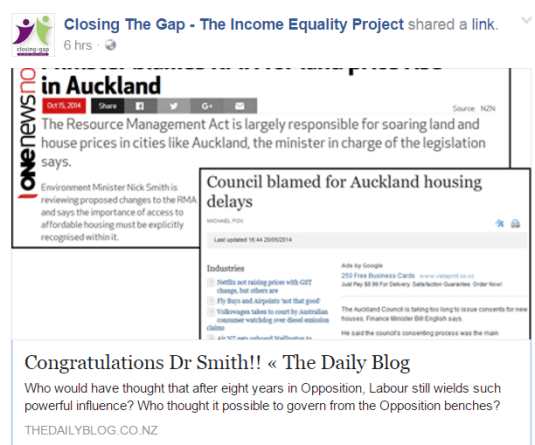
Housing affordability New Zealand is an obvious example of the power of an effective opposition party. The National party-led government is unwilling to take risks for fear of losing votes to the opposition Labour Party at the next election. New Zealand election is always close because of MMP. Winning margins are one or two seats.
Party with best approach to getting the economy growing/creating jobs: CON: 51% LAB: 32% UKIP: 7% LDEM: 5% SNP: 4% (via Lord Ashcroft polls)
One of the great complaints against the British Labour Party now by ordinary voters including those are never vote for them is that the Tory government faces no effective opposition to their plans and because there is no effective opposition, there is no break on what they could do. They are not challenged; their ideas are not being tested in Parliament and elsewhere and perhaps found wanting.
Party with best approach to controlling immigration: UKIP: 36% CON: 34% LAB: 22% LDEM: 6% SNP: 3% (via Lord Ashcroft polls)
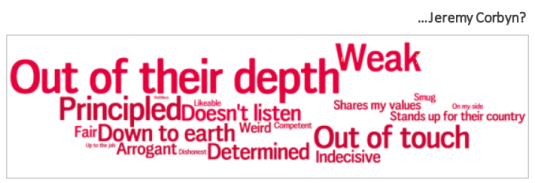
A leading reason for the mass resignations from the shadow cabinet recently was the lack of an effective opposition to government policies was letting the Tories have a free reign. The first step in slowing the Tories down is having a leader in the opposition who is not widely regarded as a clown.
We are interested in the different ways in which people organise politically, including novel forms of organisation operating outside of the traditional parliamentary sphere. We situate ourselves within a period of international political experimentation and innovation, and are committed to conducting research from a strongly anti-capitalist position.
By working with activists, academics, unionists, workers, beneficiaries, and others, we aim to facilitate rigorous and useful research that can further political thinking and organisational practices.
This is a welcome development. Maybe the far left has finally noticed how dismally it has performed in the last two New Zealand elections under the banner of the Mana party.
In 2011, it was assured of a seat in parliament, but Mana struggled to win more than 1% of the vote. I was deeply surprised at how small the far left boat was in New Zealand. The massively funded hard left campaign in the 2014 election won 1.2% of the party vote. The sitting Mana party MP lost his seat.
In the 2011 election, the same hard left party, when woefully underfunded, won 1.1% of the party vote. Getting the message out appears to have absolutely no effect on the party vote of the hard left. The median voter theory rules.
The British Labour Party under the leadership of Tony Blair also had a metamorphosis similar to this new far left think tank when it came to political organisation. In the House of Commons, those crazies to the right or left of you are tempered by a general election only every 5 years.
Little wonder UK Labor reconsidered devolution, an assembly for London, and regional government after 15 years of Maggie Thatcher, good and hard, with her unfettered right to ask the house of commons to make or unmake any law whatsoever.
Developing positive alternatives on the Left includes what to do about the rotation of power and fettered versus unfettered parliamentary and executive power. The failure of the Left to develop its own constitutional political economy is a major strategic shortcoming. Frequenting wine bars, cafes and blogs muttering to each other ‘our day will come, our day will come’ is not enough.
Too many on the left, in Richard Posner’s view, want to remake democracy with the faculty workshop as their model but followed up by a street march wherever possible. Such deliberation has demanding requirements for popular participation in the democratic process, including a high level of knowledge and analytical sophistication and a severe curtailment of self-interested motives.
The biggest challenge this new far left think tank must consider is democratic socialism is pointless because electoral power is fleeting: sooner or later, the left wing parties representing the socialist alternative lose power, and capitalism is resorted. How can democratic socialism work without entertaining the certain prospects of the right-wing winning office in 6, 9, 12 years time and undoing everything?
Under pension fund socialism, with the majority of the share market owned by superannuation funds, any call for wide-spread nationalisations is political suicide for the far left. The same for re-nationalisation later when the left-parties get another turn in office.
The rotation of power is common in democracies, and the worst rise to the top. So it is wise to design constitutional safeguards to minimise the damage done when those crazies to the right or left of you get their chance in office, as they will. New Zealand Parliamentary elections are always close because of proportional representation. This makes reality of ending up in the minority again very quickl at the next election if not the one after very real.
It is unfortunate that this far left think tank is starting to think of extra-parliamentary means of social change. The great strength of democracy is a small group of concerned and thoughtful citizens can band together and change things by mounting single issue campaigns or joining a political party and running for office and winning elections or influencing who wins.
That is how new Australian parties in the 20th century such as the Australian Labour Party, the Country Party, Democratic Labour Party, Australian Democrats and Greens changed Australia. Most of these parties started in someone’s living room, full of concerned citizens aggrieved with the status quo. In the 21st century, Australian democracy could not be more democratic, with a wide range of totally obscure new political parties winning seats in the state upper houses and the Senate.
The recent Senate election in Australia vindicates the view that the wrong sort of people get into parliament all the time. By wrong I mean people that the establishment parties would prefer not to be there including the establishment of the Australian Greens.
Indeed, it is that very strength of democracy – small groups of concerned citizens banding together – is what is holding up legislating on an end of life choice. It is not that minorities are powerless and individuals are voiceless. Exactly the opposite.
It is wise to design constitutional safeguards to minimise the damage done when those crazies to the right or left of you get their chance in office, as they will sooner or later rather than focus on the powers you and those that currently agree with you should have in your few days in which you fleetingly have a majority.
Too many policies and ideas of the one political party or another assume that they are the face of the future, rather than just another political party that will hold power as often as not and always for an uncertain time. Too many policies and ideas of the Left assume that they are the face of the future, rather than just another political party that will hold power as often as not.
State power was something that the classical liberals feared, and the problem of constitutional design is insuring that such power would be effectively limited. Sovereignty must be split among several levels of collective authority; federalism was designed to allow for a decentralization of coercive state power. At each level of authority, separate branches of government were deliberately placed in continued tension, one with the other. The legislative branch is further restricted by the establishment of two strong houses, each of which organised on a separate principle of representation.
Unfettered power loses its shine when it must be shared with your political opponents at least once a decade. The far left should look favourably upon federalism as a brake on neoliberalism.
Privatisation and deregulation is a lot slower in a federal system with an effective upper house elected by proportional representation. Regulatory powers and public asset ownership is spread over different levels of federations, with different parties always in power at various levels at the same time, all worried about losing office by going to far away from what the majority wants.
The will of the people is constantly tested and measured in a federal system with elections at one level or another every year or so contested on a mix of local and national issues. Any failings of privatisation or deregulation in pioneering jurisdictions would quickly become apparent and would not be copied by the rest of the country. These errors could be undone where they originated by incoming progressive governments.
As James Buchanan pointed out in 1954, the great strength of democracies is majorities are temporary so the exploitation by the majority of the minority is never permanent. If electoral majorities are other than temporary, the minority would have no choice but to fight.
Because of political ignorance and apathy, Richard Posner championed Schumpeter’s view of democracy. Schumpeter disputed the widely held view that democracy was a process by which the electorate identified the common good, and that politicians carried this out:
The people’s ignorance and superficiality meant that they were manipulated by politicians who set the agenda.
Although periodic votes legitimise governments and keep them accountable, their policy programmes are very much seen as their own and not that of the people, and the participatory role for individuals is limited.
Schumpeter’s theory of democratic participation is that voters have the ability to replace political leaders through periodic elections. Citizens do have sufficient knowledge and sophistication to vote out leaders who are performing poorly or contrary to their wishes.
The power of the electorate to turn elected officials out of office at the next election gives elected officials an incentive to adopt policies that do not outrage public opinion and administer the policies with some minimum honesty and competence. That is the best that the hard left can do. Help throw the rascals out in the hope that the replacements might be a bit better.
The preference for this new far left think tank for extra-parliamentary action is a confession. In Australia, it is possible for just about anyone except a Trot to win a seat at the next election on issues that are important to them because they don’t need that many others to share their concerns and aspirations to win that last upper house seat on preferences.
The hard left in general failed abysmally in taking advantage of the unrest after the global financial crisis. Bernie Sanders can be explained by Clinton being a terrible candidate for president despite her practice run in 2008. Gary Johnson is attracting attention simply because Clinton and Trump are such appalling candidates. Corbyn got were he got because the 35 heroes of #Tories4Corbyn did understand the role of MPs in filtering out fringe candidates.
Europe elected centre-right governments in the aftermath of the global financial crisis. The parties that are on the rise are anti-immigration, anti-foreigner populist parties that support the welfare state. They currently play identity politics better than the left.
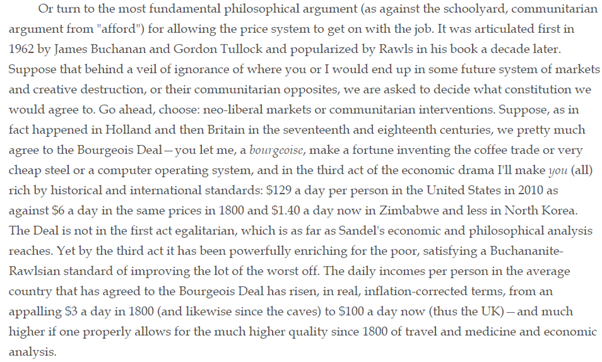
Source: Deirdre McCloskey: editorials: Review of Michael J. Sandel’s What Money Can’t Buy: The Moral Limit of Markets , New York: Ferrar, Straus and Giroux, 2012. Pp. 244 +viii. Index. by Deirdre McCloskey August 1, 2012. Shorter version published in the Claremont Review of Books XII(4), Fall 2012.
Current global climate change is primarily caused by human activities contributing to increased concentrations of greenhouse gases in the atmosphere, and is already contributing to disruption of human societies through sea level rise, extreme weather events, desertification, harm to health, wellbeing and other effects. This is the overwhelming consensus of the international scientific community.
The Greens then give their opponents a free kick regarding their views on coal:and their commitment to science-based risk policy:
No new coal-fired power stations or coal mines, and no expansions to any existing power stations or mines, plus the development of programs to assist coal-dependent communities to make the transition to other more sustainable sources of economic prosperity.
There is no attempt to refer to science to justify this blanket prohibition against a specific energy source.
Genetically modified organisms (GMOs), their products, and the chemicals used to manage them may pose significant risks to natural and agricultural ecosystems.
GMOs have not been proven safe to human health.
Scientific evidence produced independently from the developers and proponents of the GMO must be undertaken and form the basis for assessing and licensing of GMOs. GMO assessments must be broad, independent and scientifically robust.
The precautionary principle must be applied to the production and use of GMOs.
Unlike the New Zealand Greens, at least they do not simply reject the possibility of GMOs, the Australian Greens prefer the tactic of never being satisfied by the evidence.
The only thing I can find on the position of the Greens on fluoridation and vaccines is from a Victorian upper house MP who is half sensible on these issues. On fluoridation she says on behalf of the Greens
The Greens policy is quite clear on this. We do not have a policy for or against fluoride. Our policy supports the right of communities to determine the introduction of fluoride into local water supplies.
Not expressing the opinion on the wisdom of not putting fluoride in local water supply hardly shows a strong commitment to science-based public health policy.
I want to begin by stating that the Greens join health and scientific experts in absolutely supporting vaccination as a safe, proven and critical preventative health measure. The elimination of horrific diseases such as polio in Australia is testament to the incredible effectiveness and importance of vaccines…
There is also a group of people who might be called ‘hesitators’. They are not strongly opposed to vaccination, but they have heard that there might be some risks and they are thus unsure about them. These people do not perceive a strong risk of their child contracting any of the horrible diseases that immunisation prevents, so they think that on balance it might be reasonable not to vaccinate or to delay vaccination until their child is older or they simply have not yet made a decision either way. Hesitating parents may not realise that in some areas the local vaccination rate is getting well below safe levels and thus the risk of an outbreak is increasing.
Changes to the NSW Public Health Act in 2013 prohibited unvaccinated children from attending childcare unless their parents held “a personal, philosophical, religious or medical belief involving a conviction that vaccination under the National Immunisation Program should not take place” and they had discussed the matter with their GP”. The NSW Greens moved an amendment to remove personal, philosophical and religious beliefs as a grounds for exemption. This is one of the few times I can say something nice about a green MP.
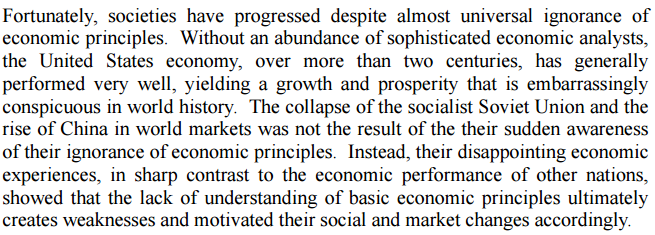
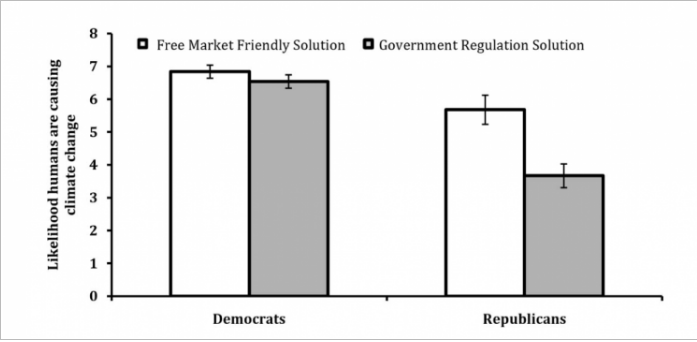
Many on the right have their doubts about climate change science, much of which is actually delivered driven by solution aversion.They do not like the costs of the solution so they attack the rationale for it for tactical reasons. Cass Sunstein explains:
It is often said that people who don’t want to solve the problem of climate change reject the underlying science, and hence don’t think there’s any problem to solve. But consider a different possibility: Because they reject the proposed solution, they dismiss the science. If this is right, our whole picture of the politics of climate change is off.
What is worse is this rejection of science is not based on solution aversion; that the costs are high. It is a plain rejection of science on principle by the green left rather than for tactical reasons such as by the right on global warming.
What is more worrying is all the science that is rejected by the left will make us more prosperous. Only when the solutions make is poorer does the green left support them such as with global warming and carbon taxes.
In many ways what divides the left and right onn science is a question of values: the value placed on progress, on the Great Enrichment, on the Great Fact and on the Great Escape.
19th century Tory radicals opposed the middle classes and the aesthetic ugliness they associated with an industrial economy; and
Like the 19th century Tory Radicals, today’s green gentry see the untamed middle classes as the true enemy.
Many Greens think they are expressing an entirely new and progressive philosophy as they mouthed the same prejudices as Trollope’s 19th century Tory squires; attacking any further expansion of industry and commerce as impossibly vulgar, because it was
ecologically unfair to their pheasants and wild ducks.
True to its 1960s origins, environmentalism is a mix of bureaucrats and hippies: a global, little-brother government that keeps the lower classes in line and a back-to-the-earth localism imposed on others but presenting no real threat to the inner city green elites’ comfortable middle class lives.
Why Evolution is True is a blog written by Jerry Coyne, centered on evolution and biology but also dealing with diverse topics like politics, culture, and cats.
“We do not believe any group of men adequate enough or wise enough to operate without scrutiny or without criticism. We know that the only way to avoid error is to detect it, that the only way to detect it is to be free to inquire. We know that in secrecy error undetected will flourish and subvert”. - J Robert Oppenheimer.




 Utopia, you are standing in it!
Recent Comments