George Stigler vindicated: Learning the Wealth of Nations

Tyler Cowen has drawn attention to a 2011 paper on policy learning in the 1970s and 80s by Francisco J. Buera, Alexander Monge-Narajo, and Giorgio E. Primiceri was published in Econometrica in 2011. Their paper found that:

1. Policymakers have priors about how good the market economy is, and they revise those views — and thus revise policy — as they observe their own growth results and those of their neighbors.

2. A simple learning model predicts about 97% of the policy choices observed in the data.  The model accounts for more than 77% of the observed policy switches over a three-year time window.

3. Evolving beliefs — and not just the fixed demographic characteristics of countries — are critical for understanding policy decisions.

4. It was probably the growth collapse of the late 1970s for interventionist countries which led to a greater reliance on markets.

5. Adjustment toward better-performing policies is often quite slow.  In part this is because policymakers attribute the superior performance of other countries to heterogeneity rather than policy per se.

This record of politicians learning from failure and success at home and abroad is a vindication of George Stigler’s views of the relative unimportance of economists in influencing public policy.

There was no neoliberal conspiracy that captured the hearts and minds of politicians through mass hypnosis in the 1970s and 1980s as both the Left over Left and the Twitter Left like to suggest

The policies of Friedman had to wait, as George Stigler predicted, for a market to develop among interest groups and the voting public. Once that market developed, Milton Friedman, FA Hayek and others looked like leaders of an opinion.

A few years earlier, Friedman and Hayek were just angry men in the wilderness.

The reason for this sudden change in their public profile and purported influence on the shape the course of public policy in th 1970s and 1980s onwards was political parties were yet to conclude that the existing policy regime had failed irretrievably, and that the successes of neighbours on economic reform might be worth imitating locally.

Once politicians, the voting public and interest groups concluded that new solutions are needed, just as Stigler predicted, the ideas for reform been around for a long time came to the front.

via http://marginalrevolution.com/marginalrevolution/2014/11/learning-the-wealth-of-nations.html

George Stigler’s five rules of how governments work

Image

Deirdre McCloskey makes the case for laissez faire and the rule of law

Image

Buchanan and Tullock on the rise of bourgeois virtues in the private and public sectors

Image

Thomas Sowell: public policy analysis in three questions

Image

How on earth did this guy get to become French Minister of Finance? Shades of Roger Douglas?

Image

Milton Friedman with a kind word for evidence-based policy

Image

David Friedman on why property rights

Image

Milton Friedman on the role of government

Image

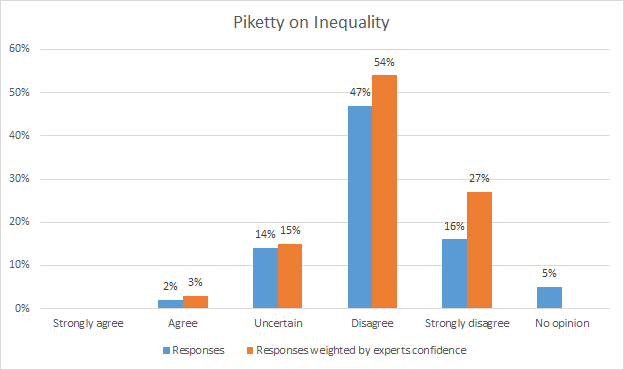
Piketty on inequality: views of the IGM economic experts

image

Question: The most powerful force pushing towards greater wealth inequality in the US since the 1970s is the gap between the after-tax return on capital and the economic growth rate?

Daron Acemoglu and James Robinson have a simple explanation for why Piketty is wrong:

But like Marx, Piketty goes wrong for a very simple reason. The quest for general laws of capitalism or any economic system is misguided because it is a-institutional.

It ignores that it is the institutions and the political equilibrium of a society that determine how technology evolves, how markets function, and how the gains from various different economic arrangements are distributed.

Despite his erudition, ambition, and creativity, Marx was ultimately led astray because of his disregard of institutions and politics. The same is true of Piketty.

Legal Systems Very Different from Ours – David Friedman’s forthcoming book

The central idea of David Friedman’s forthcoming book on legal systems of different societies is they face similar problems and solve them, or fail to, in an interesting variety of ways.

Looking at a range of such societies and trying to make sense of their legal systems provides a window into both problems and solutions, useful for the general project of understanding law—in particular but not exclusively from an economic point of view—and for the narrower project of improving it.

Unlike the usual course in comparative law, he did not look at systems close to ours such as modern Civil Law or Japanese law. Instead, Friedman examined systems from the distant past (Athens, Imperial China), from radically different societies (saga period Iceland, Sharia), or contemporary systems independent of government law (gypsy law, Amish).

System Chapters
Icelandic Law
18th c. English Criminal Law
Gypsy Law
Chinese Law
Athenian Law: The Work of a Mad Economist
Jewish Law
Islamic Law [Recently Updated]
Plains Indian Law
Puzzles of Irish Law
Amish Law
Somali Law [Recently Updated]
Commanche, Kiowa and Cheyenne: The Plains Indians
Thread Chapters

Enforcement Mechanisms: Civil, Criminal, And Lots More

The Incentive to Enforce: What and How Much

Embedded and Polylegal Systems

God as Legislator
Making Law
Guarding the Guardians

His Class web page is based on Student Papers from the SCU Seminar

Aaron Director on the constitutional political economy of laissez-faire

Image

Hayek (1983) on social evolution and the origin of traditions

HT: rfmcelroyiii

The United States of Conspiracy

image

Image

Hayek on evidence-based policy

Image

Previous Older Entries Next Newer Entries

Bassett, Brash & Hide

Celebrating humanity's flourishing through the spread of capitalism and the rule of law

Truth on the Market

Scholarly commentary on law, economics, and more

The Undercover Historian

Beatrice Cherrier's blog

Matua Kahurangi

Celebrating humanity's flourishing through the spread of capitalism and the rule of law

Temple of Sociology

Celebrating humanity's flourishing through the spread of capitalism and the rule of law

Velvet Glove, Iron Fist

Celebrating humanity's flourishing through the spread of capitalism and the rule of law

Why Evolution Is True

Why Evolution is True is a blog written by Jerry Coyne, centered on evolution and biology but also dealing with diverse topics like politics, culture, and cats.

Down to Earth Kiwi

Celebrating humanity's flourishing through the spread of capitalism and the rule of law

NoTricksZone

Celebrating humanity's flourishing through the spread of capitalism and the rule of law

Homepaddock

A rural perspective with a blue tint by Ele Ludemann

Kiwiblog

DPF's Kiwiblog - Fomenting Happy Mischief since 2003

The Dangerous Economist

Celebrating humanity's flourishing through the spread of capitalism and the rule of law

Watts Up With That?

The world's most viewed site on global warming and climate change

The Logical Place

Tim Harding's writings on rationality, informal logic and skepticism

Doc's Books

A window into Doc Freiberger's library

The Risk-Monger

Let's examine hard decisions!

Uneasy Money

Commentary on monetary policy in the spirit of R. G. Hawtrey

Barrie Saunders

Thoughts on public policy and the media

Liberty Scott

Celebrating humanity's flourishing through the spread of capitalism and the rule of law

Point of Order

Politics and the economy

James Bowden's Blog

A blog (primarily) on Canadian and Commonwealth political history and institutions

Science Matters

Reading between the lines, and underneath the hype.

Peter Winsley

Economics, and such stuff as dreams are made on

A Venerable Puzzle

"The British constitution has always been puzzling, and always will be." --Queen Elizabeth II

The Antiplanner

Celebrating humanity's flourishing through the spread of capitalism and the rule of law

Bet On It

Celebrating humanity's flourishing through the spread of capitalism and the rule of law

History of Sorts

WORLD WAR II, MUSIC, HISTORY, HOLOCAUST

Roger Pielke Jr.

Undisciplined scholar, recovering academic

Offsetting Behaviour

Celebrating humanity's flourishing through the spread of capitalism and the rule of law

JONATHAN TURLEY

Res ipsa loquitur - The thing itself speaks

Conversable Economist

In Hume’s spirit, I will attempt to serve as an ambassador from my world of economics, and help in “finding topics of conversation fit for the entertainment of rational creatures.”

The Victorian Commons

Researching the House of Commons, 1832-1868

The History of Parliament

Articles and research from the History of Parliament Trust

Books & Boots

Reflections on books and art

Legal History Miscellany

Posts on the History of Law, Crime, and Justice

Sex, Drugs and Economics

Celebrating humanity's flourishing through the spread of capitalism and the rule of law

European Royal History

Exploring the Monarchs of Europe

Tallbloke's Talkshop

Cutting edge science you can dice with

Marginal REVOLUTION

Small Steps Toward A Much Better World

NOT A LOT OF PEOPLE KNOW THAT

“We do not believe any group of men adequate enough or wise enough to operate without scrutiny or without criticism. We know that the only way to avoid error is to detect it, that the only way to detect it is to be free to inquire. We know that in secrecy error undetected will flourish and subvert”. - J Robert Oppenheimer.

STOP THESE THINGS

The truth about the great wind power fraud - we're not here to debate the wind industry, we're here to destroy it.

Lindsay Mitchell

Celebrating humanity's flourishing through the spread of capitalism and the rule of law

Alt-M

Celebrating humanity's flourishing through the spread of capitalism and the rule of law

croaking cassandra

Economics, public policy, monetary policy, financial regulation, with a New Zealand perspective

The Grumpy Economist

Celebrating humanity's flourishing through the spread of capitalism and the rule of law

International Liberty

Restraining Government in America and Around the World