
Moral and other philosophical values had to be given greater consideration in economic analysis
14 Aug 2014 Leave a comment


Hate speech is still speech, and much of hate speech is the gauche expression of everyday ideas
12 Aug 2014 Leave a comment
in constitutional political economy, law and economics, liberalism Tags: free speech, hate speech, political correctness, trigger warning

A lot of polite political conversation is, on close inspection, hate speech but expressed with the manners your mother taught you. Well-brought up children can get their ideas across with just as much bite as the uncouth without going potty mouthed.
Now let’s think of religion: leaving to one side the hateful things religions say about each other, according to them religious types, we non-believers are supposed to burn in the Devil’s own private furnace. As I recall, Baptists believe that the Pope is the Antichrist and the mass is idolatry.

In an age of information overload, it is easy to fall back on our own prejudices and insulate ourselves with comforting opinions that reaffirm our core beliefs. the blogosphere forms into information cocoons and echo chambers. People can avoid the news and opinions they don’t want to hear.
The politically correct are often among the most uncouth. Some of the worst things said about Sarah Palin in 2008 cannot be repeated on a blog hoping to be safe to view at work.

Marxist ideologies even worse: it should have a trigger warning over the entire field because of a hurtful things it says about capitalists and their motivation.

Scorn, ridicule and satire is as welcome as a bee sting and is always controversial to some and continuously goes beyond the bounds of good taste and conventional manners. Scorn, ridicule and satire often shock people into reconsidering their world view.

In a court case about a particularly vile cartoon in Hustler about Jerry Falwell, the United States Supreme Court said:
Debate on public issues will not be uninhibited if the speaker must run the risk that it will be proved in court that he spoke out of hatred; even if he did speak out of hatred, utterances honestly believed contribute to the free interchange of ideas and the ascertainment of truth…
The appeal of the political cartoon or caricature is often based on exploitation of unfortunate physical traits or politically embarrassing events – an exploitation often calculated to injure the feelings of the subject of the portrayal.
A good example of using shock value to make a point is the Ohio strip club that held a topless counter-protest outside a church they were attempting to shut down.

The target of their counter-protest was a church that spent the last nine years protesting outside their club seeking to shut it down. You must admire both side’s determination.

What a member of parliament is, is a legal curio. So are heads of state.
11 Aug 2014 1 Comment
in constitutional political economy, economics of crime, law and economics, property rights Tags: bribery and corruption, constitutional law, patronage

Under the Sale of Offices Act 1809, the sale of House of Commons seats was outlawed so membership of parliament must be freehold property. Prior to that 1808 Act, there is a lively trade in seats in the House of Commons: you can buy them outright, or just rent a seat for a session of Parliament.
- Being paid a salary as a member of parliament is very 20th century with the House of Representatives beating the House of Commons by 5 years.
- Back in 1695, the House of Commons resolved that offering a bribe to a Member of Parliament shall be a high crime and misdemeanour liable to impeachment, and an MP accepting such a bribe shall be a matter of privilege.
- In 1858, the House resolved to prohibit advocacy for fee or reward.
- In 1947, a further resolution banning MPs from entering agreements which restricted their freedom to act and speak, or require them to act as a representative of outside bodies.
Prior to the 19th century virtually all European civil appointments were made through outright sale or patronage, included judicial courts, public finance, sheriffs, and notaries public so the offices were freeholds – effectively private property.
Once an office had been granted it could be mortgaged, sold privately or through public auction, and bequeathed to heirs. The key source of income from most offices was the right to charge fees for service.
The buying and selling applied to army officer commissions, but never to the British navy for reasons explained by Doug Allen in his clever writings on the economics of patronage and veniality. The sale of military commissions ended in 1871.
The queen is corporation sole in perpetual succession – she or he may possess property as monarch which is distinct from the property he or she possesses personally, and may do acts as monarch distinguished from their personal acts.
Elizabeth II has several corporations sole – Her Majesty the Queen in Right of the United Kingdom, Her Majesty the Queen in Right of Canada, Her Majesty the Queen in Right of Australia are all distinct corporations sole. She is also a distinct corporation sole for states and provinces.
Ministers of the crown can be corporations sole. This is administratively convenient as regards the ownership of property because it facilitates continuity when the office-holder changes.
There ends today’s trivia.
Why Bills of Rights
08 Aug 2014 Leave a comment
in constitutional political economy, law and economics Tags: Bill of Rights, democracy, Justice Robert Jackson, rule of law

Advertising and free speech: the best test of truth is the power of the thought to get itself accepted in the competition of the market
08 Aug 2014 Leave a comment

Most political disagreements are about the predicted effects of competing policies, not basic values – Milton Friedman
07 Aug 2014 Leave a comment


Unfettered power loses its shine when it must be shared with your opponents for more than a brief time
05 Aug 2014 Leave a comment
in constitutional political economy, Federalism, James Buchanan, Public Choice Tags: democracy, Leftover Left, rotation of power, separation of powers
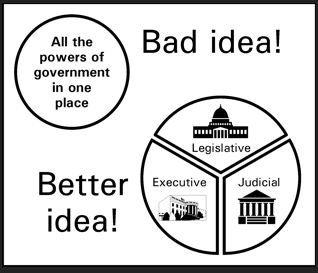
The rotation of power is common in democracies, and the worst rise to the top, so it is wise to design constitutional safeguards to minimise the damage done when those crazies to the right or left of you get their chance in office, as they will.
Too many policies and ideas of the Left assume that they are the face of the future, rather than just another political party that will hold power as often as not.
Privatisation and deregulation is a lot slower in a federal system with an effective upper house elected by proportional representation. Regulatory powers and public asset ownership is spread over different levels of federations, with different parties always in power at various levels at the same time, all worried about losing office by going to far away from what the majority wants.
The will of the people is constantly tested and measured in a federal system with elections at one level or another every year or so contested on a mix of local and national issues. Any failings of privatisation or deregulation in pioneering jurisdictions would quickly become apparent and would not be copied by the rest of the country. These errors could be undone where they originated by incoming progressive governments.
The Left may want to protect the rights of the unpopular and the unpleasant, and to want constitutional safeguards to slow an impassioned majority down is, in part, because they could be next if they lose the next election to the latest right-wing populist.
In a unitary unicameral parliament, those crazies to the right or left of you are tempered by an occasional general election only every 3 to 5 years. Little wonder that UK Labor reconsidered devolution, an assembly for London, and regional government after 15 years of Maggie Thatcher, good and hard, with her unfettered right to ask the house of commons to make or unmake any law whatsoever.

Developing positive alternatives on the Left includes what to do about the rotation of power and fettered versus unfettered parliamentary and executive power. The failure of the Left to develop its own constitutional political economy is a major strategic shortcoming. Frequenting wine bars, cafes and blogs muttering to each other ‘our day will come, our day will come’ is not enough.
State power was something that the classical liberals feared, and the problem of constitutional design is insuring that such power would be effectively limited.
Sovereignty must be split among several levels of collective authority; federalism was designed to allow for a decentralization of coercive state power.
At each level of authority, separate functional branches of government were deliberately placed in continued tension, one with the other. The legislative branch is further restricted by the establishment of two strong houses, each of which organised on a separate principle of representation


Recent Comments