
P.T. Bauer on the role of government in economic development
16 Jun 2014 Leave a comment
in constitutional political economy, development economics, P.T. Bauer Tags: P.T. Bauer

…the preoccupation with aid, investment, and development planning has served to divert attention from more important factors in development which are influenced by government policy. This same preoccupation has also served somewhat paradoxically to bring about a serious neglect of essential tasks of government.
Governments seem anxious to plan but unable to govern. The neglect extends to such familiar and essential tasks as the maintenance of law and order, the effective management of the monetary and fiscal system, and the provision of basic transport and educational facilities.
Justice Antonin Scalia on democracy and social change
14 Jun 2014 Leave a comment
in constitutional political economy, law and economics Tags: Antonin Scalia

The virtue of a democratic system [with a constitutionally guaranteed right to free speech] is that it readily enables the people, over time, to be persuaded that what they took for granted is not so and to change their laws accordingly
United States Supreme Court Justice Antonin Scalia
The Chardonnay socialists are not as left-wing as they think
08 Jun 2014 Leave a comment
in constitutional political economy, politics, Public Choice Tags: voter demographics
As people hit middle age their youthful radicalism tends to be replaced with a growing conservatism. There has been a study of the 136,000 people in the World Values Survey. The data was from 48 different countries, during five periods between 1981 and 2008:
- Participants were asked to choose whether they saw themselves as left-wing or right-wing.
- The results were then compared with their responses to more detailed questions about their views, to determine how closely the participants own perception matched their real position on the ideological spectrum.
Well-educated individuals are more likely to wrongly characterise their political positions as more left-wing than they actually are. Holding down a job and raising a family leads them to adopt a more conservative outlook.
 One reason the left-intellectuals do not realise that they have shed their youthful liberalism is that they socialise with people going through the same ideological shift to the right.
These results are no particular surprise given the growing authoritarian nature of the Left both in terms of social regulation and political correctness. Like a true conservative, the Left is a great believer in ordering their inferiors about while exempting themselves from these laws.
The US voting data shows that:
- Americans who identify as independents is inversely related to age. More than one-third of the youngest Americans identify as independents, a percentage that drops steadily as the population ages.
-
The percentage who identify as Republicans follows roughly the opposite pattern. Only around 20% of Americans below 25 identify as Republicans.
-
Democrats are quite strong among those under age 24. The percentage of Democrats stays at the one-third mark until about age 45, when it climbs slightly and remains higher through the 50s and early 60s, hovering at around the 40% point.
Why specific people change is more interesting, because as Hayek said, aggregates conceal more than they reveal.

Justice Antonin Scalia on the nature of democratic constitutions
07 Jun 2014 Leave a comment
in constitutional political economy, law and economics Tags: Antonin Scalia, constitutional law

What’s going on in the EU with the electing of so many anti-EU candidates?
05 Jun 2014 Leave a comment
in constitutional political economy, Federalism, Public Choice Tags: European Union

The best achievements of European institutions have all stemmed from removing restrictions—to trade, travel, residency and financial transactions.
But for at least 30 years, the EU has mainly been in the business of imposing restrictions on everything from the judicial sentences that national courts can impose to the shape of the vegetables that Europeans get to eat.
Stealth Europe transmogrified into Busybody Europe.
Wall Street Journal via Managerial Econ: What’s going on in the EU?
David Friedman – Market Failure: An Argument Both For and Against Government
04 Jun 2014 Leave a comment
in applied welfare economics, constitutional political economy, David Friedman Tags: comparative institutional analysis, David Friedman, government failiure, market failure
Sam Peltzman and the great restraint in the growth of government, 1980-2007
01 Jun 2014 Leave a comment
in constitutional political economy, Gary Becker, income redistribution, Public Choice, rentseeking, Sam Peltzman Tags: growth in government, The Great Restraint
From 1950 to 1980 the size of government doubled in the developed world and then stopped dead in 1980. This great restraint on the growth of government happened everywhere. It was not just Thatcher’s Britain or Reagan’s America. It was everywhere, in France and Germany, and even in Scandinavia.
Peltzman’s data below has government spending double between 1950 and 1980, and then nothing much happened in between 1980 and 2007 – the size of government is pretty flat as a share of GDP for 27 years.
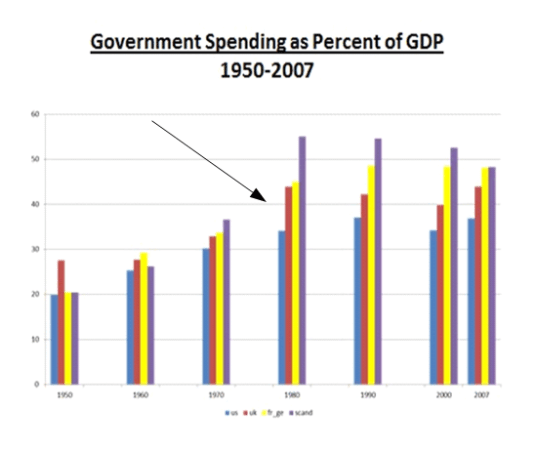
Source: Sam Peltzman, The Socialist Revival? (2012).
There is a noticeable reduction in the size of government spending in Scandinavia. Reagan and Thatcher had nothing on those Social Democrats in Scandinavia when it comes to cutting the size of government.
Governments everywhere hit a brick wall in terms of their ability to raise further tax revenues. Political parties of the Left and Right recognised this new reality.
Government spending grew in many countries in the 20th century because of demographic shifts, more efficient taxes, more efficient spending, a shift in the political power from those taxed to those subsidised, shifts in political power among taxed groups, and shifts in political power among subsidised groups.
The median voter in all countries was alive to the power of incentives and to not killing the goose that laid the golden egg.
After 1980, the taxed, regulated and subsidised groups had an increased incentive to converge on new lower cost modes of redistribution.
More efficient taxes, more efficient spending, more efficient regulation and a more efficient state sector reduced the burden of taxes on the taxed groups.
Most subsidised groups benefited as well because their needs were met in ways that provoked less political opposition.
Gary Becker made this warning about the political repercussions of tax reform and economic reform in general for the size of government:
…the greater efficiency of a VAT and its ease of collection is a two-edged sword.
On the one hand, it would raise a given amount of tax revenue efficiently and cheaply.
Since economists usually evaluate different types of taxes by their efficiency and ease of collecting a given amount of tax revenue, economists typically like value added taxes.
The error in this method of evaluating taxes is that it does not consider the political economy determinants of the level of taxes.
From this political economy perspective, the value added tax does not look so attractive, at least to those of us who worry that governments would spend and tax at higher levels than is economically and socially desirable.
Reforms ensued after 1980 led by parties on the Left and Right, with some members of existing political groupings benefiting from joining new political coalitions.
The deadweight losses of taxes, transfers and regulation limit inefficient policies and the sustainability of redistribution.
Peltzman likes to note that at the start of the 20th century, the United States government was about 8% of GDP. The two largest programs were education and highways. The post office was as big as the military.
Government is about five times that now with defence, health, education and income security accounting for 70% of this total. Peltzman makes the very interesting point that:
There is no new program in the political horizon that seems capable of attaining anything like the size of any of these four.
For the time being the future government rest on the extent of existing mega programs.
Health and income security account for 55% of total government spending in the OECD. It is in these two programs where the future of the growth of government lie.
The pressure for that growth in government will come from the elderly. Governments will have to choose between high taxes on the young to fund these programs for the elderly or find other options.
Gordon Tullock on the motives for income distribution
01 Jun 2014 Leave a comment
in applied welfare economics, constitutional political economy, Gordon Tullock, income redistribution, Public Choice Tags: Gordon Tullock, income redistribution

Ronald Coase on applied welfare economics versus comparative institutional analysis
21 May 2014 Leave a comment
in applied welfare economics, constitutional political economy, law and economics, Ronald Coase Tags: Coase, comparative institutional analaysis

All solutions have costs, and there is no reason to suppose that governmental regulation is called for simply because the problem is not well handled by the market or the firm.
Satisfactory views on policy can only come from a patient study of how, in practice, the market, firms and governments handle the problem of harmful effects….
It is my belief that economists, and policy-makers generally, have tended to over-estimate the advantages which come from governmental regulation.
But this belief, even if justified, does not do more than suggest that government regulation should be curtailed. It does not tell us where the boundary line should be drawn.
This, it seems to me, has to come from a detailed investigation of the actual results of handling the problem in different ways.
Why do we have governments?
09 May 2014 Leave a comment
in constitutional political economy, Gordon Tullock, Public Choice Tags: federalism
Ancient philosophers in general thought that it was to establish virtue or do good. Most modern public choice scholars are more modest in their evaluation of government.
We simply want government to provide those goods and services that people in fact want and that, for a variety of reasons, are hard to provide through the market.
Most people, for example, would like to have the poor taken care of by taxes on those better off. It is true they would have no objection if the poor were taken care of by voluntary contributions, but our experience seems to indicate that voluntary contributions don’t produce adequate funds for this purpose. Hence the use of the government to provide that particular service is generally approved. Of course, that does not prove that in general people are in favour of the exact quantity transferred or the methods used by the government.
There is a large literature on why certain types of things, sometimes called public goods, are provided by the market in a very inefficient way and will be provided in a better (although far from optimal) way by the government.
…We will just accept as a fact that there are a number of things which are better dealt with by the government. We will also accept as a fact that there are other things which are better dealt with by the market.
…In general, we want the government to give the citizens what they themselves want. That, indeed, is the point of democracy.
The smaller the government, the smaller the number of its voters. The smaller the number of voters, the more power each individual voter has. That’s one side of the argument.
On the other side, we have the fact that many government services are hard or impossible for small governmental units to provide.
These two arguments have to be set off against each other and since different government activities will turn out to have a different balance, having different governmental sizes is sensible.
… The existence of many small government units dealing with certain special problems has another advantage. Not only are these small governments more under the control of their voters in the sense that each individual voter’s preferences count for more than in the large government, their existence means that citizens may move from one to the other if they are dissatisfied.
Gordon Tullock
The New Federalist (1995)

New Zealand is not a federal state. I like federalism because a divided government is a weak government.
In praise of traffic cops
05 May 2014 1 Comment
in applied welfare economics, constitutional political economy, law and economics, transport economics Tags: crime and deterrence, James Buchanan, punishment dilemma
Due to budget cuts, 35% of Oregon State Highway Police were laid off. These mass layoffs dramatically reduced citations and resulted in a 10-20% increase in injuries and fatalities.

The strongest effects were under fair weather conditions outside of city-limits where state police employment levels were most relevant.
These results in DeAngelo and Hansen’s “Life and Death in the Fast Lane: Police Enforcement and Traffic Fatalities” American Economic Journal: Economic Policy 2014 suggest that a highway fatality can be prevented with $309,000 of additional expenditures on traffic police.
A standard measure of the “value of a statistical life” is it is worth taking regulatory or law enforcement actions that reduce the risks of death when the costs of these actions are less than about $9 million per life saved.
Road safety is an area where James Buchanan’s punishment dilemma is strong:
For some laws or behavioural rules, the individual’s self-interest may override adherence [to the law], at least in certain circumstances.
Traffic violations offer a good example here.
Recognizing that he may himself violate traffic regulations on occasion, the individual may be reluctant to accept institutions that impose severe penalties, despite his preferences that all “others” than himself should be led to obey the general rules by sufficiently severe sanctions.
Just as the individual prefers that all others abide voluntarily by law while he remains free to violate it, so, too, he prefers that differentially severe punishment for law violation be meted out to others than himself.
Voters are less than keen to support strong penalties and convict when sitting on juries because of the fear that there but for the grace of god go I: that they would be in the dock at the receiving end of the heavy punishments.
If we commit to punish offenders and those who might commit offenses are deterred by this commitment to punish them, there would be fewer offenses. This also means doing the unpleasant things of meeting out these punishment when there are offenses by the undeterred:
- It is painful to subject others to punishment (“son, this is going to hurt me as much as it hurts you”); and
- It is even more painful to vote for penalties that may be imposed on yourself in person.
The initially low penalties for causing death by dangerous driving is an example of the punishment dilemma. These penalties only slowly increased over several decades as societal attitudes hardened.
Why Does 1% of History Have 99% of the Wealth? | Learn Liberty – YouTube
04 May 2014 Leave a comment
in constitutional political economy, development economics, entrepreneurship, liberalism, market efficiency, technological progress Tags: Deirdre McCloskey, industrial revolution, Rise of the Western World, rule of law, The Bourgeois Virtues, The Great Fact
Throughout the history of the world, the average person on earth has been extremely poor: subsisting on the modern equivalent of $3 per day.
This was true until 1800, at which point average wages—and standards of living—began to rise dramatically.
Prof. Deirdre McCloskey explains how this tremendous increase in wealth came about.
In the past 30 years alone, the number of people in the world living on less than $3 per day has been halved.
The cause of the economic growth we have witnessed in the past 200 years may surprise you.
It’s not exploitation, or investment. Innovation—new ideas, new inventions, materials, machinery, organizational structures—has fueled this economic boom.
Prof. McCloskey explains how changes in Holland and England in the 1600s and 1700s opened the door for innovation to take off—starting the growth that continues to benefit us today.
via Why Does 1% of History Have 99% of the Wealth? | Learn Liberty – YouTube.
 Utopia, you are standing in it!
Recent Comments