Robin Williams on David Letterman shows troops in “Retreat”
21 Feb 2018 Leave a comment
in defence economics, movies, television
Watch BBC Timewatch Eddie Chapman double agent zigzag
19 Feb 2018 Leave a comment
in defence economics, television, war and peace Tags: World War II
September 11th Airspace Shutdown With Timeline
16 Feb 2018 Leave a comment
in defence economics, economics of crime, law and economics, politics - Australia Tags: 9/11
How a Fitness App’s Heat Map Uncovers Military Bases
10 Feb 2018 Leave a comment
in defence economics, health economics Tags: unintended consequences
Belsen Trials – 1945
09 Feb 2018 Leave a comment
in defence economics, economics of crime, International law, law and economics, laws of war, war and peace Tags: Nazi Germany, The Holocaust
Reagan and RFK (1967) debate Vietnam war with angry British student
05 Feb 2018 Leave a comment
in defence economics, war and peace Tags: Vietnam war
FLENSBURG – THE LAST ROUND UP
04 Feb 2018 Leave a comment
in defence economics, war and peace Tags: Nazi Germany, World War II
What I learned by befriending Iranians on Facebook
04 Feb 2018 Leave a comment
in defence economics, International law, war and peace Tags: Iran
10 Crazy Ways Finland Fought Off Soviet Domination
03 Feb 2018 Leave a comment
in defence economics, war and peace Tags: World War II
The Great WW1 Helmet Mystery
31 Jan 2018 Leave a comment
in defence economics, war and peace Tags: World War I
CIA field sabotage manual 1944 was an early classic in managerial economics. Identified countless shortcomings in organisations.
29 Jan 2018 1 Comment
in defence economics, industrial organisation, managerial economics, organisational economics
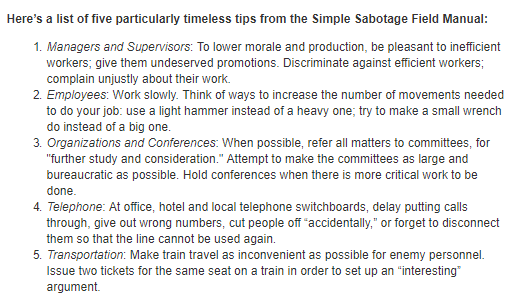
Organizations and Conferences
-
Insist on doing everything through “channels.” Never permit short-cuts to be taken in order to expedite decisions.
-
Make “speeches.” Talk as frequently as possible and at great length. Illustrate your “points” by long anecdotes and accounts of personal experiences.
-
When possible, refer all matters to committees, for “further study and consideration.” Attempt to make the committee as large as possible — never less than five.
-
Bring up irrelevant issues as frequently as possible.
-
Haggle over precise wordings of communications, minutes, resolutions.
-
Refer back to matters decided upon at the last meeting and attempt to re-open the question of the advisability of that decision.
-
Advocate “caution.” Be “reasonable” and urge your fellow-conferees to be “reasonable” and avoid haste which might result in embarrassments or difficulties later on.
Managers
-
In making work assignments, always sign out the unimportant jobs first. See that important jobs are assigned to inefficient workers.
-
Insist on perfect work in relatively unimportant products; send back for refinishing those which have the least flaw.
-
To lower morale and with it, production, be pleasant to inefficient workers; give them undeserved promotions.
-
Hold conferences when there is more critical work to be done.
-
Multiply the procedures and clearances involved in issuing instructions, pay checks, and so on. See that three people have to approve everything where one would do.
Employees
-
Work slowly
-
Work slowly.
-
Contrive as many interruptions to your work as you can.
-
Do your work poorly and blame it on bad tools, machinery, or equipment. Complain that these things are preventing you from doing your job right.
-
Never pass on your skill and experience to a new or less skillful worker.
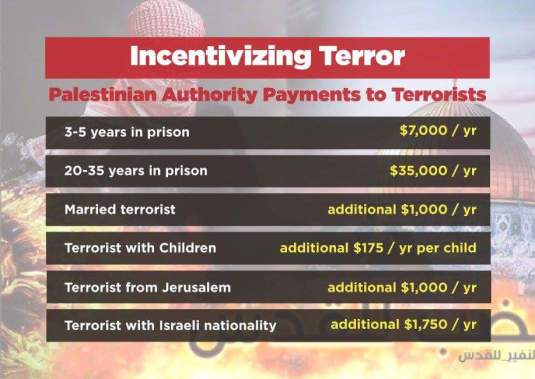
When terrorists run a country
26 Jan 2018 Leave a comment
in defence economics, economics of crime, law and economics, laws of war, war and peace Tags: Gaza Strip, Israel
How A Cargo Ship Helped Win WW2: The Liberty Ship Story
26 Jan 2018 Leave a comment
in defence economics, transport economics, war and peace Tags: World War II
 Utopia, you are standing in it!
Recent Comments