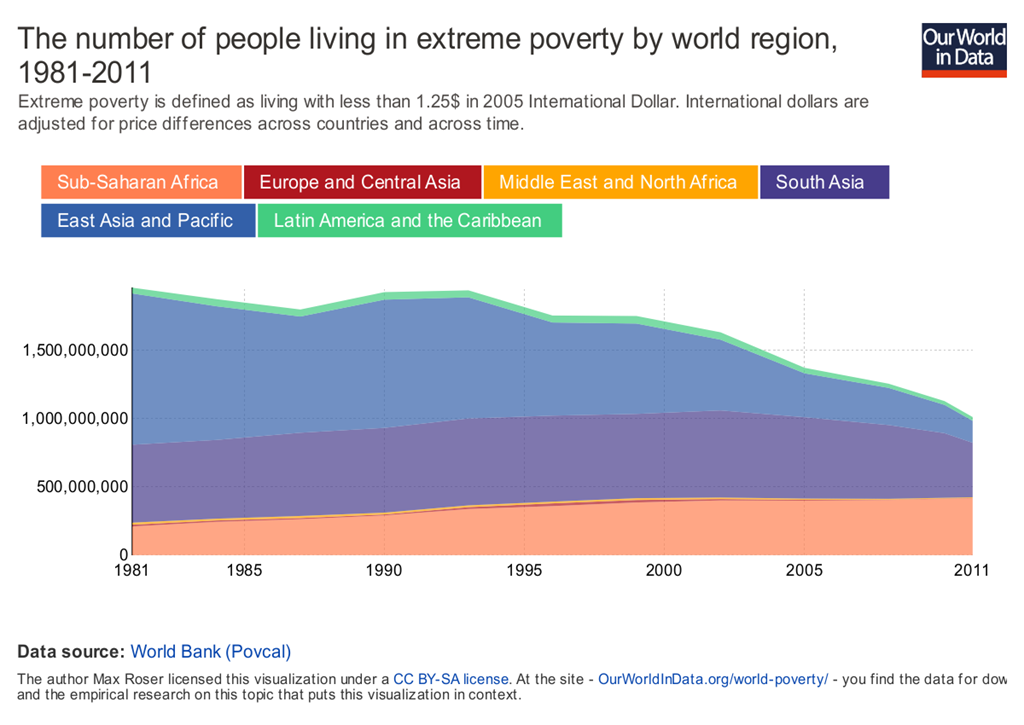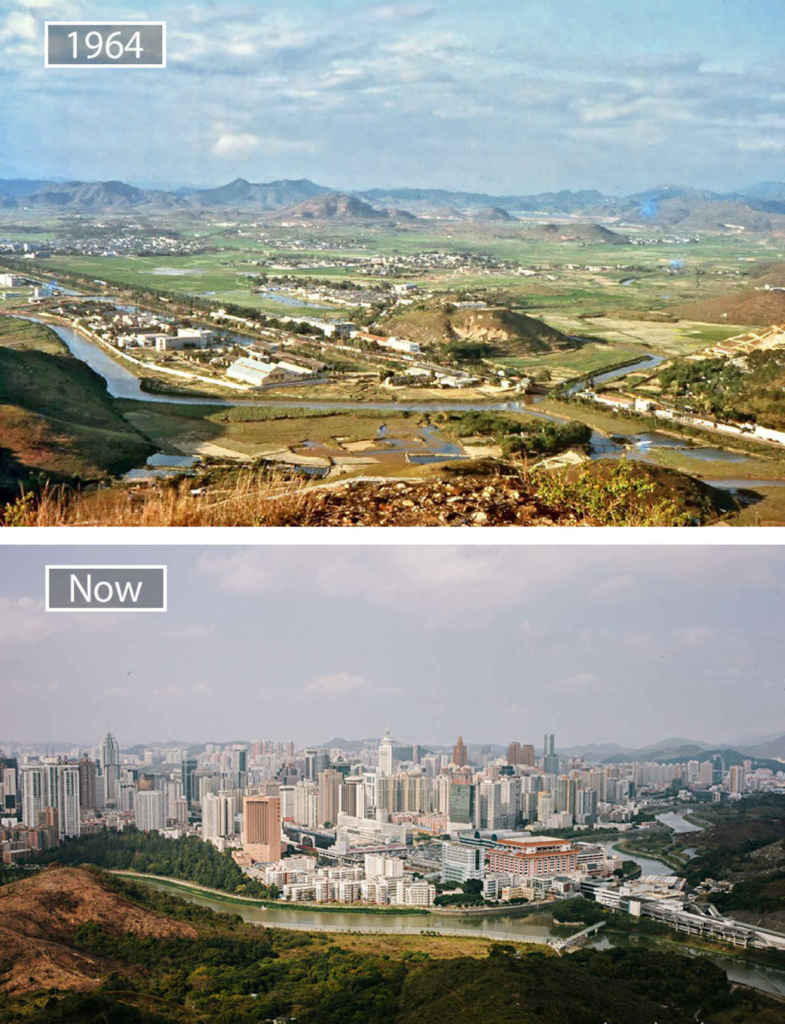
Source: Brad DeLong It’s Fidel Castro’s 90th Birthday!
Celebrating humanity's flourishing through the spread of capitalism and the rule of law
20 Aug 2016 Leave a comment
in development economics, economic history, growth disasters, Marxist economics

Source: Brad DeLong It’s Fidel Castro’s 90th Birthday!
09 Aug 2016 Leave a comment
in development economics, growth disasters, growth miracles, law and economics, property rights Tags: Brazil, doing business, Oxfam
Oxfam International managed to post a video clip blaming Brazilian poverty on inequality then tweet the same day on an important cause of poverty in developing nations. That important cause was the difficulty of establishing property rights in poor countries.
Brazil is a terrible place to start a business, register property, pay taxes and trade across borders to name but a few of many deficiencies is a business environment. Little wonder that it is poor because of all these factors that are within the remit of its government.
Source: Doing Business in Brazil – World Bank Group.
Oxfam International would serve the poor of Brazil and the rest of the Third World far better by spending more time complaining about bad business environments.
Countries that embraced capitalism such as in East Asia did far better than those in Latin America that hesitated and preferred crony capitalism.
Oxfam mislead its readers about the degree of inequality in Latin America compared to the past.
08 Aug 2016 Leave a comment
in applied price theory, applied welfare economics, comparative institutional analysis, constitutional political economy, development economics, economic history, economics of media and culture, economics of regulation, energy economics, environmental economics, global warming, growth disasters, growth miracles, health economics, politics - Australia, politics - New Zealand, Public Choice, rentseeking, technological progress Tags: Anti-Science left, anti-vaccination movement, atomic energy, Australian Greens, climate alarmism, coal, fluoridation, global warming, GMOs, New Zealand Greens, nuclear power, The Great Enrichment, The Great Escape, The Great Fact, vaccinations, vaccines
Source: Denying Problems When We Don’t Like the Solutions | Duke Today
I am not sure that the Australian Greens earn brownie points for referring to the scientific consensus on global warming as follows
Current global climate change is primarily caused by human activities contributing to increased concentrations of greenhouse gases in the atmosphere, and is already contributing to disruption of human societies through sea level rise, extreme weather events, desertification, harm to health, wellbeing and other effects. This is the overwhelming consensus of the international scientific community.
The Greens then give their opponents a free kick regarding their views on coal:and their commitment to science-based risk policy:
No new coal-fired power stations or coal mines, and no expansions to any existing power stations or mines, plus the development of programs to assist coal-dependent communities to make the transition to other more sustainable sources of economic prosperity.
There is no attempt to refer to science to justify this blanket prohibition against a specific energy source.
The views of the Australian Greens is no more science based on atomic energy:
If there is any basis in science with this blanket opposition, I am sure the Australian Greens might have mentioned it.
Do the Australian Greens refer to the scientific consensus on GMOs in their policy platform as a helpful reminder or is there just have an ever rising demand for more evidence
Unlike the New Zealand Greens, at least they do not simply reject the possibility of GMOs, the Australian Greens prefer the tactic of never being satisfied by the evidence.
The only thing I can find on the position of the Greens on fluoridation and vaccines is from a Victorian upper house MP who is half sensible on these issues. On fluoridation she says on behalf of the Greens
The Greens policy is quite clear on this. We do not have a policy for or against fluoride. Our policy supports the right of communities to determine the introduction of fluoride into local water supplies.
Not expressing the opinion on the wisdom of not putting fluoride in local water supply hardly shows a strong commitment to science-based public health policy.
On vaccines, this Victorian upper house green MP is not too bad at all:
I want to begin by stating that the Greens join health and scientific experts in absolutely supporting vaccination as a safe, proven and critical preventative health measure. The elimination of horrific diseases such as polio in Australia is testament to the incredible effectiveness and importance of vaccines…
There is also a group of people who might be called ‘hesitators’. They are not strongly opposed to vaccination, but they have heard that there might be some risks and they are thus unsure about them. These people do not perceive a strong risk of their child contracting any of the horrible diseases that immunisation prevents, so they think that on balance it might be reasonable not to vaccinate or to delay vaccination until their child is older or they simply have not yet made a decision either way. Hesitating parents may not realise that in some areas the local vaccination rate is getting well below safe levels and thus the risk of an outbreak is increasing.
This is far better than her New Zealand counterparts who do not seem to have an opinion on this vital public health issue. Indeed, the New South Wales Greens moved in the state parliament to tighten up a bill on exemptions from vaccinations.
Changes to the NSW Public Health Act in 2013 prohibited unvaccinated children from attending childcare unless their parents held “a personal, philosophical, religious or medical belief involving a conviction that vaccination under the National Immunisation Program should not take place” and they had discussed the matter with their GP”. The NSW Greens moved an amendment to remove personal, philosophical and religious beliefs as a grounds for exemption. This is one of the few times I can say something nice about a green MP.
Many on the right have their doubts about climate change science, much of which is actually delivered driven by solution aversion.They do not like the costs of the solution so they attack the rationale for it for tactical reasons. Cass Sunstein explains:
It is often said that people who don’t want to solve the problem of climate change reject the underlying science, and hence don’t think there’s any problem to solve. But consider a different possibility: Because they reject the proposed solution, they dismiss the science. If this is right, our whole picture of the politics of climate change is off.
The Left picks and chooses which scientific consensus as it accepts. The overwhelming consensus among researchers is biotech crops are safe for humans and the environment. This is a conclusion that is rejected by the very environmentalist organisations that loudly insist on the policy relevance of the scientific consensus on global warming.
What is worse is this rejection of science is not based on solution aversion; that the costs are high. It is a plain rejection of science on principle by the green left rather than for tactical reasons such as by the right on global warming.
What is more worrying is all the science that is rejected by the left will make us more prosperous. Only when the solutions make is poorer does the green left support them such as with global warming and carbon taxes.
In many ways what divides the left and right onn science is a question of values: the value placed on progress, on the Great Enrichment, on the Great Fact and on the Great Escape.
The Greens are no more than a reincarnation of the 19th century British Tory Radicals with their aristocratic sensibilities that combined strong support for centralised power with a paternalistic concern for the plight of the poor:
Many Greens think they are expressing an entirely new and progressive philosophy as they mouthed the same prejudices as Trollope’s 19th century Tory squires; attacking any further expansion of industry and commerce as impossibly vulgar, because it was
ecologically unfair to their pheasants and wild ducks.
Neither the failure of the environmental apocalypse to arrive nor the steady improvement in environmental conditions because of capitalism has dampened the ardour of those well-off enough to be eager to make hair-shirts for others to wear.
True to its 1960s origins, environmentalism is a mix of bureaucrats and hippies: a global, little-brother government that keeps the lower classes in line and a back-to-the-earth localism imposed on others but presenting no real threat to the inner city green elites’ comfortable middle class lives.
08 Aug 2016 Leave a comment
in behavioural economics, comparative institutional analysis, constitutional political economy, development economics, economic history, growth disasters, growth miracles, industrial organisation, law and economics, Public Choice Tags: industrial revolution, The Great Fact
08 Aug 2016 Leave a comment
in development economics, economic history, growth disasters, growth miracles Tags: Africa, extreme poverty, global poverty, The Great Escape
07 Aug 2016 Leave a comment
in development economics, economics, growth disasters, growth miracles Tags: India
06 Aug 2016 Leave a comment
in applied price theory, applied welfare economics, comparative institutional analysis, constitutional political economy, development economics, economic history, economics, growth disasters, growth miracles Tags: Deirdre McCloskey, The Great Enrichment, The Great Escape, The Great Fact
20 Jul 2016 Leave a comment
in defence economics, economics, growth disasters, health economics Tags: Ebola
15 Jul 2016 Leave a comment
in constitutional political economy, development economics, growth disasters, law and economics, property rights, Public Choice
08 Jul 2016 Leave a comment
in applied price theory, applied welfare economics, comparative institutional analysis, constitutional political economy, development economics, economics of bureaucracy, entrepreneurship, financial economics, growth disasters, growth miracles, industrial organisation, politics - USA, Public Choice, rentseeking, survivor principle Tags: crony capitalism, superstar wages, superstars, top 1%
04 Jul 2016 Leave a comment
in development economics, economic growth, economic history, growth disasters, growth miracles, macroeconomics Tags: The Great Escape, The Great Fact
Celebrating humanity's flourishing through the spread of capitalism and the rule of law
Scholarly commentary on law, economics, and more
Beatrice Cherrier's blog
Celebrating humanity's flourishing through the spread of capitalism and the rule of law
Why Evolution is True is a blog written by Jerry Coyne, centered on evolution and biology but also dealing with diverse topics like politics, culture, and cats.
Celebrating humanity's flourishing through the spread of capitalism and the rule of law
A rural perspective with a blue tint by Ele Ludemann
DPF's Kiwiblog - Fomenting Happy Mischief since 2003
Celebrating humanity's flourishing through the spread of capitalism and the rule of law
The world's most viewed site on global warming and climate change
Tim Harding's writings on rationality, informal logic and skepticism
A window into Doc Freiberger's library
Let's examine hard decisions!
Commentary on monetary policy in the spirit of R. G. Hawtrey
Thoughts on public policy and the media
Celebrating humanity's flourishing through the spread of capitalism and the rule of law
Politics and the economy
A blog (primarily) on Canadian and Commonwealth political history and institutions
Reading between the lines, and underneath the hype.
Economics, and such stuff as dreams are made on
"The British constitution has always been puzzling, and always will be." --Queen Elizabeth II
Celebrating humanity's flourishing through the spread of capitalism and the rule of law
WORLD WAR II, MUSIC, HISTORY, HOLOCAUST
Undisciplined scholar, recovering academic
Celebrating humanity's flourishing through the spread of capitalism and the rule of law
Res ipsa loquitur - The thing itself speaks
Celebrating humanity's flourishing through the spread of capitalism and the rule of law
Researching the House of Commons, 1832-1868
Articles and research from the History of Parliament Trust
Reflections on books and art
Posts on the History of Law, Crime, and Justice
Celebrating humanity's flourishing through the spread of capitalism and the rule of law
Exploring the Monarchs of Europe
Cutting edge science you can dice with
Small Steps Toward A Much Better World
“We do not believe any group of men adequate enough or wise enough to operate without scrutiny or without criticism. We know that the only way to avoid error is to detect it, that the only way to detect it is to be free to inquire. We know that in secrecy error undetected will flourish and subvert”. - J Robert Oppenheimer.
The truth about the great wind power fraud - we're not here to debate the wind industry, we're here to destroy it.
Celebrating humanity's flourishing through the spread of capitalism and the rule of law
Economics, public policy, monetary policy, financial regulation, with a New Zealand perspective
Celebrating humanity's flourishing through the spread of capitalism and the rule of law
Restraining Government in America and Around the World
Recent Comments