This month, there is a new case on the docket after the Supreme Court granted certiorari in Smith & Wesson Brands v. Estados Unidos Mexicanos. The First Circuit reversed a trial court that dismissed the case, alleging that the American firearms industry is legally responsible for violence in Mexico. I believe the First Circuit is […]
I’m back from my first trip to India, where I visited Mumbai, Delhi, Agra, and Amritsar. I enjoyed fine company in all four cities. In Mumbai, my new friend Sachin Aggarwal, head of the local EconTalk Club, rolled out the red carpet — and ACX Mumbai joined the festivities. (Thank you, Scott Alexander, for creating…
The Nobel prize goes to Daron Acemoglu, Simon Johnson and James Robinson for their work on institutions, prosperity, and economic growth. Here is a key piece summarizing their work: Institutions as a Fundamental Cause of Long-Run Growth. This paper develops the empirical and theoretical case that differences in economic institutions are the fundamental cause of […]
The Sveriges Riksbank Prize in Economic Sciences in Memory of Alfred Nobel 2024 has been awarded to Daron Acemoglu, Simon Johnson and James Robinson “for studies of how institutions are formed and affect prosperity.” Each year, the Nobel Committee helpfully publishes both a “Popular information” overview of of the award and a “Scientific Background” essay that goes into greater depth.…
I sometimes make the theoretical case against socialism. Usually, this means exposing the flaws of the core components of the socialist ideology. Government ownership of the means of production is a recipe for resource misallocation. Central planning has a miserable track record of failure because consumer preferences are ignored. Price controls distort incentives to make […]
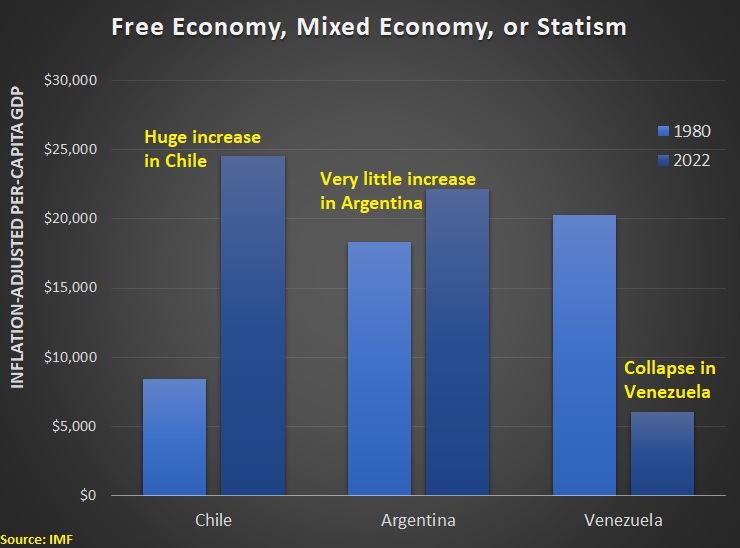
About 10 days ago, i showed that Milton Friedman was a much better economist than Joseph Stiglitz by comparing Chile (which followed Friedman’s ideas) and Venezuela (which followed Stiglitz’s ideas). It was a slam-dunk win for Friedman. Chile started poor and has become relatively prosperous. The opposite happened in Venezuela, which started relatively prosperous and […]
It’s unbelievable that the bulk of American progressive liberals and academics seems to sympathize with a group of terrorist thugs who not only invaded Israel and killed 1,139 people, many in gruesome ways, including killing women after raping them, but also took 250 hostages of various nationalities, including children, into Gaza to use as bargaining […]
By Paul Homewood h/t Dennis Ambler The latest Issue of World Coal contains a feature on India: https://issuu.com/palladianpublications/docs/worldcoal_issue2_2024/11 Unfortunately the report cannot be downloaded, but below are some of the key highlights: “As of April 2023, the Geological Survey of India reported coal reserves amounting to 378 billion tonnes. India’s coal production […]
A guest post by Lucy Rogers: Today (as of the time of writing) I saw Associate Professor Michael Mawson of the theology faculty at Auckland University advertise on Facebook an event hosting Professor Miguel De La Torre, a Cuban academic specialising in liberation theology. The event is to be held at the Maclaurin Chapel at […]
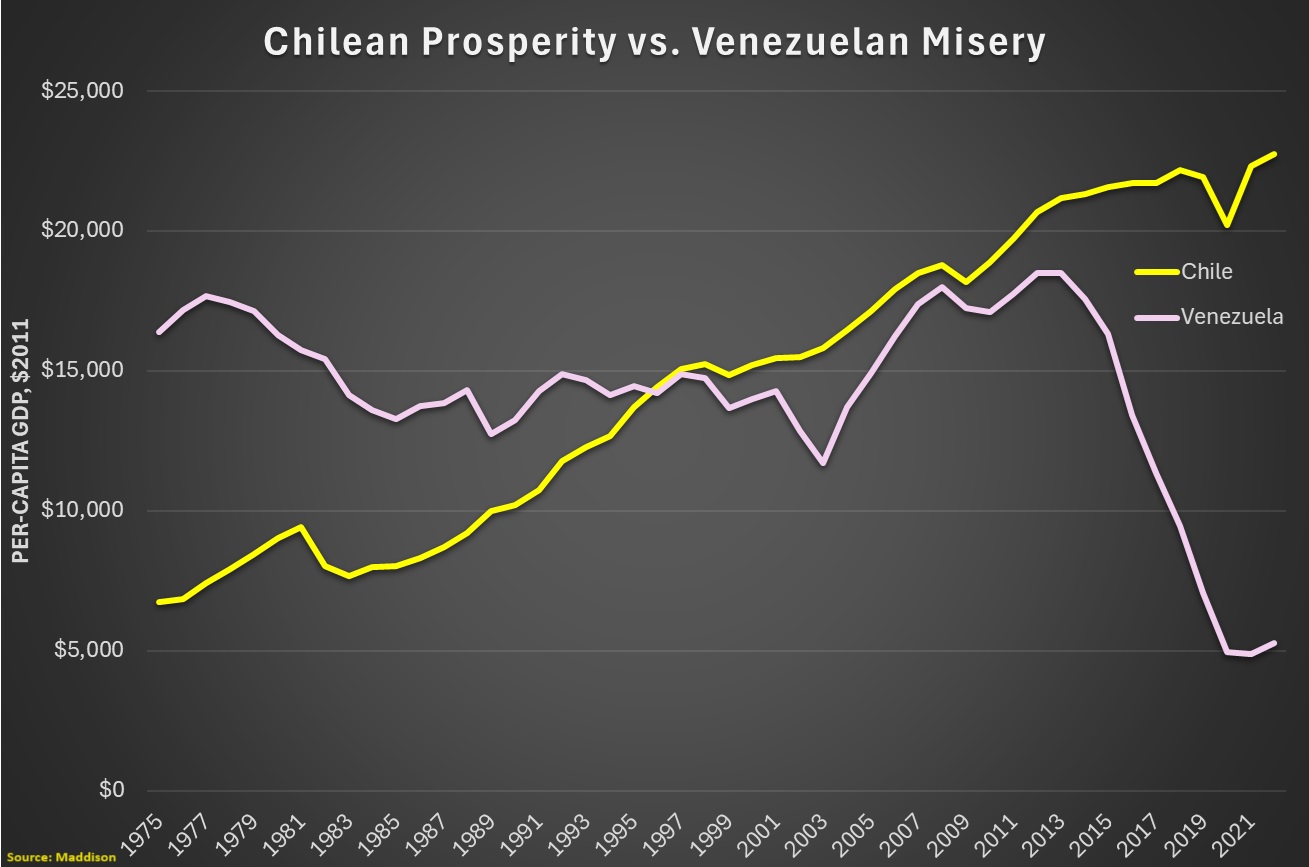
I’ve repeatedly praised Chile’s pro-market reforms (see here, here, and here) and I’ve repeatedly condemned Venezuela’s shift to socialism (see here, here, and here). But if you don’t have time to read all those columns, this chart from the Maddison database tells you everything you need to know. Simply stated, Chile’s reforms have delivered huge […]
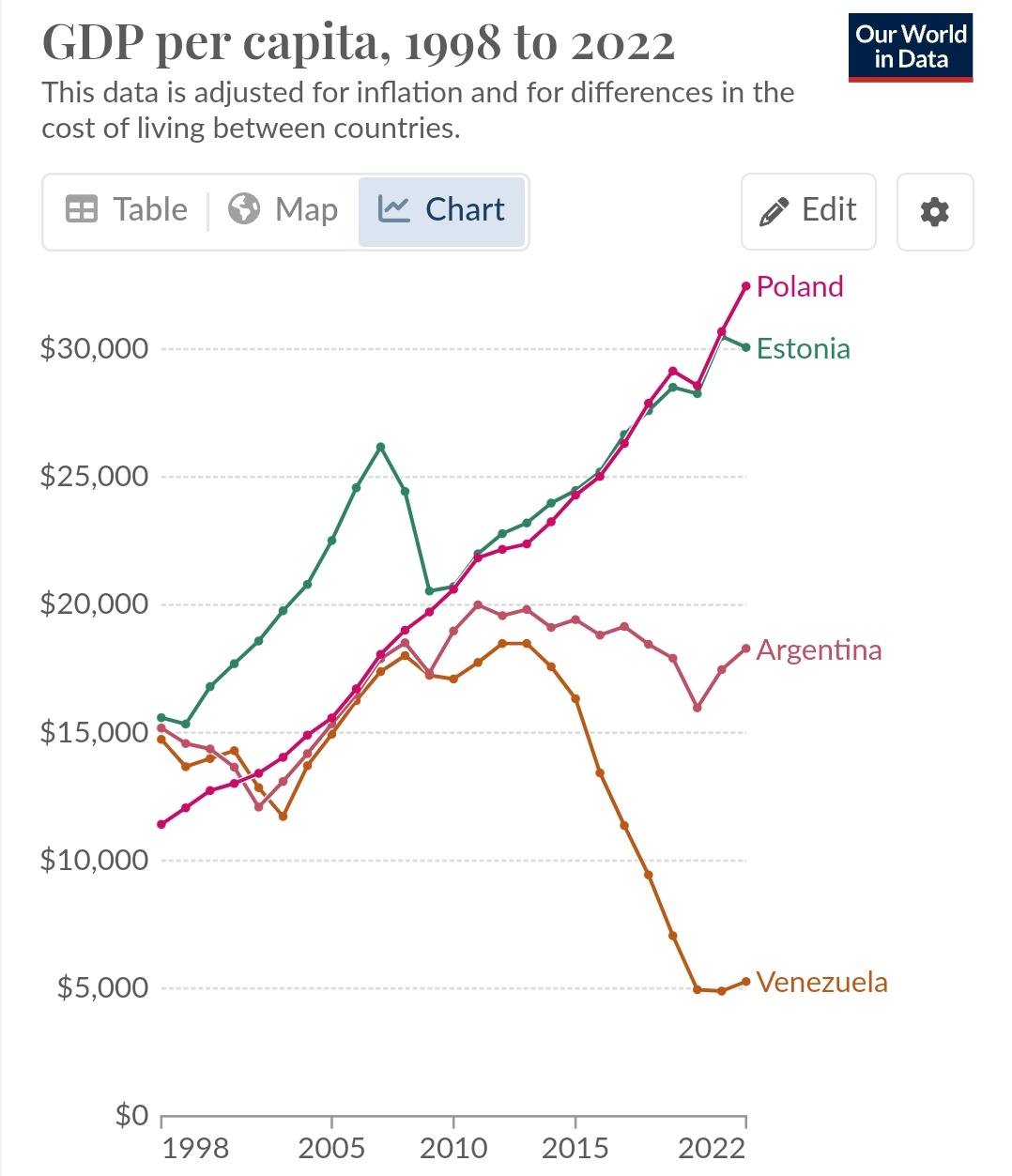
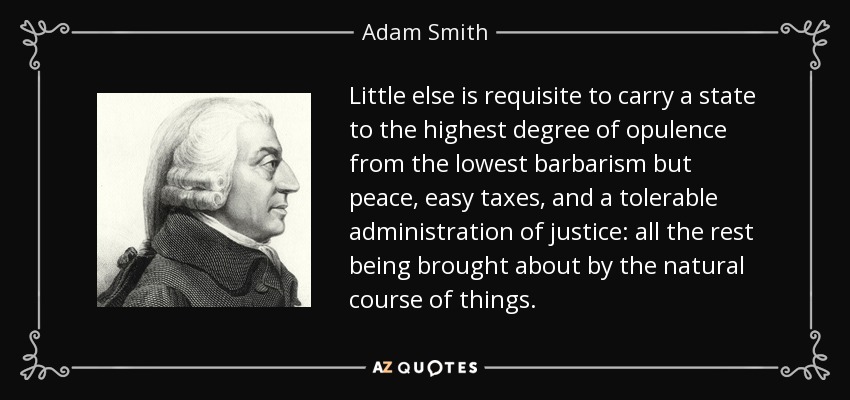
The recipe for economic growth is not complicated. You can put it in very simple terms, as Adam Smith did a few hundred years ago. Or you can develop and utilize data-heavy indexes like the ones published by the Fraser Institute and Heritage Foundation. In either case, the result will be the same. If you […]
The Miami Herald reports: A stunning 10% of Cuba’s population — more than a million people — left the island between 2022 and 2023, the head of the country’s national statistics office said during a National Assembly session Friday, the largest migration wave in Cuban history. Isn’t it such a weird coincidence that the queue […]
Jeffrey Clemens points us to some bonkers editorializing in the NYTimes coverage of the likely stolen election in Venezuela. The piece starts out reasonably enough: Venezuela’s authoritarian leader, Nicolás Maduro, was declared the winner of the country’s tumultuous presidential election early Monday, despite enormous momentum from an opposition movement that had been convinced this was […]
I’m in China this week, teaching about fiscal policy, convergence theory, and inequality at Northeastern University in Shenyang. So it’s a good opportunity to write about some pluses and minuses of Chinese economic policy. We’ll start this series by looking at demographics, which almost surely is the biggest long-run challenge for Chinese policymakers. How big […]
Why Evolution is True is a blog written by Jerry Coyne, centered on evolution and biology but also dealing with diverse topics like politics, culture, and cats.
“We do not believe any group of men adequate enough or wise enough to operate without scrutiny or without criticism. We know that the only way to avoid error is to detect it, that the only way to detect it is to be free to inquire. We know that in secrecy error undetected will flourish and subvert”. - J Robert Oppenheimer.





 Utopia, you are standing in it!
Recent Comments