
Robert Lucas interview in Brazil, 2nd November 2012
24 Jan 2015 Leave a comment
in applied welfare economics, business cycles, comparative institutional analysis, development economics, economic growth, global financial crisis (GFC), great recession, growth disasters, growth miracles, inflation targeting, macroeconomics, monetarism, Robert E. Lucas Tags: Robert E. Lucas
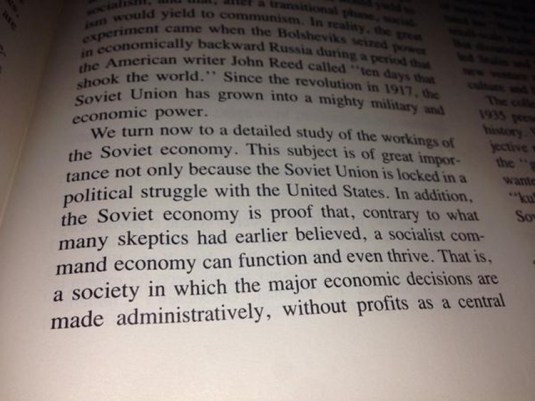
Paul Samuelson’s repeated predictions of the Soviet Union economy catching up with the USA
24 Jan 2015 1 Comment
in economic history, economics of bureaucracy, growth disasters, Marxist economics Tags: fall of communism, fall of the USSR, forecasting errors, Paul Samuelson, The fatal conceit, The pretence to knowledge
Paul Samuelson wrote in the 1961 edition of his famous economics textbook that GNP in the Soviet Union was about half that in the United States but the Soviet Union was growing faster.
Figure 1: Samuelson’s 1961 Forecast of Soviet catch up

Source: Levy and Peart (2006)
As a result, Soviet GNP would exceed that of the United States by as early as 1984 or perhaps by as late as 1997, depending on whether you were reading the early 1960s or later editions of Samuelson’s immensely popular textbook. In the 1980 edition there was little change in the analysis, though the two dates were delayed to 2002 and 2012
Samuelson predicted that the Soviet Union would catch up with the United States and kept predicting this until 1989 in every edition of his textbook of which there are at least 14. Levy and Peart were good enough to tabulate these predictions by Samuelsson of Soviet catch up with the USA over the editions of his textbook in the table below.
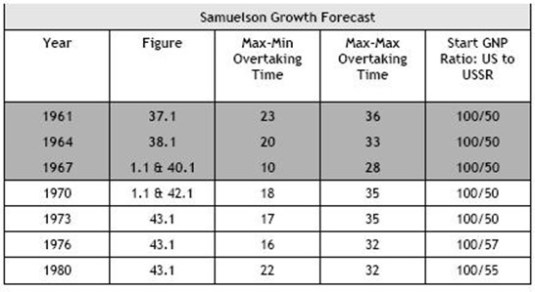
Source: Levy and Peart (2009)
Samuelson’s predictions of the Soviet Union catching up to and overtaking the United States were echoed in most other major economics textbooks of his time.
Plainly, they all got it wrong except for the Austrian economists, Eastern bloc émigrés and G. Warren Nutter.
From 1956 to 1961, Nutter undertook a massive study of the history of the economy of the Soviet Union and published The Growth of Industrial Production in the Soviet Union in 1962.
Nutter’s study concluded that Soviet economic growth over the first half of the 20th Century was indeed remarkable, and that there had been periods of growth spurts, but when the entire Soviet period was taken into consideration, Soviet growth lagged behind Western economies and Soviet economic capacity showed every sign of falling further behind rather than catching up with the West.
Nutter’s conclusions were certainly not welcomed by the Sovietologists of his time. As the fall of the Soviet Union revealed more realistic data, Nutter’s estimates of Soviet growth rates have been vindicated, and in fact, if anything Nutter overstated rather than understated Soviet economic performance.
Paul Craig Roberts found worse exaggeration with the Romanian economy in 1979. A World Bank report, Romania: The Industrialization of an Agrarian Economy under Socialist Planning, credited central planning with achieving a 9.8 annual rate of economic growth over the quarter century from 1950 to 1975. It should be added that in the 1970s, Romania was a western favourite because of its independent stance within the Eastern European bloc.
The World Bank did not realize that using these growth rates to project backward these growth figures on Romanian income per capita quickly produced a figure too low to sustain life. This mistake provoked the Wall Street Journal observation:
We have heard exaggerated claims made for central economic planning, but never that it resurrected a whole nation from the dead.
Samuelson never reflected in his later textbooks after 1989 about how wrong he was for many decades about Soviet economic performance. Few people, thank you for admitting that there you’re wrong – they are more likely to dance on the grave of your error.
In Paul Samuelson’s case, he had more reasons of most to learn from his failed predictions because as his predictions didn’t work out, he had to rewrite and update his book and charts predicting the USSR was going to overtake the USA in about 20 years.
Rather than the suspect that there something wrong with the Soviet economic system, Paul Samuelson looked for excuses – increasingly pathetic excuses. As Larry White explained:
In the seven editions of his textbook published from 1961 to 1980, Samuelson kept including a chart indicating that Soviet output was growing faster that U.S. output, and predicting a catch-up in about twenty-five years. He repeatedly had to move the predicted catch-up date forward from the previous edition because the gap had never actually begun to close. In several editions he blamed low realized Soviet growth on bad weather.
What is more puzzling is Samuelson did update his views on the merits of fiscal and monetary policy in stabilising the economy, and the effectiveness of each over the decades in light of experience and between the 1960s and 1980s. In the 1948 edition of his best-selling textbook, Economics, Samuelson wrote that:
few economists regard Federal Reserve monetary policy as a panacea for controlling the business cycle.
In 1967 Samuelson said that monetary policy had “an important influence” on total spending. His 1985 edition states;
“Money is the most powerful and useful tool that macroeconomic policymakers have,” adding that the Fed “is the most important factor” in making policy.
Samuelson’s 1967 edition said policymakers faced a trade-off between inflation and unemployment. His 1980 edition said there was less of a trade-off in the long run than in the short run. The 1985 edition, he said there is no long-run trade-off between unemployment and inflation.
Samuelson gave quite compelling reasons as to why Keynesianism declined:
- Keynesian macroeconomists and policymakers made the mistake of projecting the experience of the Great Depression onto the post-war era;
- it turned out that, contrary to what Keynes had said, monetary policy mattered a lot; and
- The final blow to Keynesianism was stagflation: There is nothing in Keynesian macroeconomics that would allow you to solve stagflation.
Samuelson did not learn in the same way from brute experience regarding the economics of socialism.
Via Why Were American Econ Textbooks So Pro-Soviet? Bryan Caplan | EconLog | Library of Economics and Liberty and Soviet Growth & American Textbooks.
On the role of R&D and boffins in lab coats in the Industrial Revolution
24 Jan 2015 Leave a comment


Eamonn Butler on how economical with the truth Oxfam was on global inequality
22 Jan 2015 Leave a comment
in development economics, growth disasters, growth miracles, income redistribution, liberalism Tags: evidence-based policy, Leftover Left, Oxfam, top 1%
Global Warming Was Worth It
22 Jan 2015 Leave a comment
in applied welfare economics, climate change, development economics, growth disasters, growth miracles, liberalism Tags: modernity, The Great Enrichment, The Great Fact

- Higher incomes that allow people to make livings that afford them more than merely survival or avoiding starvation.
- A low poverty rate.
- High quality and diversity of employment opportunities. Rather than the choice of being a farmer or being a blacksmith, the average citizen should have an array of careers to choose from, and the ability to be industrious and take risks for profit.
- The availability of housing. On an average night in the United States, a country with a population of somewhere around 350 million, fewer than one million people are homeless.
- Consistent GDP growth.
- Access to quality health care.
- The availability of quality education. (I suppose we could quibble over the word “quality,” but certainly there is widespread free education availability.)
- High life expectancy. Worldwide life expectancy has more than doubled from 1750 to 2007.
- Low frequency of deadly disease.
- Affordable goods and services.
- Infrastructure that bolsters economic growth.
- Political stability.
- Air conditioning.
- Freedom from slavery, torture and discrimination.
- Freedom of movement, religion and thought.
- The presumption of innocence under the law.
- Equality under the law regardless of gender or race.
- The right to have a family – as large as one can support. Maybe even larger.
- The right to enjoy the fruits of labor without government – or anyone else – stealing it.
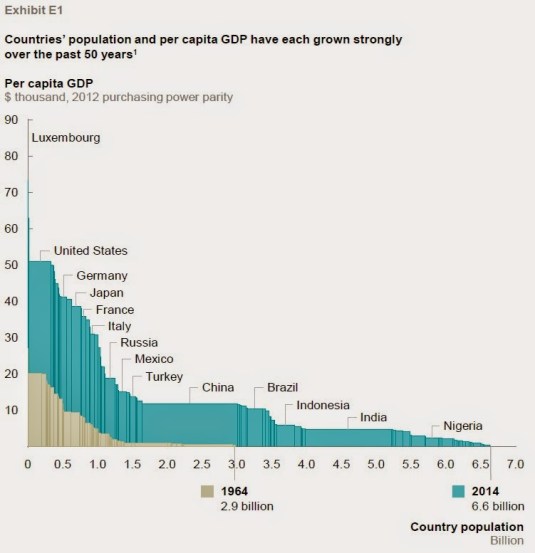
The Great Fact in one chart
21 Jan 2015 Leave a comment
in development economics, growth disasters, growth miracles, liberalism Tags: The Great Enrichment, The Great Fact
First McDonald’s in Moscow
20 Jan 2015 Leave a comment
GDP at PPP by population shares
20 Jan 2015 Leave a comment
Why World Inequality Is Falling And Not Rising
20 Jan 2015 Leave a comment
in applied welfare economics, development economics, growth disasters, growth miracles Tags: life expectancy

The regional composition of global wealth
19 Jan 2015 Leave a comment
in development economics, growth disasters, growth miracles Tags: The Great Fact
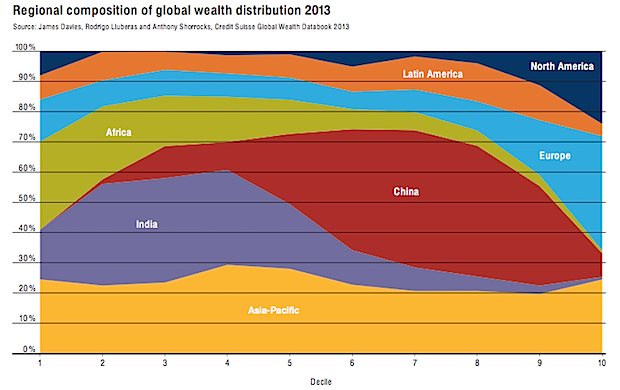
What Oxfam doesn’t want you to know: global capitalism means there’s less poverty than ever » Spectator Blogs
19 Jan 2015 Leave a comment
in development economics, growth disasters, growth miracles Tags: Leftover Left, Oxfam, The Great Escape, The Great Fact


We are, right now, living through the golden age of poverty reduction.
Anyone serious about tackling global poverty (and I’m afraid we have to exclude Oxfam from this category) has to accept that whatever we’re doing now, it’s working – so we should keep doing it.
We are literally on the road to an incredible goal: the abolition of poverty, as we know it, within our lifetime.
Those who care more about helping the poor than hurting the rich will celebrate the fact – and make sure free trade and global capitalism keep spreading so as to finish the job.
 Utopia, you are standing in it!
Recent Comments