https://twitter.com/BjornLomborg/status/593445076321312769/photo/1
@oxfamgb @GreenpeaceUSA Cooking is now one of the biggest causes for outdoor air pollution
28 Oct 2015 Leave a comment
in applied welfare economics, development economics, energy economics, environmental economics, growth disasters, growth miracles Tags: air pollution, energy poverty, indoor air pollution
A rising majority of university students around the world are women
26 Oct 2015 Leave a comment
in development economics, discrimination, economic history, economics of education, gender, growth disasters, growth miracles, human capital, labour economics Tags: College premium, compensating differentials, education premium, graduate premium, marriage and divorce, reversing gender gap
A rising majority of university students around the world are women (HT @cblatts) http://t.co/6loTmSgrk9—
William Easterly (@bill_easterly) June 15, 2015
The Great Escape and #vegetarianism
25 Oct 2015 Leave a comment
in development economics, economic history, environmental economics, growth miracles, health economics, Public Choice, rentseeking Tags: expressive politics, The Great Enrichment, The Great Escape, The Great Fact, vegetarianism
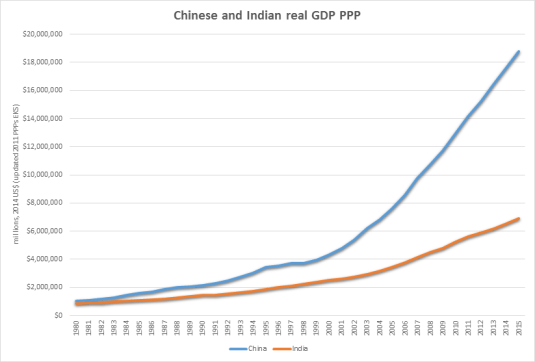
@JamilAnderlini @ft @PickardJE British & Chinese real GDP PPP @urmyes1
25 Oct 2015 Leave a comment
in development economics, economic history, growth miracles
Stunning statistic from @JamilAnderlini @ft https://t.co/Uotf5kzwlQ—
Jim Pickard (@PickardJE) October 24, 2015
Looks like it’s been another big day for breathless journalism at the Financial Times.

Source: The Conference Board. 2015. The Conference Board Total Economy Database™, May 2015, http://www.conference-board.org/data/economydatabase/

Source: The Conference Board. 2015. The Conference Board Total Economy Database™, May 2015, http://www.conference-board.org/data/economydatabase/
Angus Deaton on slow growth as a force for distributional conflict
25 Oct 2015 Leave a comment
in applied welfare economics, comparative institutional analysis, constitutional political economy, development economics, growth disasters, growth miracles, income redistribution, liberalism, Public Choice, rentseeking Tags: Angus Deaton, The Great Enrichment, The Great Escape, The Great Fact
RT @NaomiAKlein what’s changed since you left high school?
24 Oct 2015 Leave a comment
in development economics, economic history, growth miracles, Marxist economics Tags: Bill Easterly, Leftover Left, Naomi Klein, The Great Enrichment, The Great Escape, The Great Fact
.@worldbankdata allows us to see how our world has changed since 1985 #BackToTheFuture https://t.co/8t5DZDMFfz—
DFID Stats (@DFID_Stats) October 21, 2015
No matter how you measure it, the news on global poverty is great. From @EconBizFin http://t.co/qKM6suo4YO—
William Easterly (@bill_easterly) October 15, 2015
Special 5pm premiere screening in Los Angeles tonight Q&A with @avilewis & @NaomiAKlein sundancecinemas.com http://t.co/Oi4oeKoQHB—
Changes Everything (@thischanges) October 16, 2015
South Korean gender pay gap for the 10th, 50th and 90th percentile since 1985
24 Oct 2015 Leave a comment
in development economics, discrimination, economic history, economics of education, gender, growth miracles, human capital, labour economics, labour supply, occupational choice Tags: asymmetric marriage premium, compensating differentials, gender wage gap, marital division of labour, South Korea
The essence of anthropology
24 Oct 2015 Leave a comment
in development economics, economics of media and culture, growth disasters, growth miracles, personnel economics Tags: academic bias, anthropology, Noble Savage, technological diffusion, The Great Escape, The Great Fact
@zoesqwilliams has great timing on capitalism not doing enough on poverty @worstall
23 Oct 2015 Leave a comment
in development economics, economic history, growth disasters, growth miracles, Marxist economics, poverty and inequality Tags: extreme poverty, global poverty, Leftover Left, life expectancies, The Great Escape, The Great Fact, Twitter left

When Zoe Williams was born in 1973, 60% of humanity lived in extreme poverty. That has dropped to 1 in 10.
When my father was born, 7 in 10 people lived in absolute poverty.
Today, it's 1 in 10! https://t.co/1Caqku3AY1—
Tim Fernholz (@TimFernholz) October 21, 2015
Just the other day, the World Bank estimated that extreme poverty has dropped below 10% of the world’s population for the first time in human history but some are still grumbling.
What will it take to finish the “Last Mile” in ending extreme #poverty? brook.gs/1LiFT8E http://t.co/YxSZ36VCSW—
Brookings (@BrookingsInst) October 07, 2015
Zoe Williams is not grumbling about the failed states and predatory government responsible for the last pockets of extreme poverty, but about the inequality from economic progress under capitalism.
The extreme poor live in conflict & rural areas: wrld.bg/Nynge #endpoverty http://t.co/43HDDI11JR—
World Bank (@WorldBank) May 31, 2015
Zoe Williams honestly believes that extreme poverty could have been reduced faster if we had taken on the socialist road.
These 4 nations are 50% of mankind. That's 3.5 billion people who are living longer. buff.ly/1Kle6mU #health http://t.co/949oqisMsL—
HumanProgress.org (@humanprogress) June 30, 2015
China and India escaped from extreme poverty by rejecting socialism.
Just released: new global poverty estimates from 1990-2015 using updated extreme poverty line http://t.co/LxD5q2n6Mg—
Laurence Chandy (@laurencechandy) October 04, 2015
China and India received next to no overseas development assistance in their Great Escape from extreme poverty.
Embrace the free market and overtake your socialist competitors. buff.ly/1PZ3yuN http://t.co/xfpF4vtqlv—
HumanProgress.org (@humanprogress) October 05, 2015
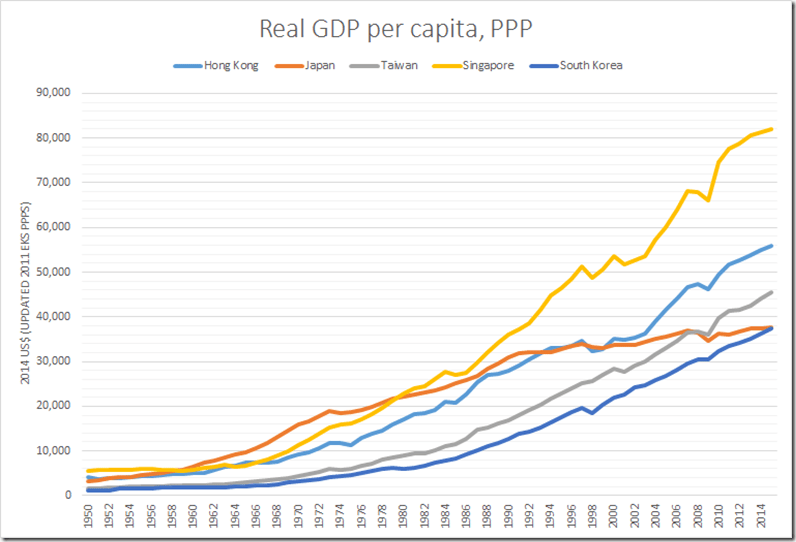
There’s been some clear-cut natural experiments such as between Chile and Venezuela and Japan, Hong Kong, Singapore and just about any other developing country in terms of capitalism as the only path to prosperity.
@oxfamnz 80% of the world lived in extreme poverty when my father was born
23 Oct 2015 Leave a comment
When my father was born, 7 in 10 people lived in absolute poverty.
Today, it's 1 in 10! https://t.co/1Caqku3AY1—
Tim Fernholz (@TimFernholz) October 21, 2015
Number living <$1.90/day in the 10 countries w/ largest extreme poor populations. using new @WorldBank #data @oxfam http://t.co/YQm8XSVpfK—
Nick Galasso (@vngalasso) October 19, 2015
The Global Middle Class Is Kind of Poor. Amazing graphic. buff.ly/1I5FDbz http://t.co/QB6maF7X2n—
Nick Galasso (@vngalasso) July 16, 2015
And people say I'm pessimistic! Is this the most important graph on the economic history of the world? HT @MaxCRoser http://t.co/pawcLOSadv—
Nick Galasso (@vngalasso) June 22, 2015
.@TheEconomist Great graph! Global #inequality to fall; what about within country #inequality? buff.ly/1c74E95 http://t.co/QTufMdR4om—
Nick Galasso (@vngalasso) May 21, 2015
Inequality has actually been falling in a lot of the world … but not in the U.S. washingtonpost.com/news/wonkblog/… https://t.co/VjnO8D6RQQ—
Matt O'Brien (@ObsoleteDogma) October 22, 2015

The official salaries of African presidents
22 Oct 2015 Leave a comment
in development economics, economics of crime, growth disasters, growth miracles, law and economics Tags: Africa, bribery and corruption
What African Presidents Make (Officially) http://t.co/X3F0j5DYHG—
ian bremmer (@ianbremmer) July 23, 2015
Are @vngalasso @OxfamAmerica @dpaulobrien Great Escape deniers? @WhitefordPeter
21 Oct 2015 Leave a comment
in development economics, economic history, growth miracles Tags: Leftover Left, life expectancy, The Great Escape, The Great Fact, Twitter left
https://twitter.com/MaxCRoser/status/656144668468641793
In 1800 there was no country with a life expectancy over 40.
bit.ly/1C8oCsK http://t.co/Ow7gE4F1qL—
Max Roser (@MaxCRoser) October 19, 2015
From my project: bit.ly/1IfQSjg
Huge progress in education in #Africa between 1950 and 2010! https://t.co/oipFNpPTqy—
Max Roser (@MaxCRoser) October 20, 2015
When more infants survive the birth rate goes down.
From: ourworldindata.org/data/populatio… https://t.co/zIZ1jNc1w5—
Max Roser (@MaxCRoser) October 20, 2015
A Graph for Pope Francis: If You Want to Help the Poor, You Should Embrace Capitalism. Exhibit A: See Chart http://t.co/yG1ixKZxrJ—
Mark J. Perry (@Mark_J_Perry) September 21, 2015
Technology diffusion to underdeveloped countries is quickening
20 Oct 2015 Leave a comment
in development economics, growth disasters, growth miracles Tags: creative destruction, international technology diffusion, technology diffusion
pace of diffusion of digital technologies in the developing world far exceeds growth in access to basic services http://t.co/Kig46T713M—
Laurence Chandy (@laurencechandy) May 20, 2015
Chinese & Indian female life expectancies as a sign of broad-based economic growth
20 Oct 2015 Leave a comment
in development economics, economic history, growth miracles, health economics
In the last 20 years in India, life expectancy at birth increased by 10 years. The same in China. There were increases in Chinese and Indian life expectancies across all age bands.

The difference between the two countries is the low base in India which was 58 years versus 70 years in China for life expectancy at birth. Obviously, recovering from the Permit Raj has been a bit of a struggle for socialist India. Either way, such a rapid increase in life expectancy in India and China suggests broad-based economic growth in the last 20 years.

If you look at China and India over the longer term and compare it with capitalism, again the socialist solution comes up short. The initial improvements in life expectancies in India and China in the mid-20th century were simply curing of endemic diseases and childhood illnesses. Hong Kong and Macau were miles ahead of China until China took the capitalist road.

Source: Cleo Infra.
In the 10 years from 2000, China close that gap in female life expectancies of birth through the blessings of capitalism but not as much freedom as we might have hoped. That said, if you stay out of politics in China, you can run a business, raise a family and travel and study abroad. China is now a tin-pot dictatorship rather than a totalitarian dictatorship. That’s a major improvement.
The differences in Hong Kong and Macau life expectancies is also a good measure of the advantages of being colonised by the British rather than the Portuguese.

Recent Comments