

via Default and Lost Opportunities: A Message from Argentina for Euro-Zone Countries – Dallas Fed.
Celebrating humanity's flourishing through the spread of capitalism and the rule of law
22 Feb 2015 Leave a comment
in applied welfare economics, development economics, economic history, growth disasters, growth miracles, international economics Tags: Argentina, sovereign defaults
21 Feb 2015 Leave a comment
in development economics, growth disasters, growth miracles Tags: overseas development assistance
19 Feb 2015 Leave a comment
in Austrian economics, development economics, economic history, economics of media and culture, growth miracles, industrial organisation Tags: China, transitional economies

Use of the word “communal” rose sharply during the Cultural Revolution, especially from 1970 to 1976; it decreased during the 1980s. (China launched economic reforms in 1978, and they continue to this day.)
The word “autonomy” was used just one-third as frequently as “obedience” in 1970. In 2008, the ratio had flipped and “autonomy” appeared three times as much as “obedience.”
The increase in use of words like “choose,” “compete,” “private,” “autonomy” and “innovation” demonstrated a growing prevalence of individualistic values coinciding with sharp rises in urban population, household consumption and education levels.
Words reflecting communal values, such as “help” and “sacrifice,” declined in frequency.
via Words used in Chinese books illuminate how a nation’s values changed during economic reforms | UCLA.
18 Feb 2015 Leave a comment
in development economics, economics of media and culture, growth miracles Tags: GMOs
17 Feb 2015 Leave a comment
16 Feb 2015 Leave a comment
in development economics, growth miracles Tags: Asian Tigers, Japan

Source: Edward Prescott
16 Feb 2015 Leave a comment

15 Feb 2015 Leave a comment
in development economics, economic history, growth disasters, growth miracles Tags: The Great Enrichment, The Great Escape, The Great Fact

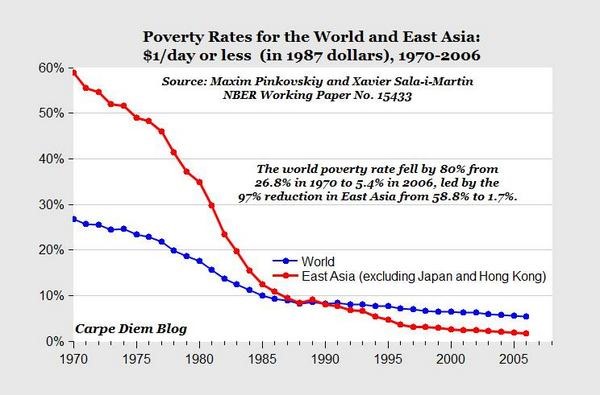
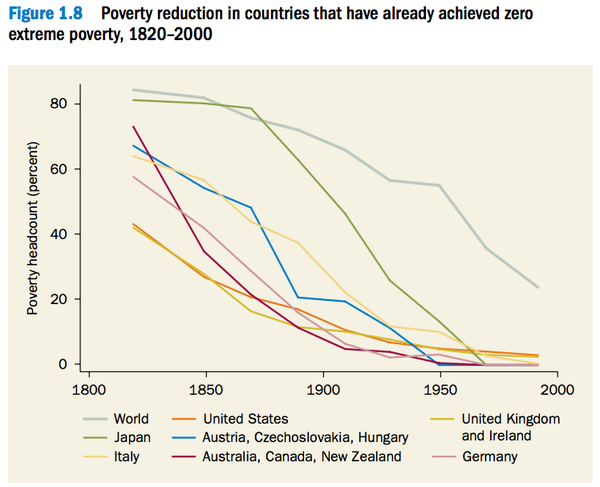
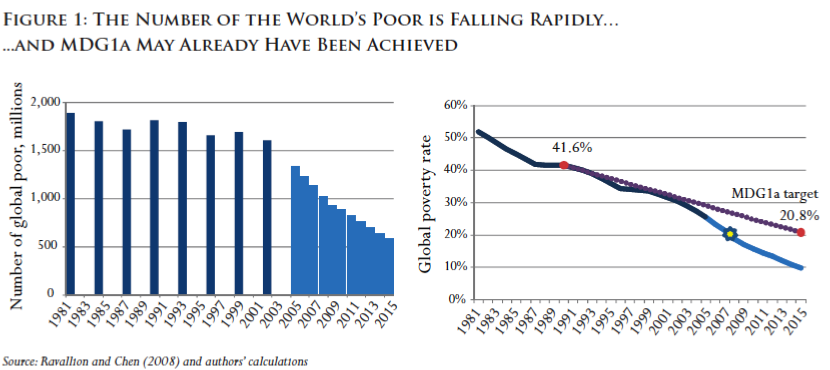
The World Bank reported on Oct. 9 that the share of the world population living in extreme poverty had fallen to 15% in 2011 from 36% in 1990. Earlier this year, the International Labor Office reported that the number of workers in the world earning less than $1.25 a day has fallen to 375 million 2013 from 811 million in 1991.
Such stunning news seems to have escaped public notice, but it means something extraordinary: The past 25 years have witnessed the greatest reduction in global poverty in the history of the world.
To what should this be attributed? Official organizations noting the trend have tended to waffle, but let’s be blunt: The credit goes to the spread of capitalism. Over the past few decades, developing countries have embraced economic-policy reforms that have cleared the way for private enterprise.
The reduction in world poverty has attracted little attention because it runs against the narrative pushed by those hostile to capitalism. The Michael Moores of the world portray capitalism as a degrading system in which the rich get richer and the poor get poorer. Yet thanks to growth in the developing world, world-wide income inequality—measured across countries and individual people—is falling, not rising, as Branco Milanovic of City University of New York and other researchers have shown.
Capitalism’s bad rap grew out of a false analogy that linked the term with “exploitation.” Marxists thought the old economic system in which landlords exploited peasants (feudalism) was being replaced by a new economic system in which capital owners exploited industrial workers (capitalism). But Adam Smith had earlier provided a more accurate description of the economy: a “commercial society.” The poorest parts of the world are precisely those that are cut off from the world of markets and commerce, often because of government policies.
Douglas Irwin
08 Feb 2015 Leave a comment
in comparative institutional analysis, development economics, growth disasters, growth miracles, politics - USA Tags: Chile, Costa Rica, Cuba
05 Feb 2015 Leave a comment
in development economics, growth disasters, growth miracles, health economics Tags: infant mortality, life expectancy, The Great Escape

HT: Alex Epstein
03 Feb 2015 Leave a comment
in development economics, growth miracles Tags: capitalism and freedom, millennium development goals, The Age of Milton Friedman, The Great Fact
Celebrating humanity's flourishing through the spread of capitalism and the rule of law
Scholarly commentary on law, economics, and more
Beatrice Cherrier's blog
Celebrating humanity's flourishing through the spread of capitalism and the rule of law
Celebrating humanity's flourishing through the spread of capitalism and the rule of law
Celebrating humanity's flourishing through the spread of capitalism and the rule of law
Why Evolution is True is a blog written by Jerry Coyne, centered on evolution and biology but also dealing with diverse topics like politics, culture, and cats.
Celebrating humanity's flourishing through the spread of capitalism and the rule of law
Celebrating humanity's flourishing through the spread of capitalism and the rule of law
A rural perspective with a blue tint by Ele Ludemann
DPF's Kiwiblog - Fomenting Happy Mischief since 2003
Celebrating humanity's flourishing through the spread of capitalism and the rule of law
The world's most viewed site on global warming and climate change
Tim Harding's writings on rationality, informal logic and skepticism
A window into Doc Freiberger's library
Let's examine hard decisions!
Commentary on monetary policy in the spirit of R. G. Hawtrey
Thoughts on public policy and the media
Celebrating humanity's flourishing through the spread of capitalism and the rule of law
Politics and the economy
A blog (primarily) on Canadian and Commonwealth political history and institutions
Reading between the lines, and underneath the hype.
Economics, and such stuff as dreams are made on
"The British constitution has always been puzzling, and always will be." --Queen Elizabeth II
Celebrating humanity's flourishing through the spread of capitalism and the rule of law
Celebrating humanity's flourishing through the spread of capitalism and the rule of law
WORLD WAR II, MUSIC, HISTORY, HOLOCAUST
Undisciplined scholar, recovering academic
Celebrating humanity's flourishing through the spread of capitalism and the rule of law
Res ipsa loquitur - The thing itself speaks
In Hume’s spirit, I will attempt to serve as an ambassador from my world of economics, and help in “finding topics of conversation fit for the entertainment of rational creatures.”
Researching the House of Commons, 1832-1868
Articles and research from the History of Parliament Trust
Reflections on books and art
Posts on the History of Law, Crime, and Justice
Celebrating humanity's flourishing through the spread of capitalism and the rule of law
Exploring the Monarchs of Europe
Cutting edge science you can dice with
Small Steps Toward A Much Better World
“We do not believe any group of men adequate enough or wise enough to operate without scrutiny or without criticism. We know that the only way to avoid error is to detect it, that the only way to detect it is to be free to inquire. We know that in secrecy error undetected will flourish and subvert”. - J Robert Oppenheimer.
The truth about the great wind power fraud - we're not here to debate the wind industry, we're here to destroy it.
Celebrating humanity's flourishing through the spread of capitalism and the rule of law
Celebrating humanity's flourishing through the spread of capitalism and the rule of law
Economics, public policy, monetary policy, financial regulation, with a New Zealand perspective
Celebrating humanity's flourishing through the spread of capitalism and the rule of law
Restraining Government in America and Around the World



 Utopia, you are standing in it!
Recent Comments