
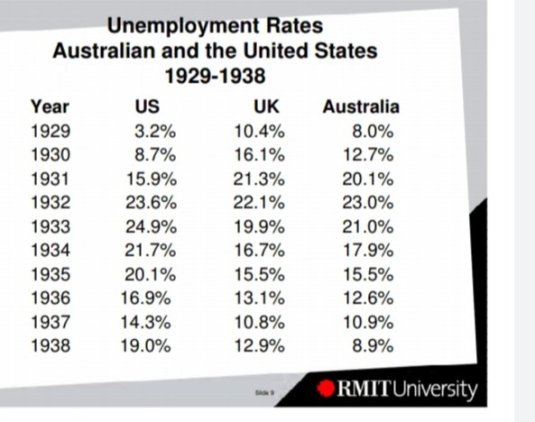
Great depression unemployment rates
30 Apr 2020 Leave a comment
in business cycles, economic growth, economic history, fiscal policy, great depression, labour economics, labour supply, macroeconomics, monetary economics, public economics, unemployment Tags: Keynesian macroeconomics
Source Sinclair Davidson

Do economists ignore the impact of debt on the business cycle?
29 Apr 2020 Leave a comment
in business cycles, economic history, financial economics, global financial crisis (GFC), great depression, great recession, history of economic thought, macroeconomics, monetarism, monetary economics Tags: Keynesian macroeconomics, New Keynesian macroeconomics

Edward Prescott on the unimportance of monetary policy
29 Apr 2020 Leave a comment
in business cycles, economic history, Edward Prescott, financial economics, fiscal policy, global financial crisis (GFC), great depression, great recession, history of economic thought, macroeconomics, monetary economics
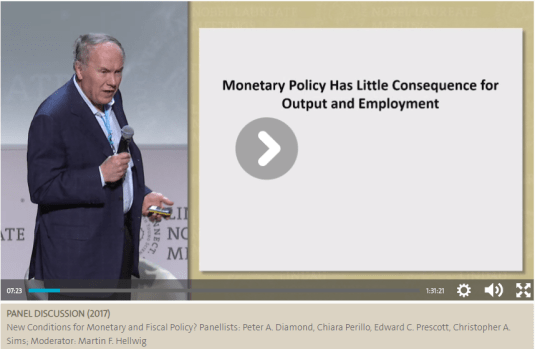
See lecture at https://www.mediatheque.lindau-nobel.org/videos/37267/panel-conditions-monetary-fiscal-policy/laureate-prescott
Edward Prescott, co-recipient of the Nobel Prize in 2004, took a different view in a presentation with the title ‘The Unimportance of Monetary Policy and Financial Crises on Output and Unemployment’. He cited financial crises that saw countries experiencing contrasting outcomes at the same time: the US and Asia in the 2008 crisis; Chile and Mexico in 1980; and Scandinavia and Japan in 1992.
‘Financial crises do not impede development,’ he claimed. While the 2008 financial crisis was localised in North America and the euro area, there was a short recession and quick recovery in Japan, Taiwan and South Korea and no recession in Scandinavia and Australia. ‘Countries where fiscal policy was irresponsible had problems’, he maintained. ‘Fiscal responsibility is crucial: to spend is to tax and to tax is to depress. That’s what happens every time.’
Edward C. Prescott on monetary policy
28 Apr 2020 Leave a comment
in business cycles, econometerics, economic history, Edward Prescott, financial economics, global financial crisis (GFC), great depression, great recession, inflation targeting, macroeconomics, monetary economics, Robert E. Lucas Tags: monetary policy
Anarchy and the Efficient Law, Part 1 | David Friedman
28 Apr 2020 Leave a comment
in comparative institutional analysis, constitutional political economy, David Friedman, economic history, economics of crime, law and economics, property rights, Public Choice Tags: economics of anarchy
The Destabilizing Consequences of Central Banking
27 Apr 2020 Leave a comment
in Austrian economics, business cycles, economic history, financial economics, macroeconomics, monetary economics Tags: economics of banking, free banking, monetary policy
PRC Forum: Gary Becker
26 Apr 2020 Leave a comment
in applied price theory, applied welfare economics, comparative institutional analysis, economic history, Gary Becker
Can the Free Market End Global Poverty? Joseph Stiglitz vs. William Easterly
26 Apr 2020 Leave a comment
in Bill Easterly, comparative institutional analysis, constitutional political economy, development economics, economic history, economics of bureaucracy, economics of education, economics of regulation, growth disasters, growth miracles, history of economic thought, income redistribution, industrial organisation, labour economics, law and economics, P.T. Bauer, privatisation, property rights, Public Choice, public economics, rentseeking, survivor principle Tags: The Great Enrichment, The Great Escape
The Fall Of The Business Suit
25 Apr 2020 Leave a comment
in economic history, economics of media and culture
Is @BernieSanders right? Is there a difference between socialism and communism?
24 Apr 2020 Leave a comment
in applied price theory, applied welfare economics, Austrian economics, comparative institutional analysis, constitutional political economy, development economics, economic history, economics of bureaucracy, economics of regulation, growth disasters, income redistribution, industrial organisation, labour economics, labour supply, law and economics, liberalism, libertarianism, Marxist economics, privatisation, property rights, Public Choice, rentseeking, survivor principle Tags: economics of central planning, fall of communism, regressive left, The fatal conceit
 Utopia, you are standing in it!
Recent Comments