
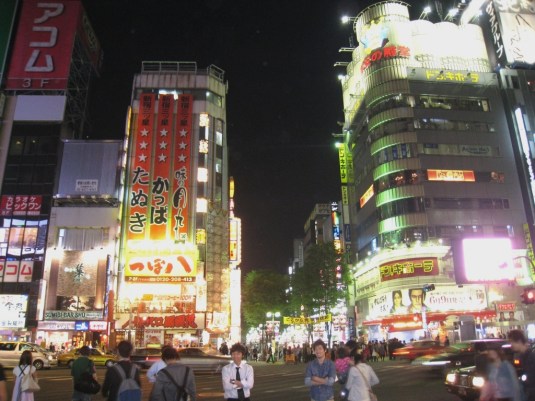
Mega-cities are the most beautiful sight in the world: Shinjuku train station by night
07 Oct 2014 Leave a comment
in economic history, economics of media and culture, liberalism, movies Tags: Blade Runner, Shinjuku, The Great Enrichment, Tokyo
The first time I walked out of the gate of Shinjuku train station the night I arrived in Tokyo in 1993, I thought I had walked into a scene from Blade Runner.
Tokyo is one of the most beautiful cities the world. It’s full of people doing the most amazing things, producing an immense amount of wealth and prosperity. Cities are as beautiful as any natural beauty, more so because they are man-made.



This isn't an outtake from Blade Runner—it's Beijing today. via @punodraws @TomHoltzPaleo @b0yle http://t.co/QHMxSunUAL—
Amos Zeeberg (@settostun) January 14, 2015
Barriers to entry alert: do late entrants have a chance
22 Sep 2014 Leave a comment
in applied price theory, Austrian economics, economic history, entrepreneurship, industrial organisation, liberalism, technological progress Tags: Austrian economics, barriers to entry, creative destruction, Israel Kirzner, market process
September 21, 1999 – Google came out of beta; the 17th search engine to officially enter the market.

Kirzner defines a competitive market as a market where no potential participant faces non-market obstacles to entry:
Following a long tradition in economics going back at least to Adam Smith, Austrians define a competitive market not as a situation where no participant or potential participant has the power to make any difference, but as a market where no potential participant faces nonmarket obstacles to entry.
(The adjective “nonmarket” refers, primarily, to government obstacles to entry; it is used to differentiate such obstacles from, for example, high production costs that might discourage entry. These latter do not constitute noncompetitive elements in a market; to be able to enter means to be able to enter a market if one judges such entry to be economically promising-it does not mean to be able to enter without having to bear the relevant costs of production.) That is, a situation is competitive if no incumbent participant possesses privileges that protect him against the possible entry of new competitors.
The achievements that free markets are able to attain depend, in the Austrian view, on freedom of entry, that is, on the absence of privilege.

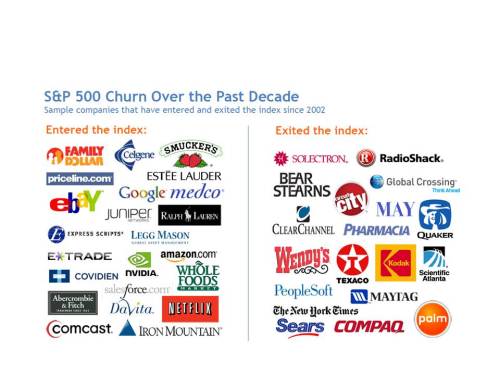
Corporate life spans| Uneasy Money
20 Jun 2014 Leave a comment

What the experiments of the 20th century told me
14 Jun 2014 Leave a comment
in applied price theory, comparative institutional analysis, development economics, economic history Tags: Deirdre McCloskey, The Great Enrichment, The Great Fact

It would have been hard to know the wisdom of Friedrich Hayek or Milton Friedman or Matt Ridley or Deirdre McCloskey in August of 1914, before the experiments in large government were well begun.
But anyone who after the 20th century still thinks that thoroughgoing socialism, nationalism, imperialism, mobilization, central planning, regulation, zoning, price controls, tax policy, labour unions, business cartels, government spending, intrusive policing, adventurism in foreign policy, faith in entangling religion and politics, or most of the other thoroughgoing 19th-century proposals for governmental action are still neat, harmless ideas for improving our lives is not paying attention.
How does a free press emerge through the market process?
10 Jun 2014 Leave a comment
in economic history, economics of media and culture, industrial organisation, market efficiency, survivor principle Tags: competition as a discovery process, Free press

For much of the 19th century U.S. newspapers were public relations tools funded by politicians. Information hostile to a paper’s political views were ignored or dismissed as sophistry. Newspaper independence was rare. Fraud and corruption in 19th century America approached today’s more corrupt developing nations.
The newspaper industry underwent fundamental changes between 1870 and 1920 as the press became more informative and less partisan.
– 11 per cent of urban dailies were independent in 1870,
– 62 per cent were in 1920.
The rise of the informative press was the result of increased scale and competitiveness in the newspaper industry caused by technological progress in the newsprint and newspaper industries.
• From 1870 to 1920, when corruption appears to have declined significantly within the United States, the press became more informative, less partisan, and expanded circulation considerably.
• By the 1920s, the partisan papers no longer coupled allegations of the corruption of their party members with condemnation of the character of the person making the charge.
A reasonable hypothesis is rise of the informative press was one of the reasons why the corruption of the Gilded Age was sharply reduced during the Progressive Era.
A supply-side model suggesting that newspapers weigh the rewards of bias—politicians’ bribes or personal pleasure—against the cost of bias—lost circulation from providing faulty news.
The key predictions of the model are that, as the size of the market for newspapers rises, and as the marginal cost of producing a paper falls, newspapers will become less biased and invest more in gathering information.
Corruption declined because media proprietors discovered that they could maintain and boost circulation by exposing it. An independent press which kept a watchful eye over government and business was a spontaneous order that was a by-product of rising incomes and literacy of readers.
Politicians did not help the process along. Technological innovations and increased city populations caused a huge increase in scale.
Newspapers become big businesses; they increased readership and revenue by presenting factual and informative news. It is not from the benevolence of the butcher, the brewer, or the baker that we expect our dinner, it is from their high regard to their own interest.
Following these incentives, newspapers changed from political tools to impartial reporting. Those newspapers that did not did not survive in competition.
HT: The Rise of the Fourth Estate: How Newspapers Became Informative and Why It Mattered by Matthew Gentzkow, Edward L. Glaeser, and Claudia Goldin in Corruption and Reform: Lessons from America’s Economic History (2006).
The great enrichment – Deirdre McCloskey’s 2013 John Bonython lecture on ABC Radio
06 Jun 2014 1 Comment
in development economics, economic history, growth miracles, history of economic thought Tags: Deirdre McCloskey, The Great Enrichment, The Great Escape, The Great Fact, The Industrial Revolution
Capitalism has raised living standards worldwide by a thousand fold. Societies that respect innovation and entrepreneurship can expect more of the same.
In the space of just a couple of hundred years real incomes and living standards have risen dramatically. From peasantry to prosperity – how did it happen ?
According to McCloskey in her 2013 John Bonython lecture presented by the Centre for Independent Studies, it was ideological change, rather than saving or exploitation, that created this prosperous modern world.
McCloskey proclaims “it’s OK to be in business” and asks those critical of capitalism to re-think their opposition.
Business and enterprise, she suggests, is altruistic, cooperative and the best way to lift living standards in developing and emerging economies.
In a marvellous speech in India on the origins of economic freedom (and its subsequent fruits), Deirdre McCloskey aptly crystallizes the deeper implications of her work on bourgeois virtues and bourgeois dignity:
The leading Bollywood films changed their heroes from the 1950s to the 1980s from bureaucrats to businesspeople, and their villains from factory owners to policemen, in parallel with a similar shift in the ratio of praise for market-tested improvement and supply in the editorial pages of The Times of India…
Did the change from hatred to admiration of market-tested improvement and supply make possible the Singh Reforms after 1991?
Without some change in ideology Singh would not in a democracy have been able to liberalize the Indian economy…
…After 1991 and Singh much of the culture didn’t change, and probably won’t change much in future.
Economic growth does not need to make people European.
Unlike the British, Indians in 2030 will probably still give offerings to Lakshmi and the son of Gauri, as they did in 1947 and 1991.
Unlike the Germans, they will still play cricket, rather well.
So it’s not deep “culture.” It’s sociology, rhetoric, ethics, how people talk about each other.


Recent Comments