Understanding Fiscal Inflation — Keynote Speech by Eric Leeper
22 Nov 2023 Leave a comment
in budget deficits, business cycles, economic growth, economic history, fiscal policy, global financial crisis (GFC), great depression, great recession, history of economic thought, inflation targeting, macroeconomics, monetary economics Tags: monetary policy
A Libertarian Landslide in Argentina
21 Nov 2023 Leave a comment
in development economics, economic history, growth disasters, liberalism, libertarianism, macroeconomics, Marxist economics, monetary economics Tags: Argentina, dollarisation
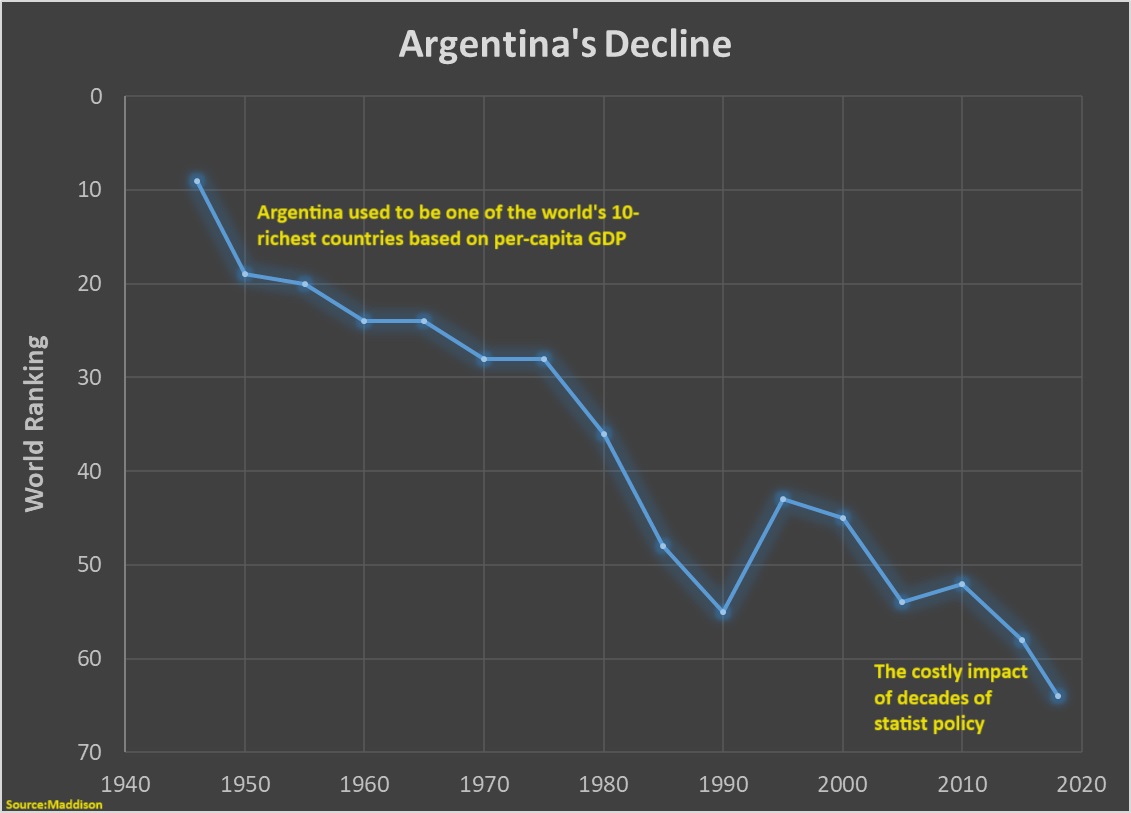
After a libertarian candidate took first place in Argentina’s presidential primary back in August, I wrote that the runoff would be the most important election of 2023 (even more important than the fortunately failed referendum to weaken TABOR in Colorado). Amazingly, Argentinian voters opted for the libertarian by a strong 56-44 margin. To understand President-Elect […]
A Libertarian Landslide in Argentina
South Africa’s Economy: 30 Years Since Apartheid
21 Nov 2023 Leave a comment
in development economics, economic history, growth disasters Tags: South Africa

In April 1994, almost 30 years ago, Nelson Mandela was elected as the first black president of South Africa. The hopes at the time went beyond developing a representative political process, and included the idea that policies of inclusive growth would raise the standard of living for whose who had been excluded. How is that…
South Africa’s Economy: 30 Years Since Apartheid
November 17, 1516: Birth of Queen Mary I of England and Ireland. Part II.
21 Nov 2023 Leave a comment
in economic history Tags: British history
From 1531, the Princess Mary was often sick with irregular menstruation and depression, although it is not clear whether this was caused by stress, puberty or a more deep-seated disease. She was not permitted to see her mother, whom King Henry VIII had sent to live away from court. In early 1533, King Henry VIII […]
November 17, 1516: Birth of Queen Mary I of England and Ireland. Part II.
Cooperation and the Co-operative Party
20 Nov 2023 Leave a comment
in economic history Tags: British history, British politics

The Co-operative Party was founded in 1917, volunteer interviewer Peter Reilly reflects on his recent oral history interview with David Lepper, a former ‘Labour Coop’ MP and what it meant to be a member of the Co-operative Party. Recent interviews I have conducted for the History of Parliament Trust Oral History Project remind us that […]
Cooperation and the Co-operative Party
Steven Pinker on free markets
19 Nov 2023 Leave a comment
in economic history, liberalism, Marxist economics Tags: capitalism and freedom, The Great Enrichment
November 17, 1516: Birth of Queen Mary I of England and Ireland. Part I.
19 Nov 2023 Leave a comment
in economic history, economics of media and culture Tags: British history
Mary I (February 18, 1516 – November 17, 1558), also known as “Bloody Mary” by her Protestant opponents, was Queen of England and Ireland from July 1553 and Queen of Spain as the wife of King Felipe II of Spain from January 1556 until her death in 1558. She is best known for her vigorous […]
November 17, 1516: Birth of Queen Mary I of England and Ireland. Part I.
George Selgin on the New Deal and Recovery (and Relief and Reform)
18 Nov 2023 Leave a comment
in budget deficits, business cycles, economic growth, economic history, fiscal policy, great depression, labour economics, labour supply, macroeconomics, monetary economics, unemployment
TweetWant to get a few hours’ worth of solid learning in less than 35 enjoyable minutes? Listen to my Mercatus Center colleague David Beckworth’s podcast (from October 2022) with George Selgin on the New Deal. Seriously. It will be 34-plus minutes very well spent. George’s book – False Dawn – is forthcoming from the University…
George Selgin on the New Deal and Recovery (and Relief and Reform)
America’s top one percent has not been seeing a rising income share
18 Nov 2023 Leave a comment
in economic history, entrepreneurship, human capital, income redistribution, labour economics, labour supply, occupational choice, poverty and inequality, Public Choice, public economics Tags: top 1%
That is the topic of my latest Bloomberg column. The opener is this: Can a single self-published paper really refute decades of work by three famous economists? If the paper is the modestly titled “Income Inequality in the United States: Using Tax Data to Measure Long-Term Trends,” then the answer — with qualifications — is yes. And…
America’s top one percent has not been seeing a rising income share
ELE LUDEMANN: Does reset need a referendum?
17 Nov 2023 Leave a comment
in comparative institutional analysis, constitutional political economy, economic history, law and economics, politics - New Zealand Tags: constitution law
Act wants a referendum to define the principles of the Treaty of Waitangi. The principles do need redefining and that redefinition will almost certainly result in a reset that reverses a lot of the insertion of the undefined principles in areas which many think have nothing to do with the Treaty. It is 23 years […]
ELE LUDEMANN: Does reset need a referendum?
Out of Africa
17 Nov 2023 Leave a comment
in economic history, economics of education, economics of media and culture Tags: Africa

BLOOD AND IRON: THE RISE AND FALL OF THE GERMAN EMPIRE 1871-1918 by Katja Hoyer
17 Nov 2023 Leave a comment
in economic history Tags: Germany

(German Chancellor Otto von Bismarck) It might surprise most of you that Germany has only been a country since 1871. By the mid-19th century Germany was a series of states, thirty nine to be exact. The dominant principalities were Prussia and Bavaria, one dominated the Lutheran north, the other the Catholic south. The question must […]
BLOOD AND IRON: THE RISE AND FALL OF THE GERMAN EMPIRE 1871-1918 by Katja Hoyer
‘Time’s finally up’: Impending Iceland eruption is part of centuries-long volcanic pulse
16 Nov 2023 Leave a comment
in economic history, economics of natural disasters

The headline obviously raises the question of the origin of such a pulse and of its suggested frequency. On the other hand a damp squib (from a spectator point of view) can’t be ruled out entirely at this stage, although some of the cracks already appearing on the surface do look quite large and other […]
‘Time’s finally up’: Impending Iceland eruption is part of centuries-long volcanic pulse
Quantity theory of money, or fiscal theory of the price level?
16 Nov 2023 Leave a comment
in defence economics, development economics, economic history, growth disasters, history of economic thought, law and economics, macroeconomics, monetary economics, property rights Tags: monetary policy, Somalia
The rebel-controlled Yemeni rial is made up entirely of a fixed supply of notes printed prior to 2016. In the chart below you can see it appreciating in value (the blue line) against the dollar, issued by the world’s most powerful state. pic.twitter.com/vioXHmz2wQ — John Paul Koning (@jp_koning) November 15, 2023
Quantity theory of money, or fiscal theory of the price level?
Milton Friedman: The Last Conservative | Hoover Institution
15 Nov 2023 Leave a comment
in applied price theory, budget deficits, business cycles, economic growth, economic history, fiscal policy, global financial crisis (GFC), great depression, great recession, history of economic thought, inflation targeting, labour economics, macroeconomics, Milton Friedman, monetarism, monetary economics, unemployment Tags: monetary policy
 Utopia, you are standing in it!
Recent Comments