Thomas Sowell on education in America
28 Dec 2016 Leave a comment
in economic history, economics of bureaucracy, economics of education, organisational economics, Public Choice Tags: Thomas Sowell


Thomas Sowell – Black Lives and Social Policy
08 Dec 2016 Leave a comment
in applied price theory, discrimination, economics of education, human capital, labour economics, minimum wage, occupational choice, poverty and inequality, unemployment Tags: economics of families, racial discrimination, Thomas Sowell
2015 #PISA gender gaps for reading, science and maths
07 Dec 2016 Leave a comment
in economics of education, gender
The reading gap in favour of teenage girls is the equivalent of 6 to 12 months more education; the science and maths gaps work out to 3 months extra schooling.

SOURCE: Organization for Economic Cooperation and Development (OECD), Program for International Student Assessment (PISA), 2015 Reading, Mathematics and Science Assessment.
2015 PISA reverse gender gap in reading, USA, UK, Japan, France, Germany, Canada, Australia and New Zealand
07 Dec 2016 Leave a comment
in economics of education, gender, human capital, labour economics, occupational choice Tags: lost boys, PISA, reverse gender gap
This reading gap is the equal if 6-12 months extra school.for girls.

SOURCE: Organization for Economic Cooperation and Development (OECD), Program for International Student Assessment (PISA), 2015 Reading, Mathematics and Science Assessment.
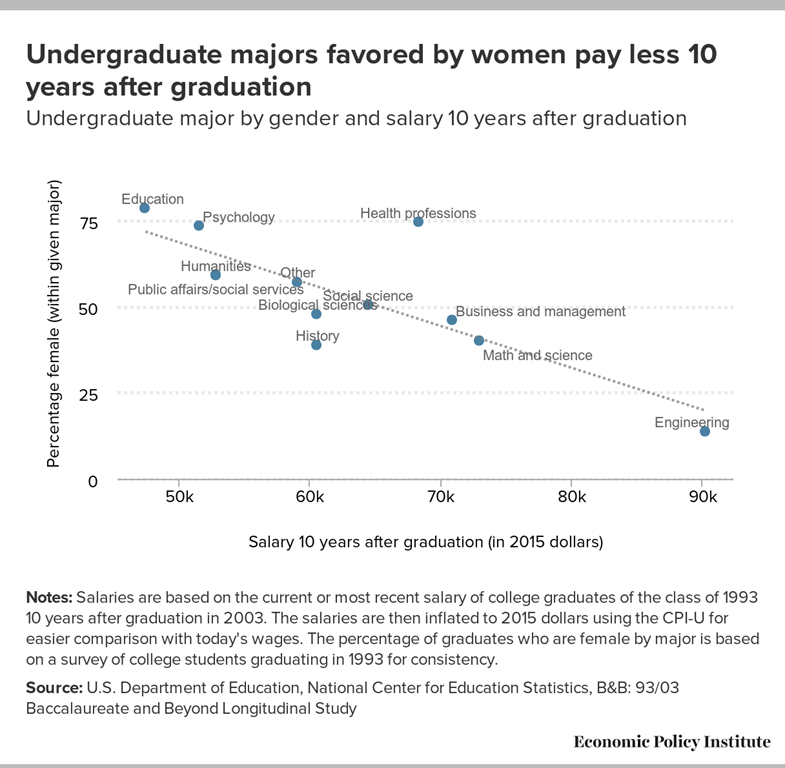
Undergraduate majors favoured by women pay less 10 years after graduation
02 Dec 2016 Leave a comment
Women Working: What’s the Pill Got to Do With It?
01 Dec 2016 Leave a comment
in applied price theory, discrimination, economic history, economics of education, gender, health economics, human capital, labour economics, labour supply, occupational choice Tags: contraception, gender gap, gender wage gap
Roland Fryer | Education, Inequality, & Incentives
11 Nov 2016 Leave a comment
in applied price theory, applied welfare economics, economics of education, human capital, labour economics, labour supply, poverty and inequality Tags: child poverty, family poverty
Skill-specific atrophy rates drive the STEM gender gap
08 Nov 2016 Leave a comment
in discrimination, economics of education, gender, human capital, labour economics, minimum wage, occupational choice Tags: gender wage gap, reversing gender gap
Rendall and Rendall (2016) found that women prefer occupations where their skills depreciate slowest when taking time out from motherhood. Verbal and reading skills depreciate at a far slower rate than mathematical and scientific skills so this gives women yet another strong reason to avoid science, technology, engineering and maths (STEM) careers.
we show that college educated women avoid occupations requiring significant math skills due to the costly skill atrophy experienced during a career break. In contrast, verbal skills are very robust to career interruptions.
The results support the broadly observed female preference for occupations primarily requiring verbal skills – even though these occupations exhibit lower average wages. Thus, skill-specific atrophy during employment leave and the speed of skill repair upon returning to the labour market are shown to be important factors underpinning women’s occupational outcomes.
Not only do women have vastly superior verbal and reading skills, worth somewhere near 6 to 12 months extra schooling, these skills do not depreciate much during career breaks. Indeed, reading and verbal skills tend to naturally increase with age until your late 60s.
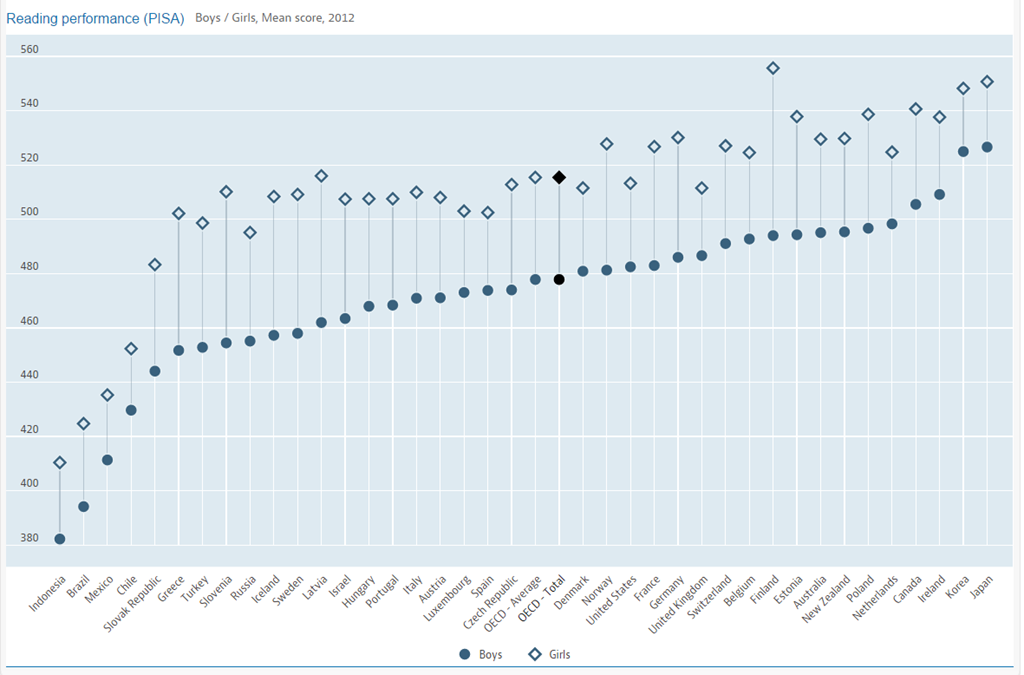
Source: Reading performance (PISA) – International student assessment (PISA) – OECD iLibrary.
Maths skills get rusty if not used while knowledge of computer languages and the like and of specific technologies can be quickly overtaken by events while on maternity leave. Rendall and Rendall (2016) again
… college educated females avoid math-heavy occupations, and pursue verbal-heavy occupations instead. This is due to the high skill atrophy associated with math skills, and the ability of verbal skills to act as “skill insurance” against gaps.
Additionally, for college educated individuals, math is the skill most vulnerable to loss during employment gaps, which also implies a slow rebuilding post-break. In contrast, non-college educated individuals experience a much smaller math skill loss.
Rendall and Rendall’s point about college educated women avoiding maths heavy occupations even if it costs them wages so as to maximise the lifetime income may explain the larger gender wage gap at the top of the income distribution than at the bottom.
At the bottom of the income distribution, skill atrophy do not really matter much. At the top, it do. Women make occupational choices where annual income may be lower but lifetime income may be higher because of the lower rates of skill depreciation when they are out having children.
 Utopia, you are standing in it!
Recent Comments