
The three laws of behavioural genetics
08 Feb 2015 Leave a comment
in economics of education, human capital, occupational choice, poverty and inequality Tags: behavioural genetics, economics of personality traits, nature versus nurture

Yes Prime Minister – The Department of Education and Science
03 Feb 2015 Leave a comment
in comparative institutional analysis, constitutional political economy, economics of education, economics of media and culture, TV shows Tags: Yes Prime Minister

Why Senator Elizabeth Warren supported school choice and school vouchers
02 Feb 2015 Leave a comment
in economics of education, entrepreneurship, politics - New Zealand, politics - USA Tags: capitalism and freedom, Elizabeth Warren, School choice, The meaning of competition, vouchers

It is not a coincidence that Warren’s support for school choice dropped through the floor once she decided to run for public office as a Democrat. In spite of large cash infusions from wealthy environmentalists and trial lawyers, teacher unions remain the party’s largest and most influential donor base.
…In recent years, Warren has bent over backwards to qualify what she “really meant” by school choice.
In a rather astonishing reinterpretation of her own work, it turns out she never supported vouchers for religious school or even for non-sectarian private schools, just the ability to go to a public school in an adjacent district.
The Upside of Income Inequality » Gary Becker and Kevin Murphy
01 Feb 2015 Leave a comment
in economics of education, human capital, labour economics, liberalism, occupational choice, poverty and inequality Tags: education premium, educational attainment, graduate premium, The Great Enrichment


Creative Routines — Information is Beautiful Awards
27 Jan 2015 Leave a comment
in economics of education, entrepreneurship, human capital, labour economics Tags: creativity, economics of personality traits, entrepreneurial alertness

Charter Schools: 5 Myths in 7 Minutes
21 Jan 2015 Leave a comment
in economics of education, politics - Australia, politics - New Zealand, survivor principle Tags: chartered schools, School choice
Test Finds College Graduates Lack Skills for White-Collar Jobs – WSJ
21 Jan 2015 Leave a comment
in economics of education Tags: education
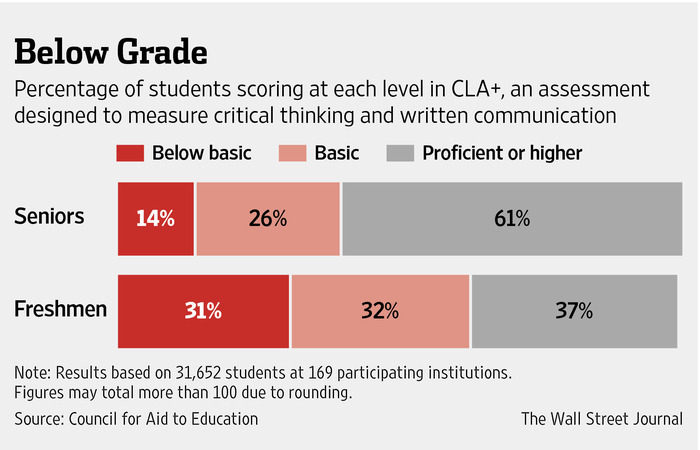
HT: http://www.wsj.com/articles/test-finds-many-students-ill-prepared-to-enter-work-force-1421432744
The response of biologists to creation theory as compared to climate alarmism
20 Jan 2015 Leave a comment
in economics of education, environmental economics, global warming, movies Tags: climate alarmism, conjecture and refutation, Inherit the Wind, JS Mill, persuasion, Socratic questions
Biologists spent great effort over many decades to rebut creation science is a cold methodical manner designed to change minds through facts and reasoned arguments. Insults and conceit give peoples excuses to not listen.
Labels like denier and alarmist are not conducive for scientists to change their minds or decide they were right in the first place, and that such unpleasantness encourages many to choose other careers or fields of study.
It is better to ask your interlocutor to think more deeply about this or that point that is in debate. Look for common ground that already exists and for a growing number of important anomalies and puzzles their current way of thinking cannot explain. Knowledge grows through critical discussion, not by consensus and agreement.
J.S. Mill pointed out that critics who are totally wrong still add value because they keep you on your toes and sharpened both your argument and the communication of your message.
If the righteous majority silences or ignores its opponents, it will never have to defend its belief and over time will forget the arguments for it.
As well as losing its grasp of the arguments for its belief, J.S. Mill adds that the majority will in due course even lose a sense of the real meaning and substance of its belief.
What earlier may have been a vital belief will be reduced in time to a series of phrases retained by rote. The belief will be held as a dead dogma rather than as a living truth.
Beliefs held like this are extremely vulnerable to serious opposition when it is eventually encountered. They are more likely to collapse because their supporters do not know how to defend them or even what they really mean.
J.S. Mill’s scenarios involves both parties of opinion, majority and minority, having a portion of the truth but not the whole of it. He regards this as the most common of the three scenarios, and his argument here is very simple.
To enlarge its grasp of the truth the majority must encourage the minority to express its partially truthful view.
Three scenarios – the majority is wrong, partly wrong, or totally right – exhaust for Mill the possible permutations on the distribution of truth, and he holds that in each case the search for truth is best served by allowing free discussion.
Mill thinks history repeatedly demonstrates this process at work and offered Christianity as an illustrative example. By suppressing opposition to it over the centuries Christians ironically weakened rather than strengthened Christian belief, and Mill thinks this explains the decline of Christianity in the modern world. They forgot why they were Christians.
Going on about how climate science is settled and the debate is over is bad tactics for the climate alarmists.
Attempts to close the debate this way provokes suspicion among those who expect some attempt to persuade them rather than to instruct them from on high.
Presumptuousness is never a good influencing strategy nor is dismissiveness. Listen here you stupid dupe of corrupt corporate lackeys converts few.
Most know that the defining feature of the growth of knowledge is knowledge grows and that is often by displacing the received wisdom. These instincts come well before any knowledge is required by the philosophy and sociology of science.

Darrow’s polite and careful cross-examination of Bryan in that great movie Inherit the Wind persuaded many to reject religious-based opposition to the theory of evolution. He asked questions and was very polite. The movie was Spencer Tracy at his finest and in black and white.
The marvel of the market: the remarkable foresight of young adults in choosing what to study
16 Jan 2015 1 Comment
in Alfred Marshall, Armen Alchian, economics of education, George Stigler, human capital, job search and matching, labour economics, occupational choice, politics - New Zealand, rentseeking Tags: 2nd laws of supply and demand, Alfred Marshall, Armen Alchian, george stigler, search and matching, skills shortgaes
Known but yet to be exploited opportunities for profit do not last long in competitive markets, including hitherto unnoticed opportunities for the greater utilisation and development of skills and experience (Hakes and Sauer 2006, 2007; Ryoo and Rosen 2004; and Kirzner 1992). Moneyball is the classic example of entrepreneurial alertness to hitherto unexploited job skills which were quickly adopted by competing firms (Hakes and Sauer 2006, 2007).
There is considerable evidence that the demand and supply of human capital responds to wage changes. For example, over- or under-supplied human capital moves either in or out in response to changes in wages until the returns from education and training even out with time (Ryoo and Rosen 2004; Arcidiacono, Hotz and Kang 2012; Ehrenberg 2004).
As evidence of this equalisation of returns on human capital investments across labour markets, the returns to post-school investments in human capital are similar – 9 to 10 percent – across alternative occupations, and in occupations requiring low and high levels of training, low and high aptitude and for workers with more and less education (Freeman and Hirsch 2001, 2008). There is evidence that workers with similar skills in similarly attractive jobs, occupation and locations earn similar pay (Hirsch 2008; Vermeulen and Ommeren 2009; Rupert and Wasmer 2012; Roback 1982, 1988).
Ryoo and Rosen (2004) found that the labour supply and university enrolment decisions of engineers is “remarkably sensitive” to career earnings prospects. Graduates are the main source of new engineers. Engineers who moved out into other occupations such as management did not often moved back to work again as professional engineers. Ryoo and Rosen (2004) observed when summarising their work that:
Both the wage elasticity of demand for engineers and the elasticity of supply of engineering students to economic prospects are large. The concordance of entry into engineering schools with relative lifetime earnings in the profession is astonishing.
Ryoo and Rosen (2004) found several periods of surplus in the market for engineers. These periods of shortage or surplus corresponded to unexpected demand shocks in the market for engineers such as the end of the Cold War.
Figure 1: New entry flow of engineers: a, actual vs. imputed from changes in stock of engineers; b, time-varying coefficients.
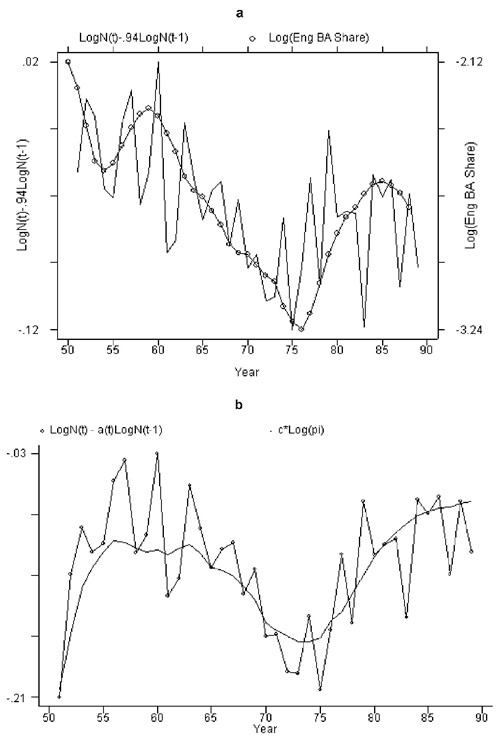
Source: Ryoo and Rosen (2004)
Ryoo and Rosen (2004) noted that importance of permanent versus transitory changes in earnings. Transitory rises and falls in earnings prospects have much less influence on occupational choices and the educational investments of students.
In light of these findings that the supply of engineers rapidly adapted to changing market conditions, Ryoo and Rosen (2004) questioned whether public policy makers have better information on future labour market conditions than labour market participants do. When politicians get worked up about skill shortages, the markets for scientists and engineers often where they make extravagant claims about the ability of the market to adapt to changing conditions because of the long training pipeline involved in university study, including at the graduate level.
There can be unexpected shifts in the supply or demand for particular skills, training or qualifications. These imbalances even themselves out once people have time to learn, update their expectations and adapt to the new market conditions (Rosen 1992; Ryoo and Rosen 2004; Bettinger 2010; Zafar 2011; Arcidiacono, Hotz and Kang 2012; Webbink and Hartog 2004).
For example, Arcidiacono, Hotz and Kang (2012) found that both expected earnings and students’ abilities in the different majors are important determinants of student’s choice of a college major, and 7.5% of students would switch majors if they made no forecast errors.
The wage premium for a tertiary degree was low and stable in New Zealand in the 1990s (Hylsop and Maré 2009) and 2000s (OECD 2013). This stability in the returns to education suggests that supply has tended to kept up with the demand for skills at least over the longer term at the national level. There were no spikes and crafts that would be the evidence of a lack of foresight among teenagers in choosing what to study.
All in all, the remarkable sensitivity of engineers to a career earnings prospects, the frequent changes of college majors by university students in response to changing economic opportunities, and the stability of the returns on human capital over time suggest that the market for human capital is well functioning.
The argument that the market was not working well was assumed rather than proven. Likewise, the case for additional subsidies for science, technology, engineering and mathematics because of perceived skill shortages has not been made out. There is a large literature showing that the market for professional education works well.
The onus is on those who advocate intervention to come up with hard evidence, rather than innate pessimism about markets that are poorly understood because of a lack of attempts to understand it. Studies dating back to the 1950s by George Stigler and by Armen Alchian found that the market for scientists and engineers works well and the evidence of shortages were more presumed than real.

 Utopia, you are standing in it!
Recent Comments