
Are humans getting cleverer?
06 Mar 2015 Leave a comment
in economics of education, technological progress Tags: Flynn effect, IQ
…if the Americans of 100 years ago took today’s tests, they would have an average IQ of 70 – the recognised cut-off for people with intellectual disabilities. To put it another way, IQ has been rising at roughly three points per decade.

HT: http://www.bbc.com/news/magazine-31556802

@greencatherine @PPTAWeb Teachers union concedes that NZ charter schools improve student outcomes?
04 Mar 2015 1 Comment
in economics of education, human capital, politics - New Zealand, politics - USA, unions Tags: charter schools, School choice
The New Zealand teachers union went into a very curious rant against chartered schools in a letter to the Dominion Post today. Instead of saying that they do not improve student outcomes, the usual propaganda, the author of the letter focused on system-wide outcomes after the introduction of charter schools.

It is usual for the teachers union to say that the schools themselves fail rather than argue that adding five or 10 schools to a system of thousands of public schools in New Zealand will through competition from these few schools to lift the entire system. For example, the teachers union sets a very high standard for the charter schools:
The United States has had charter schools for a more than a decade and there has been no measurable improvement in that country’s overall performance in literacy, maths and science. The United States lags far behind New Zealand on recent performance tests in all those areas.
It is unwise to say there is no evidence because that leaves you open to the cheap shot that will find one piece of evidence and then ask why you making things up. For example, the Maxim Institute found that:
The evidence from the small body of research that exists is mixed: some studies have found the presence of charter schools to have had a small negative impact on pupil achievement in regular state schools, while other studies have found charter schools to have had either a negligible or small positive impact…
There my work is done. All I had to show was that there was some evidence showing that charter schools improved the performance of neighbouring schools.

Why is the teachers union pretending that this evidence is not there when it can be found and so easily on the Internet?

Is the reason that the evidence that charter schools improve the outcomes of students that go to them is so strong that they have to move to new reasons for opposing them? The evidence is some chartered schools do very well and in particular for minority students. Their greatest strength is they are closed if they fail. No similar standard applies to failing public schools.

At a minimum, the teachers unions have conceded that the charter schools seem to work and that they do no harm to the rest of the system? If there was evidence of that, they would be quick to put it forward.
The US teaching workforce is disproportionately unionized
03 Mar 2015 Leave a comment
in economics of education, labour economics, unions Tags: charter schools, teachers union, union power, union wage premium, which school choice

HT: Vox
Are women just too smart to be computer scientists?
02 Mar 2015 1 Comment
in discrimination, economics of education, gender, human capital, labour economics, occupational choice Tags: gender wage gap, reversing gender gap
Women started drifting away from computer science in the mid-1980s. The interpretation put forward by the professional grievance industry, that is, by National Public Radio in the USA is:
The share of women in computer science started falling at roughly the same moment when personal computers started showing up in U.S. homes in significant numbers.
These early personal computers weren’t much more than toys. You could play pong or simple shooting games, maybe do some word processing.
And these toys were marketed almost entirely to men and boys. This idea that computers are for boys became a narrative. It became the story we told ourselves about the computing revolution. It helped define who geeks were, and it created techie culture.
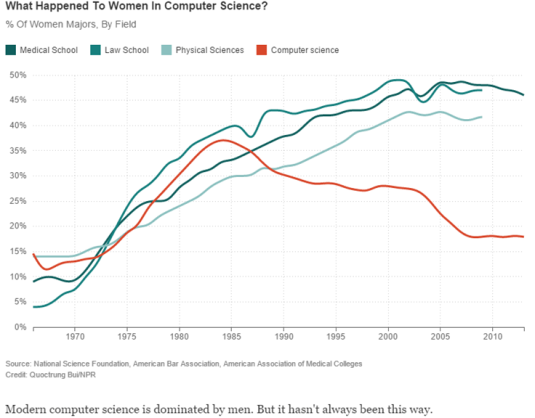
Source: NPR
Another interpretation is there are systematic differences between teenage boys and teenage girls in verbal and written skills. Young women moved away from enrolling in computer science because they could make better use of their superior written and verbal skills in medicine and law. Computer science is for those with inferior social skills, on average.
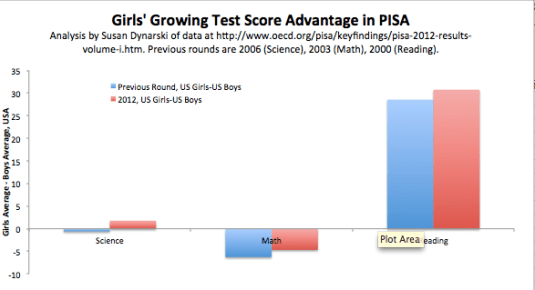
As for computers in the early days been marketed to men and boys, people with inferior verbal and reading skills would be attracted to sitting in front of the computer playing games because of their inferior social skills. Computers were expensive back in the 80s so marketing them to people with fewer social skills is sensible as they were more willing to spend money to fill the extra time they spend on their own.
The difference in reading and verbal skills between girls and boys at the age of 15 is equal to 6-months extra schooling. Six months schooling explains a lot of the wage gaps on ethnic, racial and gender lines. Not surprisingly, fewer women do computer science because their superior reading and verbal skills qualify them for medicine and law where they can take greater advantage of their mix of talents.
It is all about being the best you can be. As many women as men ending up in STEM occupations does not necessarily mean people are making the choices that help them be the best they can be because some women may not be taking advantage of their superior reading skills.
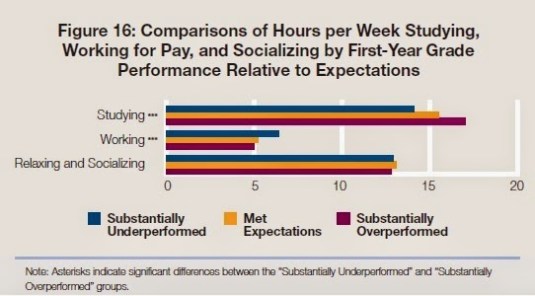
Today’s university students are a bit lazy
02 Mar 2015 Leave a comment
in economics of education Tags: University days
John Cleese on Stupidity
27 Feb 2015 Leave a comment
in behavioural economics, economics of education, economics of information, economics of media and culture, health economics, human capital Tags: Dunning-Kruger effect


What is the return on higher education?
26 Feb 2015 Leave a comment
in economics of education, human capital, labour supply, occupational choice Tags: age-earnings profile


Mark Twain on the getting of wisdom
23 Feb 2015 Leave a comment
in economics of education Tags: conjecture and refutation, persuasion, political psychology, rational ignorance, rational irrationality
Strong public support for school choice in the USA
18 Feb 2015 Leave a comment
in economics of education, politics - New Zealand, politics - USA Tags: charter schools, School choice

HT: Stephen Franks
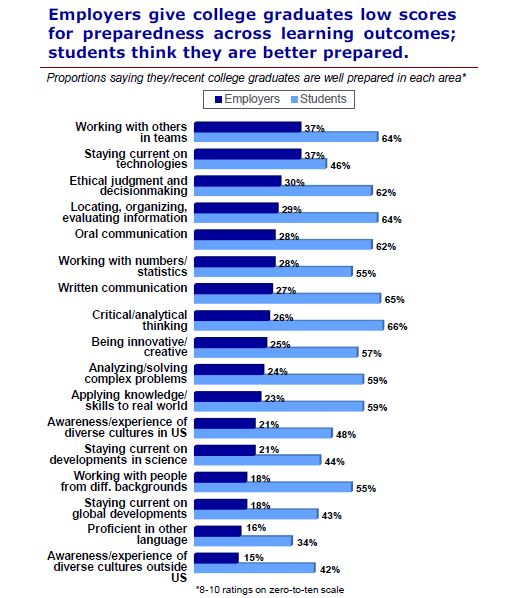
College graduates have a much higher opinion of themselves than do the recruiting employers
18 Feb 2015 Leave a comment
in economics of education, human capital, job search and matching, labour economics, labour supply, personnel economics Tags: job market signaling, recruitment standards


Recent Comments