The role of entrepreneurial alertness in sifting out quackery
30 Apr 2015 Leave a comment
in economics of information, economics of media and culture, entrepreneurship, health economics Tags: charlatans, creative destruction, entrepreneurial alertness, market selection, quackery
Most accurate attack ad ever from 1933
29 Apr 2015 Leave a comment
Prescient 1932 Hindenburg campaign poster showing Commies as Moscow stooges & Nazis as aspiring mass murderers. Yup. http://t.co/5IIYsaYwDy—
Mark Tooley (@markdtooley) April 28, 2015
Persuasive power of quoting a number
29 Apr 2015 Leave a comment
in applied price theory, applied welfare economics, behavioural economics, econometerics, economic history, economics of information Tags: cognitive biases, cognitive psychology, data mining, economics of persuasion, evidence-based policy
Politicians & statistics. My proposal in today's @FT : ft.com/cms/s/0/dcf46a… http://t.co/HYbV4V2ps2—
Jonathan Portes (@jdportes) January 26, 2015
Another pointless warning sign
27 Apr 2015 Leave a comment
in economics of information Tags: warning signs
Further evidence of the Anti-Science Left
27 Apr 2015 Leave a comment
in economics of information, economics of media and culture, economics of regulation, environmentalism Tags: advocacy bias, Anti-Science left, anti-vaccination movement, expressive voting, motivated reasoning, rational ignorance, rational irrationality
The right of the political spectrum is less likely to accept scientific conclusions if they involve excessive regulation of the economy. The anti-vaccination infestation of left-wing thinking shows that they are not immune to magical thinking and therefore should not be so smug.
A fantastic redeeming feature of homeopathy
26 Apr 2015 Leave a comment
in economics of information, health economics Tags: brand names, fisheries economics, homeopathy, organic agriculture, organic farming, product certification, quackery, Quacks
Organic certification is currently an issue in New Zealand at the behest of the Green Party:
Green Party spokesman for agriculture Steffan Browning has called on the Government to safeguard the value of the term "organic". For him, waiting until 2017 to look at the issue was "simply unacceptable".
Companies can become "certified organic", and by doing this it means they meet an agreed international standard during production, processing, and selling their products.
A certified organic company’s food is free of additives, and has not relied on chemicals during growth.
But certification isn’t compulsory – and there is no legal requirement for claims of uncertified organic produce to be genuine, Browning said.
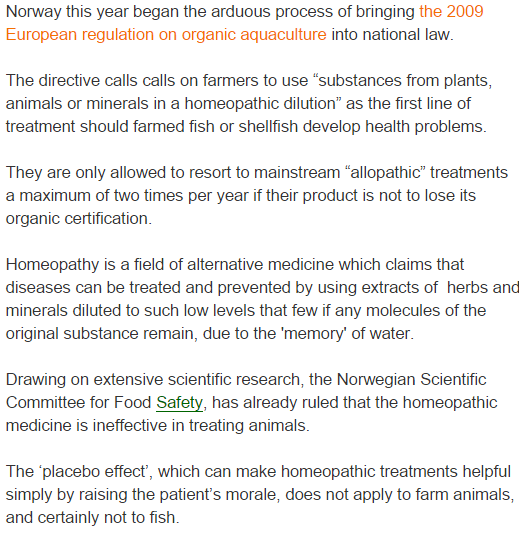
via EU’s crazy homeopathy cure for Norway fish – The Local.
The one and the same Green Party spokesman Steffan Browning last year called for homeopathic remedies to be used against Ebola!

I wonder which manifestation of quackery will win out: Organic farming or homeopathy? It’ll be fun to watch with glee.

The share market rose 2 points today because of…
23 Apr 2015 Leave a comment
in economics of information, entrepreneurship, financial economics Tags: active investing, efficient markets hypothesis, entrepreneurial alertness, passive investing
American English mapped
22 Apr 2015 Leave a comment
in economics of information, economics of media and culture Tags: American English, economics of languages

The FDA is holding a public hearing today on regulating homeopathic remedies
21 Apr 2015 Leave a comment
in economics of information, economics of regulation, health economics Tags: homoeopathy, quackery
The history of English mapped
21 Apr 2015 Leave a comment
in economics of education, economics of information Tags: economics of language, English

A guide to Green labelling of food
15 Apr 2015 Leave a comment
in economics of information, economics of media and culture, environmental economics, health economics Tags: advertising, product labelling
How toxic is it?
15 Apr 2015 Leave a comment
in economics of information, economics of regulation, health economics Tags: Anti-Science left
The sharing economy in a nutshell
15 Apr 2015 Leave a comment
in economics of information, economics of media and culture, entrepreneurship Tags: entrepreneurial alertness, Facebook, sharing economy, Uber
@FlipChartRick spotted this earlier http://t.co/q6FoyIGJFL—
(@MervynDinnen) March 20, 2015
The three lags on monetary policy
31 Mar 2015 1 Comment
in business cycles, economics of information, inflation targeting, macroeconomics, Milton Friedman, monetarism, monetary economics Tags: lags on monetary policy, monetary policy
There are large uncertainties about the size and timing of responses to changes in monetary policy. There is a close and regular relationship between the quantity of money and nominal income and prices over the years. However, the same relation is much looser from month to month, quarter to quarter and even year to year. Monetary changes take time to affect the economy and this time delay is itself highly variable. The lags on monetary policy are three in all:
- The lag between the need for action and the recognition of this need (the recognition lag)
-
The lag between recognition and the taking of action (the legislation lag)
-
the lag between action and its effects (the implementation lag)
These delays mean that is it difficult to ascertain whether the effects of monetary policy changes in the recent past have finished taking effect.

Secondly, it is difficult to ascertain when proposed changes in monetary policy will take effect. Thirdly, feedbacks must be assessed. The magnitude of the monetary adjustment necessary to deal with the problem at hand is never obvious.
It is common for a central bank to act incrementally. The central bank makes small adjustments to monetary conditions over time as more information is available on the state of the economy and forecasts are updated.
Most discussions on monetary policy focus on the implementation lag. This lag depends on the fundamental characteristics of the economy.
A long and variable implementation lag means that it is difficult for central banks to ascertain what is happening now or forecast what will happen. Central banks may stimulate the economy after it is well on the way to recovery and tighten monetary policy when the economy is already going into a recession.
In his classic A Program for Monetary Stability, published in 1959, Milton Friedman summarised his empirical findings on length and variability of the lags on monetary policy:
on the average of 18 cycles, peaks in the rate of change in the stock of money tend to preceded peaks in general business by about 16 months and troughs in the rate of change in the stock of money to precede troughs in general business by about 12 months. For individual cycles, the recorded lead has varied between 6 and 29 months at peaks and between 4 and 22 months at troughs.
With lags as variable as those estimated by Friedman, it is difficult to see how any policy maker could know which direction to adjust his policy, much less the precise magnitude needed. Long lags greatly complicate good forecasting. A forecaster cannot know what the state of the economy will be when his policy takes effect.
Many Keynesians, Friedman notes, advocate “leaning against the wind.” By this they mean, in some sense, that the monetary (and fiscal) authorities should try to balance out the private sector’s excesses rather than passively hope that it adjusts on its own.
Friedman tested the Fed’s success at leaning “against the wind” by checking whether the rate of money growth has truly been lower during expansions and higher during contractions. He admits that this method of grading he Fed’s performance is open to criticism, but decides to go ahead and see what turns up. He finds that Fed has – for the periods surveyed – been unsuccessful.
By this criterion, for eight peacetime reference cycles from March 1919 to April 1958. Actual policy was in the ‘right’ direction in 155 months, in the ‘wrong’ direction in 226 months; so actual policy was ‘better’ than the [constant 4% rate of money growth] rule in 41% of the months.
Nor is the objection that the inter-war period biased his study is good since Friedman found that:
For the period after World War II alone, the results were only slightly more favourable to actual policy according to this criterion: policy was in the ‘right’ direction in 71 months, in the ‘wrong’ direct in 79 months, so actual policy was better than the rule in 47% of the months. [2]
One of the best ways to parry a metaphor is with another metaphor. Keynesians have a host of metaphors in their rhetorical arsenal; one frequently voiced is that a wise government should “lean against the wind” when choosing policy. Friedman counters:
We seldom know which way the economic wind is blowing until several months after the event, yet to be effective, we need to know which way the wind is going to be blowing when the measures we take now will be effective, itself a variable date that may be a half year or a year or two from now. Leaning today against next year’s wind is hardly an easy task in the present state of meteorology.
By scrutinising the practice of monetary policy over the decades, Friedman manages to produce objections that both Keynesians and non-Keynesians must take seriously. A key part of any response to Friedman rests on the ability of forecasters to do their jobs with tolerable accuracy.
 Utopia, you are standing in it!
Recent Comments