“Most People I Know” by Billy Thorpe & The Aztecs (Live)
25 Apr 2016 Leave a comment
in economics of media and culture, Music
Economics of ‘The Big Bang Theory’
25 Apr 2016 Leave a comment
in economics of media and culture

A HT to Michael Cameron associate professor in the Department of Economics for his post on Bazinganomics. It is a website that uses scenes from the comedy show The Big Bang Theory to illustrate economic concepts which mainly fall into micro topics:
FOUNDATIONS
MARKETS AT WORK
ELASTICITY
PRICE CONTROLS
EXTERNALITIES & PUBLIC GOODS
COSTS & PRODUCTION
PERFECT COMPETITION
MONOPOLY AND PRICE DISCRIMINATION
MONOPOLISTIC COMPETITION
STRATEGIC BEHAVIOR & OLIGOPOLY
BEHAVIORAL ECON & RISK
CONSUMER CHOICE
Like the Economics of Seinfeld, the purpose of Bazinganomics is to provide teachers with video clips from a popular television programme that can be used in the classroom to help facilitate engagement. Worth a look especially if you are a fan of the show.

Is Replicability in Economics better than in Psychology?
25 Apr 2016 Leave a comment
in economics of media and culture

Colin Camerer and colleagues recently published a Science article on the replicability of behavioural economics. ‘It appears that there is some difference in replication success’ between psychology and economics, they write, given their reproducibility rate of 61% and psychology’s of 36%. I took a closer look at the data to find out whether there really are any substantial differences between fields.
Commenting on the replication success rates in psychology and economics, Colin Camerer is quoted as saying: “It is like a grade of B+ for psychology versus A– for economics.” Unsurprisingly, his team’s Science paper also includes speculation as to what contributes to economics’ “relatively good replication success”. However, such speculation is premature as it is not established whether economics actually displays better replicability than the only other research field which has tried to estimate its replicability (that would be psychology). Let’s check the numbers in Figure 1.
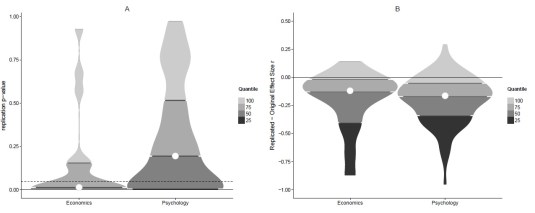
Figure 1. Replicability…
View original post 702 more words
Yet more evidence for questionable research practices in original studies of Reproducibility Project: Psychology
25 Apr 2016 Leave a comment
in economics of media and culture
The replicability of psychological research is surprisingly low. Why? In this blog post I present new evidence showing that questionable research practices are at the heart of failures to replicate psychological effects.
Quick recap. A recent publication in Science claims that only around 40% of psychological findings are replicable, based on 100 replication attempts in the Reproducibility Project Psychology (Open Science Collaboration, 2015). A few months later, a critical commentary in the same journal made all sorts of claims, including that the surprisingly low 40% replication success rate is due to replications having been unfaithful to the original studies’ methods (Gilbert et al., 2016). A little while later, I published an article in Psychonomic Bulletin & Review re-analysing the data by the 100 replication teams (Kunert, 2016). I found evidence for questionable research practices being at the heart of failures to replicate, rather than…
View original post 1,141 more words
Female radicalisation and violent extremism
25 Apr 2016 Leave a comment
in economics of media and culture

Written by Anja Radjenovic,
 © Sondem / Fotolia
Radicalisation and violent extremism that lead to terrorist attacks are a serious threat both to countries’ security and to their citizens. Although both phenomena often concern male perpetrators, the recent rise in European female fighters recruited by terrorist organisations, notably ISIL/Da’esh, shows the need to consider the role of women when addressing violent extremism. Acknowledging the potential threat resulting from radicalised women and paying greater attention to the gender dimension of counter-radicalisation strategies and the specific contribution that women can make in this area is urgent.
To understand female radicalisation and violent extremism, experts increasingly focus on the potential threat posed by radicalised women by asking questions: who they are, why they are being radicalised, and what role they play in radicalisation and within violent extremist organisations. The OSCE has found that there is no single pathway to radicalisation, nor a single…
View original post 399 more words
An Examination of Rolling Stone’s 500 Greatest Songs of All Time
25 Apr 2016 Leave a comment
in economics of media and culture

My usual routine when I’ve exhausted the social media sites that I visit four or five times a day is to rotate between a specific three or four websites. I usually check in with ESPN, fivethirtyeight, reddit, and Rolling Stone. About a week ago when I was following this same pattern I stumbled onto Rolling Stone Magazine’s list of the “500 Greatest Songs of All Time”.
View original post 457 more words
Examining the Best Years for Films Based on Rotten Tomatoes and IMDb’s Top Movie Lists
25 Apr 2016 Leave a comment
in economics of media and culture
In my last blog post I examined the best decades in music according to Rolling Stone Magazine’s list of the “500 Greatest Songs of All Time”. I got some good feedback on this project so I decided to use a similar formula and examine the best decades for movies based on IMDb’s Top 250 movies list and Rotten Tomatoes Top 100 movies list.
View original post 924 more words
World War I: Every Day
25 Apr 2016 Leave a comment
in defence economics, economics of media and culture Tags: World War I
A graphical comparison of earthquake energy release
25 Apr 2016 Leave a comment
in economics of media and culture, economics of natural disasters Tags: earthquakes
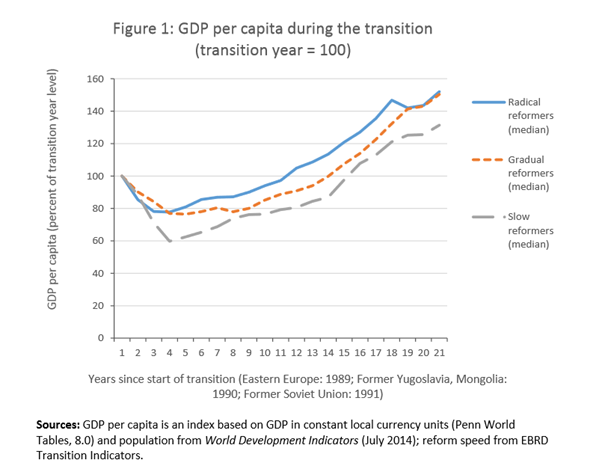
Should economic reform have been slower in the transitional economies?
25 Apr 2016 Leave a comment
in economics of media and culture

Map of Europe if the Central Powers won World War I
25 Apr 2016 Leave a comment
in defence economics, economics of media and culture Tags: maps, World War I
1000 Years Time-Lapse Map of Europe
25 Apr 2016 Leave a comment
in economic history, economics of media and culture Tags: Europe, maps
run, bern, run
25 Apr 2016 Leave a comment
in economics of media and culture

The 2016 Democratic primary is a mirror image of the 2008 primary. In 2008, Hillary Clinton fell behind in delegates on Super Tuesday and required blow out victories to regain the lead. Even though it was extraordinarily unlikely that she could do that, Clinton continued to run until the very, very end. Now Hillary has done the same to Sanders in 2016. He got a big win in New Hampshire and a tie in Iowa, but did very poorly in South Carolina and never recovered. He can only climb back into the lead if he gets big wins in big states to offset Clinton’s lead, which didn’t happen this week and is unlikely to happen over the next month. Yet, Sanders is still running strong. Why?
A few reasons:
- By basing his campaign on small donors, it is possible to continually raise money. He can bypass the party establishment who would…
View original post 183 more words
Some perspectives on reform and the RB in the 1980s
25 Apr 2016 Leave a comment
in economics of media and culture

A new book came in the post the other day. It is a scholarly look at the long-term relative economic performance of New Zealand and Uruguay, something I wrote about quite recently and a subject I may come back to when I’ve read the book.
But there is an old line, especially applied to newspaper and magazine articles, that when the coverage of something you know about doesn’t ring true, be wary of the rest of the article. And flicking through this new book my eye lit on a strange reference to the Reserve Bank.
In a paragraph on the reform period from the mid-1980s to the early 1990s (“which showed characteristics of a coup”), the author writes
Douglas as well as further members of the Cabinet, the Business Roundtable, and other strategically located institutions represented the exclusive inner circle of the new right. Until at least 1988, they used their large human…
View original post 1,655 more words
Did 60 Minutes Get Played?
25 Apr 2016 Leave a comment
in economics of media and culture

It goes without saying that the whole 60 Minutes saga has some serious knobs on it.
However, I don’t just mean the ’60 Minutes are a bunch of idiots with a serious corporate culture problem'(*) kind of knobs. I also mean the ‘this all got resolved very quickly and a little too easily with a lot of money changing hands’ knobs.
View original post 849 more words


Recent Comments