
Ten Word Answers
21 Apr 2016 Leave a comment
in economics of media and culture, Public Choice, public economics Tags: West Wing
Guardian report on NUS vote omits Malia Bouattia’s ‘Zionist-led media’ comment
21 Apr 2016 Leave a comment
in economics of media and culture

An April 20th Guardianreport on Britain’s National Union of Students (NUS) election was titled ‘NUS elects first female black Muslim president after tense contest’. However, the report by Jessica Elgot fails to inform readers that the new NUS president, BDS activist Malia Bouattia, represents another first – the first time NUS (a group representing the interests of 7 million British students) will be led by someone who’s supported terrorism and used thinly veiled antisemitic tropes.
Elgot’s report deals with the controversy surrounding Bouattia’s refusal to boycott ISIS for fear of stoking Islamophobia, as well as criticism surrounding her ‘accusation’ that University of Birmingham is “a Zionist outpost in British higher education” due it’s “large Jewish Society”. However, Elgot failed to note far worse comments by Bouattia revealed in a video circulated elsewhere in the media (including at theBBC) hours before her Guardian report was published.
Here’s the video, filmed at an…
View original post 425 more words
What leads to profits in mutual fund industry?
21 Apr 2016 Leave a comment
in economics of media and culture

James Kwak has a piece wondering why does mutual fund industry make large profits?
It is mainly because they continue to get high asset management charges. Why have people not ditched these active funds for index funds where charges are far lower?
View original post 523 more words
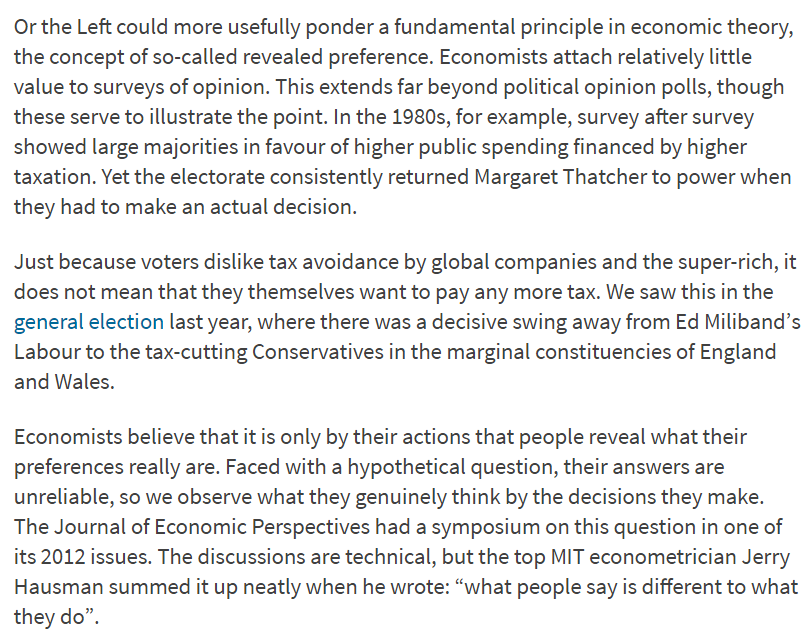
Forget avoidance outrage: public’s real attitude to tax is revealed by their actions @JordNZ
21 Apr 2016 Leave a comment
in applied price theory, constitutional political economy, economic history, economics of media and culture, politics - Australia, politics - New Zealand, politics - USA, Public Choice, public economics Tags: British economy, British politics, expressive voting, growth of government, rational irrationality, revealed preference, size of government, voter demographics
M.A. Adelman on natural resource exhaustion
21 Apr 2016 Leave a comment
in economics of media and culture


Columbia University begrudgingly admits the benefits of CO2 on crops
21 Apr 2016 Leave a comment
in economics of media and culture
Britain and Europe (6): Mrs Thatcher’s Handbag
21 Apr 2016 Leave a comment
in economics of media and culture

 Margret Thatcher transformed much in our national life. Now taken as the totemic figure of Tory Euroscpeticism, her attitudes to Europe were perhaps less fixed, and more interesting.
Thatcher often portrayed herself as an ideological politician, and her supports followed suit. Of course, she was just that. Certainly, it would impossible to understand Thatcherism without some understanding of monetarism and free markets, for example. To see Thatcher and Thatcherism in purely ideological terms would be to misread her, and misread her career.
In the first place it makes what appear like her inconsistencies as hard to account for. To square the Heathite milk-snatcher and slayer of grammar schools with the later Thatcher has always required explanation. In part, it is argued, she was on the ideological and political path that would lead her to monetarism, free markets and the radical Conservatism of the likes of Sir Keith Joseph or even Enoch…
View original post 1,182 more words
George Plunkitt of Tammany Hall on the difference between honest and dishonest political graft
21 Apr 2016 Leave a comment
in economic history, economics of bureaucracy, economics of crime, economics of media and culture, law and economics, politics - USA, Public Choice, rentseeking Tags: bribery and corruption

In the book Plunkitt of Tammany Hall William Riordan published many of George Washington Plunkitt’s thoughts about government and about big city machines. In the link below, you can find the passage that explains the difference between honest and dishonest graft.
Honest graft is using your connections and knowledge as a government official to enrich yourself. It is essentially what we would now call “insider trading.”
Honest graft is when a goverment official goes out (for example) and buys up land because he knows a city project will need that land and he will be able to make a lot of money by buying the land now while no one else knows that it is about to be bought by the city. He can buy it cheap and then sell it at a higher price to the city.
Dishonest graft consists of doing things like blackmailing people who are doing illegal or semi-illegal things. It can also consist of actually taking money directly from the city treasury.
It is more of what you would expect mobsters to do–things like forcing prostitutes to pay money to police in order to be allowed to work in a given area rather than being arrested.
Source: How does George Plunkitt define “honest/dishonest graft”? | eNotes.

Left-wing Biases, Too, May Block Progress on Climate Change @GarethMP @JulieAnneGenter
20 Apr 2016 Leave a comment
in applied price theory, applied welfare economics, economics of media and culture, energy economics, environmental economics, global warming, Public Choice Tags: antimarket bias, carbon emissions, climate alarmists, expressive voting, greenhouse gases, nuclear power, rational irrationality

Source: Liberal Biases, Too, May Block Progress on Climate Change – The New York Times.

Source: Mr. Sanders’s war on clean energy – The Washington Post.
More kittens clips
20 Apr 2016 Leave a comment
in cats, economics of media and culture Tags: kittens
O competition, we stand on guard for thee
20 Apr 2016 Leave a comment
in economics of media and culture
The Exxon Climate Papers
20 Apr 2016 Leave a comment
in economics of media and culture

by Andy West
New York Attorney General Eric T. Schneiderman has accused ExxonMobil of lying to the public and investors about the risks of climate change according to the NY Times and has launched an investigation and issued a subpoena demanding extensive financial records, emails and other documents.
View original post 2,341 more words


Recent Comments