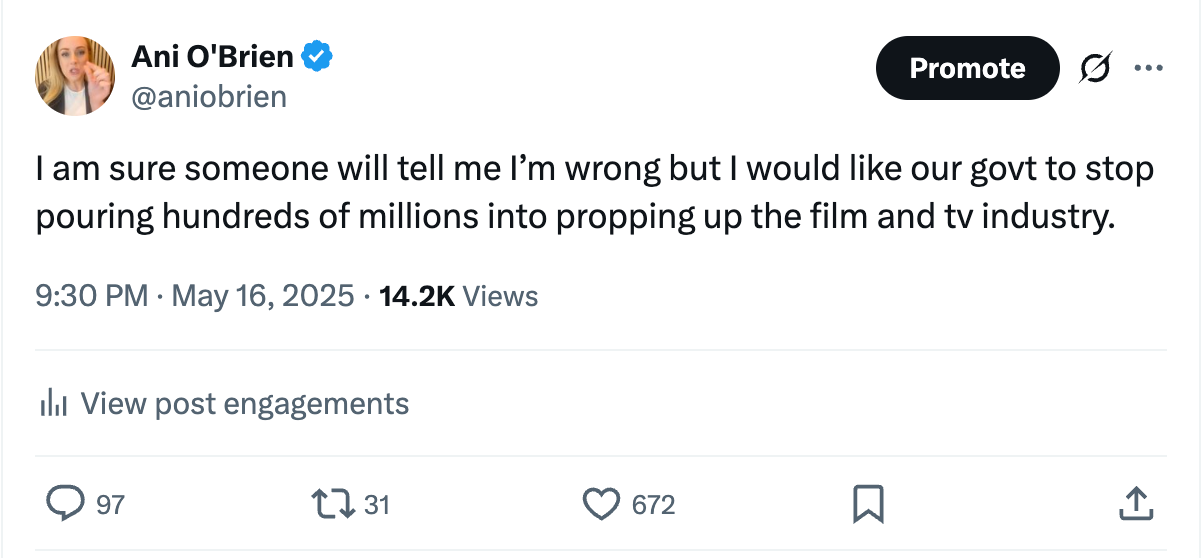
Ani O’Brien writes – On Friday night, having imbibed a few wines I strayed onto X to unwisely engage in some (slightly drunk) opinion sharing. I tweeted:
Propping up the film sector or stimulating growth?
Celebrating humanity's flourishing through the spread of capitalism and the rule of law
19 May 2025 Leave a comment
in economics of media and culture, entrepreneurship, industrial organisation, movies, politics - New Zealand, Public Choice, rentseeking, survivor principle, television Tags: corporate welfare
Ani O’Brien writes – On Friday night, having imbibed a few wines I strayed onto X to unwisely engage in some (slightly drunk) opinion sharing. I tweeted:
Propping up the film sector or stimulating growth?
26 Apr 2025 Leave a comment
in applied price theory, economics of information, economics of media and culture
A global team of gambling whizzes hatched a scheme to snag the jackpot; millions of tickets in 72 hoursBy Joe Wallace and Katherine Sayre of The WSJ. Excerpts:”There were 25.8 million potential number combinations. The tickets were $1 apiece. The jackpot was heading to $95 million. If nobody else also picked the winning numbers, the…
How a Secretive Gambler Called ‘The Joker’ Took Down the Texas Lottery
03 Apr 2025 Leave a comment
in comparative institutional analysis, constitutional political economy, economics of bureaucracy, economics of education, economics of information, economics of media and culture, international economics, law and economics, liberalism, Marxist economics, politics, property rights, Public Choice Tags: Brexit, British politics, political psychology
Political battles historically have been framed as contests between left-wing and right-wing ideologies, with clear distinctions based on policy preferences and socio-economic class interests. However, contemporary political dynamics reveal a new axis of conflict: the division between the educated and the uneducated. This emerging distinction marks a significant departure from traditional political alignments, reshaping electoral […]
Uneducated vs educated
29 Mar 2025 Leave a comment
in economics of education, economics of media and culture, liberalism, Marxist economics, politics - USA Tags: free speech, political correctness, regressive left
Erick Erickson writes: The press and left call the right “culture warriors,” but we were not the ones who put pornographic material in elementary schools. We were not the ones who demanded kids in colleges attend seminars to learn about their inner racism. We were not the ones who demanded boys get into girls sports. […]
Erick Erickson on the culture wars
17 Mar 2025 Leave a comment
in economics of education, economics of media and culture Tags: conspiracy theorists, cranks
The terms “crank” and “crackpot” are often used interchangeably to describe someone who holds eccentric or unorthodox views, especially in science or other intellectual disciplines. However, there can be subtle differences in their connotations: Both terms are pejorative and used to express disapproval or skepticism towards the individual’s ideas or behaviors. The distinction, while subtle, […]
Cranks, crackpots and conspiracy theorists
15 Mar 2025 Leave a comment
in economic history, economics of media and culture, entrepreneurship, monetary economics Tags: Roman empire

13 Mar 2025 Leave a comment
in applied price theory, defence economics, economics of information, economics of media and culture, Public Choice, war and peace Tags: game theory, Iran, Israel, Middle-East politics, war against terror

In The Conversation last October, Andrew Thomas (Deakin University) discussed the recent (at that time) military flare-up between Iran and Israel, likening it to a ‘game of chicken’:Israel’s strike on military targets in Iran over the weekend is becoming a more routine occurrence in the decades-long rivalry between the two states…There is a reason why…
Hawks, doves, Israel and Iran
06 Mar 2025 Leave a comment
in economics of education, economics of media and culture, health economics, liberalism, Marxist economics, politics - USA Tags: conjecture and refutation, free speech, gender gap, philosophy of science, political correctness, regressive left, sex discrimination

I’ve written sentences like this many times: “While biological sex is a binary, gender in humans forms more of a spectrum.” But I was never really sure what “gender” meant. I know that it’s generally synonymous with “sex”, but that is clearly not what I meant when I spoke as I did above. What did […]
Should we ditch the word “gender”?
27 Feb 2025 Leave a comment
in economics of bureaucracy, economics of education, economics of information, economics of media and culture, entrepreneurship, financial economics, industrial organisation, law and economics, liberalism, Marxist economics, politics - USA, property rights, Public Choice, rentseeking Tags: 2024 presidential election, free speech, political correctness, regressive left

Below is my column in the Hill on the new American emigres: “disinformation experts” who are finding themselves unemployed with the restoration of free speech protections. Here is the column:
The American Rōnin: How Displaced “Disinformation Experts” Are Seeking New Opportunities in Europe and Academia
26 Feb 2025 Leave a comment
in economics of climate change, economics of education, economics of information, economics of media and culture, environmental economics, environmentalism, global warming, politics - Australia, politics - New Zealand, politics - USA Tags: conjecture and refutation, conspiracies theories, philosophy of science
Conspiracy theories and science denial are two phenomena that often intersect, influencing public discourse and societal trust in authoritative knowledge sources. This essay explores their connection, elucidates the psychological and social mechanisms underpinning them, and provides examples to demonstrate how these two manifestations of skepticism reinforce each other, often with deleterious consequences. The Connection At […]
Conspiracy theories and science denial
26 Feb 2025 Leave a comment
in discrimination, economics of education, economics of media and culture, gender, health economics, human capital, labour economics, liberalism, Marxist economics, politics - USA Tags: free speech, gender gap, life expectancies, political correctness, regressive left

This article was mentioned in a comment by reader Ted Gold, but I thought I would highlight it just to show that when the rubber meets the road, people recognize that, yes, there are just two sexes. This is from the NYT on Feb. 25th. Click headline to read, or find the article archived here. […]
More tacit recognition of two sexes in humans
26 Feb 2025 Leave a comment
in economics of education, economics of media and culture

11 Feb 2025 Leave a comment
in applied price theory, discrimination, econometerics, economics of education, economics of information, economics of media and culture, gender, human capital, labour economics, labour supply Tags: gender wage gap
One explanation of the gender wage gap is taste discrimination, as in Becker (1957). We test for taste discrimination by constructing a novel measure of misogyny using Google Trends data on searches that include derogatory terms for women. We find—surprisingly, in our view—that misogyny is an economically meaningful and statistically significant predictor of the wage […]
Does the Gender Wage Gap Actually Reflect Taste Discrimination Against Women?
Celebrating humanity's flourishing through the spread of capitalism and the rule of law
Scholarly commentary on law, economics, and more
Beatrice Cherrier's blog
Celebrating humanity's flourishing through the spread of capitalism and the rule of law
Celebrating humanity's flourishing through the spread of capitalism and the rule of law
Celebrating humanity's flourishing through the spread of capitalism and the rule of law
Why Evolution is True is a blog written by Jerry Coyne, centered on evolution and biology but also dealing with diverse topics like politics, culture, and cats.
Celebrating humanity's flourishing through the spread of capitalism and the rule of law
Celebrating humanity's flourishing through the spread of capitalism and the rule of law
A rural perspective with a blue tint by Ele Ludemann
DPF's Kiwiblog - Fomenting Happy Mischief since 2003
Celebrating humanity's flourishing through the spread of capitalism and the rule of law
The world's most viewed site on global warming and climate change
Tim Harding's writings on rationality, informal logic and skepticism
A window into Doc Freiberger's library
Let's examine hard decisions!
Commentary on monetary policy in the spirit of R. G. Hawtrey
Thoughts on public policy and the media
Celebrating humanity's flourishing through the spread of capitalism and the rule of law
Politics and the economy
A blog (primarily) on Canadian and Commonwealth political history and institutions
Reading between the lines, and underneath the hype.
Economics, and such stuff as dreams are made on
"The British constitution has always been puzzling, and always will be." --Queen Elizabeth II
Celebrating humanity's flourishing through the spread of capitalism and the rule of law
Celebrating humanity's flourishing through the spread of capitalism and the rule of law
WORLD WAR II, MUSIC, HISTORY, HOLOCAUST
Undisciplined scholar, recovering academic
Celebrating humanity's flourishing through the spread of capitalism and the rule of law
Res ipsa loquitur - The thing itself speaks
Celebrating humanity's flourishing through the spread of capitalism and the rule of law
Researching the House of Commons, 1832-1868
Articles and research from the History of Parliament Trust
Reflections on books and art
Posts on the History of Law, Crime, and Justice
Celebrating humanity's flourishing through the spread of capitalism and the rule of law
Exploring the Monarchs of Europe
Cutting edge science you can dice with
Small Steps Toward A Much Better World
“We do not believe any group of men adequate enough or wise enough to operate without scrutiny or without criticism. We know that the only way to avoid error is to detect it, that the only way to detect it is to be free to inquire. We know that in secrecy error undetected will flourish and subvert”. - J Robert Oppenheimer.
The truth about the great wind power fraud - we're not here to debate the wind industry, we're here to destroy it.
Celebrating humanity's flourishing through the spread of capitalism and the rule of law
Celebrating humanity's flourishing through the spread of capitalism and the rule of law
Economics, public policy, monetary policy, financial regulation, with a New Zealand perspective
Celebrating humanity's flourishing through the spread of capitalism and the rule of law
Restraining Government in America and Around the World

 Utopia, you are standing in it!
Recent Comments