Dealing with the Spanish bureaucracy
28 Jun 2015 Leave a comment
in comparative institutional analysis, constitutional political economy, economics of bureaucracy, economics of regulation, industrial organisation, Public Choice, rentseeking, survivor principle Tags: cost of doing business, endogenous growth theory, Eurosclerosis, Spain
Boozy baby boomers?
28 Jun 2015 Leave a comment
in economic history, economics of regulation, health economics Tags: alcohol regulation
Mad Men makes the 1960s seem like a nonstop booze-fest. This chart proves it wasn't. bit.ly/1EdM9qu http://t.co/1dE5SA5Kdc—
Ezra Klein (@ezraklein) May 06, 2015
HL Mencken on the Harmful Digital Communication Bill
26 Jun 2015 Leave a comment
in applied price theory, applied welfare economics, comparative institutional analysis, constitutional political economy, economics of crime, economics of media and culture, economics of regulation, law and economics, liberalism, politics - New Zealand, Public Choice Tags: chilling effect, disorderly conduct, free speech, infotopia, Internet trolls, meddlesome preferences, nanny state, offsetting behaviour, The fatal conceit, The pretence to knowledge, unintended consequences
Banning Bottled Water: the Unintended Consequences.
26 Jun 2015 Leave a comment
in applied price theory, economics of regulation, health economics, politics - USA Tags: meddlesome preferences, nanny state, offsetting behaviour, The fatal conceit, The pretence to knowledge, unintended consequences
Starting in 2012, the University of Vermont began a process of requiring that all campus locations selling beverages provided 30% “healthy” beverages, and then that all locations phases out all sales of bottled water.
There were two hope: 1) reduced use of bottles, when bottled water was no longer available, and 2) that healthier beverages would be consumed.
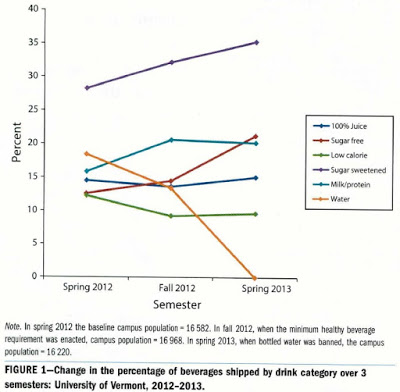
The orange line that drops to zero shows bottled water being phased out. The rising line at the top shows the rise in sugar-sweetened beverages. The red line in the middle that rises sharply shows the rise in sugar-free beverages.
via CONVERSABLE ECONOMIST: Banning Bottled Water: Unintended Consequences.
Auckland housing is more expensive than many big US cities
22 Jun 2015 Leave a comment
in economics of regulation, politics - New Zealand, politics - USA, urban economics Tags: Auckland, land supply, land use planning, RMA, zoning
Rising mortgage rates to test U.S. housing market rebound on.wsj.com/1IsKVde http://t.co/vHDJAdM292—
Pedro da Costa (@pdacosta) June 22, 2015
Green parties score 2/3 on this test?
21 Jun 2015 Leave a comment
in economics of regulation, health economics, politics - Australia, politics - New Zealand, politics - USA, technological progress Tags: 9/11, anti-vaccination movement, antiscience left, conspiracy theories, expressive voting, GMOs, inspiriting theorists, rational ignorance, rational irrationality, risk risk trade-offs, vaccines
The GMO food die-hard GMO opponents love (and oppose a label for)
20 Jun 2015 Leave a comment
in economics of information, economics of media and culture, economics of regulation, environmental economics, health economics, law and economics, politics - USA Tags: antiscience left, expressive voting, food labelling, GMOs, product labelling, rational ignorance, rational irrationality
Gun-free zones an easy target for killers | John Lott
19 Jun 2015 1 Comment
in applied price theory, economics of crime, economics of regulation, law and economics, politics - USA Tags: game theory, gun control, John Lott, mass public shootings, offsetting behaviour, read killers, The fatal conceit, The pretence to knowledge, unintended consequences

The decline of home ownership in the USA
16 Jun 2015 1 Comment
in economics of regulation, politics - USA, urban economics Tags: home ownership, housing affordability, lamb supply, land use planning, zoning
Home ownership rate, down to level of 20 yrs-ago, is headed even lower, says @NickTimiraos on.wsj.com/1IvwgDA http://t.co/2GeP3VIZzE—
Greg Ip (@greg_ip) June 08, 2015
The ridiculous non-candidate charade in presidential primary elections
15 Jun 2015 Leave a comment
in economics of media and culture, economics of regulation, politics - USA, Public Choice Tags: 2016 presidential election, campaign finance regulation, offsetting behaviour, The fatal conceit, The pretence to knowledge, unintended consequences

Australians are the world’s worst gamblers
15 Jun 2015 Leave a comment
in economics of media and culture, economics of regulation Tags: gambling, gambling regulation
Australians gamble (and lose) more than anyone else on a per-person basis econ.st/1Fy42BO #econarchive http://t.co/z2BeOcbRAn—
The Economist (@TheEconomist) June 06, 2015
Is Uber taking British customers for a ride?
14 Jun 2015 Leave a comment
in economics of regulation, entrepreneurship, industrial organisation, survivor principle Tags: creative destruction, taxi regulation, Uber
Is Uber taking British customers for a ride? i100.io/40kqOqH http://t.co/ok7UJmmgNQ—
i100 (@thei100) June 11, 2015
Prohibition lives! Counties where alcohol cannot be sold
12 Jun 2015 Leave a comment
in economics of regulation, health economics Tags: economics of prohibition, our goal regulation
US counties where alcohol is not allowed to be sold AKA dry counties (red) http://t.co/MC6iR6G9KE—
Charts and Maps (@ChartsandMaps) June 05, 2015
The rising gales of creative destruction in brewing
09 Jun 2015 Leave a comment
in economic history, economics of regulation, entrepreneurship, health economics, industrial organisation, survivor principle Tags: alcohol regulation, beer brewing, creative destruction, entrepreneurial alertness, innovation
Breweries in the US http://t.co/rcYlpmJspa—
Charts and Maps (@ChartsandMaps) April 11, 2015
What It’s Like to Be Declared Dead by the US Government
09 Jun 2015 Leave a comment
in economics of bureaucracy, economics of regulation, politics - USA Tags: government failure, Social Security numbers
In 2011, the Office of the Inspector General conducted an audit of the Death Master File, and found that, from May 2007 to April 2010, 36,657 living people (12,219 per year) had been prematurely added, nulling them legally dead. After probing deeper, officials estimated that between 700 and 2,800 people were erroneously declared dead every month since the list’s inception. Over the file’s 35-year history, the Inspector General suspects that more than 500,000 Americans have been affected.


Recent Comments