17 Apr 2015
by Jim Rose
in economics of regulation, Euro crisis, global financial crisis (GFC), great recession, job search and matching, labour economics, macroeconomics, unemployment
Tags: employment law reform, employment protections laws, Eurosclerosis, Germany
The countries with the more liberal labour markets are recovering fastest from the Great Recession and the Global Financial Crisis.
This includes Germany where there were major labour market reforms a couple of years before the onset of the Global Financial Crisis. For that reason, German unemployment rates didn’t rise much in 2008 and after and are now falling quite rapidly because of their labour market liberalisations. Germany has the lowest unemployment rate in Europe.

11 Apr 2015
by Jim Rose
in economics of media and culture, economics of regulation

A UK Greens voter spends more on organic food than do your average UKIP supporter and they are a lot thinner too.
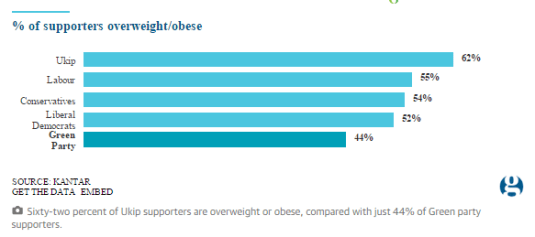
It’s a lot easier to support Nanny State policies when they mostly won’t apply you and are about forcing others to live like you:
Greens “Living the lifestyle; slim and organic-eating, home-delivered, concerned about health issues, the most eclectic shopping basket.”
I almost took this all back when I found out that Greens and Lib Dems are the most likely voters to have cats (30% and 25%) while UKIP supporters prefer dogs (28%).
07 Apr 2015
by Jim Rose
in economics of regulation, politics - Australia, politics - New Zealand, urban economics
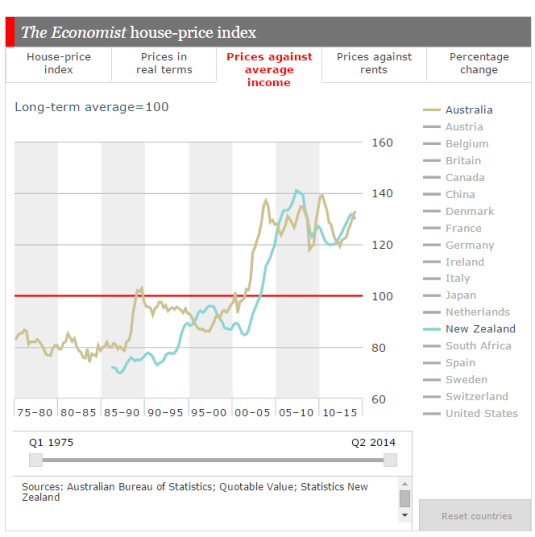
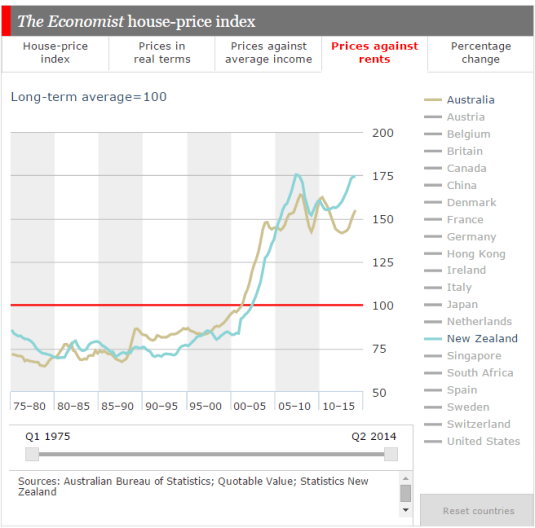
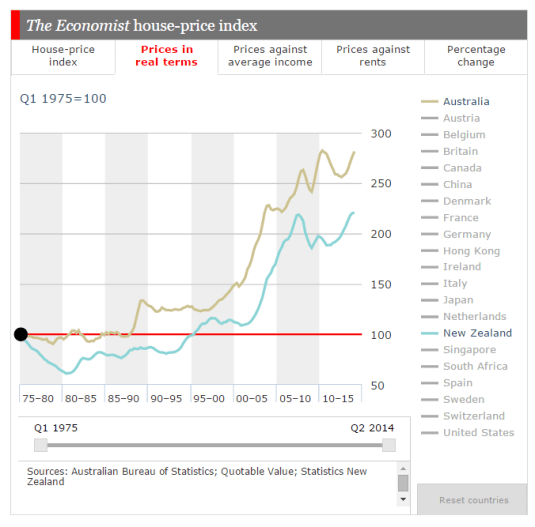
Everything seemed to go wrong regarding housing prices in New Zealand in about the year 2000, which was the year after the election of a Labour government. Labour parties are supposed to stand for a better deal for the ordinary worker. Clearly, they did not when housing prices run away because of restrictions on land supply.
05 Apr 2015
by Jim Rose
in applied price theory, economics of regulation, politics - New Zealand, urban economics
Tags: housing affordability, RMA, supply of land, zoning
If homebuyers access additional lines of funding because they can tap into their KiwiSaver retirement savings, they will use this to bid up the price of housing and land.
If the supply of land is fixed or otherwise constrained from expanding much, such as by the Resource Management Act and the metropolitan urban limit in Auckland, the only thing that will happen is that the price will go up with more money chasing the same amount of land and housing.

The price of land and housing must go up in the absence of some reforms that increase the supply of land. Rather than increase access to housing among those with don’t own a house, allowing homebuyers to access their KiwiSaver retirement savings entrenches the prospects of Generation Rent.
30 Mar 2015
by Jim Rose
in economics of media and culture, economics of regulation, health economics
Tags: Japan
One of the pluses of moving to Japan to study in 1995 was I didn’t move to study in Japan before 1992, which was when Japanese ambulances were first allowed to administer first aid.

Prior to 1992, Japanese ambulances were not permitted to administer first aid.They just loaded you into the back of the ambulance and off they went.
I know this to be true because I visited the Tokyo Fire Department in 1997 on on a field trip. On page 400 or so of their hand-out, there is a discussion of the change in Japanese ambulance law in 1992 permitting limited first aid to be administered in an ambulance under the supervision of a doctor by radio.
In our tour of the Tokyo Fire Department, we saw the control room where the doctor was sitting who administer guidance while first aid was being administered in an ambulance. Japanese ambulance professionals still have relatively limited training compared to other advanced countries.
21 Mar 2015
by Jim Rose
in currency unions, economic growth, economics of regulation, Euro crisis, fiscal policy, job search and matching, labour economics, labour supply, macroeconomics
Tags: British disease, Euroland, European Union, Eurosclerosis, Robert Solow

HT: Brad Delong
21 Mar 2015
by Jim Rose
in applied price theory, economics of regulation, environmental economics, politics - New Zealand, politics - USA, urban economics
Tags: land supply, land use regulation, RMA, supply and demand, zoning

In areas with a readily available supply of land on which to construct new homes—either because of geography or few land-use restrictions—builders have been sensitive to increases in local demand and existing-home prices. When existing houses rise in price relative to the cost of new homes, prospective buyers are willing and able to buy new units.
Supply conditions determine how house price and construction react to shifting demand. When housing demand rises—perhaps due to rising incomes, lower mortgage interest rates or easier credit standards—the outward shift in demand produces sharply higher house prices with a small increase in the supply of newly built units in areas with less-plentiful land. By comparison, when there is a more-plentiful land supply, the amount of housing is more supply sensitive and a rise in demand results in a less-pronounced rise in house prices and a greater increase of newly constructed homes.
As a result, house prices rise less in these supply-sensitive areas during booms and they fall less in downturns. Similarly, prices swing more and homebuilding varies less in regions with less-sensitive housing supply.


via Regionally, Housing Rebound Depends on Jobs, Local Supply Tightness – The Long-Awaited Housing Recovery – 2013 Annual Report – Dallas Fed.
Previous Older Entries Next Newer Entries



 Utopia, you are standing in it!
Recent Comments