The Green Left versus world hunger
20 Mar 2015 Leave a comment
in development economics, economics of information, economics of media and culture, economics of regulation, environmental economics, growth disasters, growth miracles, health economics Tags: extreme poverty, global poverty, GMOs, Green Left, Leftover Left, world poverty
Afghan Women in 1950 vs. 2013
17 Mar 2015 Leave a comment
Airline crash fatalities since 1947
15 Mar 2015 Leave a comment
in economics of regulation, transport economics

Via The String of ‘Safest Airline Years’ Is Over – NYTimes.com
RT if you think this summarises the Anti-Science Left
15 Mar 2015 Leave a comment
in economics of information, economics of media and culture, economics of regulation, environmental economics, global warming, health economics, politics - Australia, politics - New Zealand, politics - USA Tags: Anti-Science left, conjecture and refutation, expressive voting, Green Left, progressive left, rational ignorance, rational irrationality
RT if you agree with this warning sign
14 Mar 2015 Leave a comment
in economics of information, economics of media and culture, economics of regulation Tags: Anti-Science left, GMOs, organic farming
Killer drug approval lags
14 Mar 2015 Leave a comment
in economics of regulation, Sam Peltzman Tags: drug lags, Drug safety
Who gains and who loses from employment protection laws over the business cycle?
13 Mar 2015 Leave a comment
in business cycles, economics of regulation, Euro crisis, job search and matching, labour economics, law and economics, macroeconomics, unemployment Tags: employment protection laws, Euroland, Eurosclerosis, labour market regulation

77% more long-term unemployed people than before the crisis – We need them back in work! bit.ly/1JTTzYm #Jobs http://t.co/EFRGclFVms—
OECD Social (@OECD_Social) July 10, 2015

HT: IMF
Eroom’s law of R&D of new drugs
13 Mar 2015 Leave a comment
Eroom’s Law is Moore’s Law backwards:
since 1950, the number of drugs approved per billions of dollars in R&D spending has halved every nine years, adjusted for inflation.
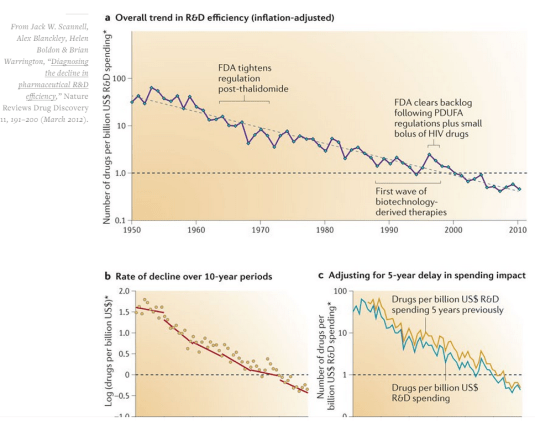
Via Toward a Wikipedia model of drug discovery — Plain Text — Medium.
Chiselling on the Closer Economic Relations agreement between New Zealand and Australia
10 Mar 2015 Leave a comment
in economics of media and culture, economics of regulation, politics - Australia, politics - New Zealand, rentseeking Tags: barriers to entry, closer economic relations, creative destruction, export pricing, free trade, Hollywood economics, price discrimination, protectionism, rent seeking
Back in the day, New Zealand television programming was sold cheaply into the Australian market. Many cultural and other products are exported into foreign markets and sold for whatever they can get above the price of shipping or digital transmission. What else explains all that rubbish on cable TV?
Under the Closer Economic Relations agreement that creates a single market between Australia and New Zealand, New Zealand made television programming content must be treated the same way as Australian content so it was included in their 50% local content rules for commercial television back from whenever I remember this story from. There was a Federal Court of Australia case that ruled that New Zealand television programming was Australian content programming for the purposes of the relevant media regulations because of Closer Economic Relations.

From the late 1990s, with revival of the New Zealand film and television industry, New Zealand content was starting to flood the Australian market, especially in the off-season in the summer when stations were looking for cheap content to fill a low ratings period.

Naturally, this Kiwi invasion did not please the rent seeking Australian television programme production industry and many a mendicant actor, writer and producer
Where there is a will, where there is a way: minimum quality standards are introduced into the Australian content rules defined by price – a price that happen to be above what the television stations used to pay for New Zealand made programming.
This question should be asked more often about the regulation of purported natural monopolies
09 Mar 2015 Leave a comment
Ample Proof That Cell Phone Towers DO NOT Cause Cancer
06 Mar 2015 Leave a comment
in economics of regulation, health economics, politics - New Zealand Tags: Anti-Science left, Greens, Quacks
Tin foil hat brigade has a recruit in New Zealand. Thousands more cellphone antennas could be installed without community consultation under a proposed environmental rule change.
Green Party environment spokeswoman Julie Anne Genter said the Government appeared to have little regard for environmental outcomes or community input.
“We support National Environmental Standards but they need to be used to protect the environment, not to override the right of local communities to have a say,” she said.


|
View original post 304 more words
France, here the New Zealand labour market comes! The Employment Court’s long march to re-regulate
03 Mar 2015 Leave a comment
in economics of regulation, job search and matching, labour economics, law and economics, organisational economics, politics - New Zealand Tags: employment protection laws, France, The fatal conceit, vexatious litigation
If the Employment Court had its way, New Zealand case law under the Employment Relations Act regarding redundancies and layoffs would be as strict as those in France. As top employment lawyer Peter Cullen explained in the Dominion Post today:
Former Employment Court chief justice Tom Goddard said employees could not be made redundant unless the company would otherwise go to the wall.
The employer appealed.
The Court of Appeal said something quite different. Its view was that if a business could be run more efficiently without a particular position, then it was entitled to disestablish it.
The Court of Appeal made it plain that it would not critically examine the logic behind the employer disestablishing a role. If the reason behind the redundancy was genuine, that was all that really mattered. Of course a fair process and consultation ought to precede any decision, but the outcome nevertheless was that the position could go.
The Employment Court wanted the position to be the same as at that in France where layoffs are permissible only to avoid bankruptcy:
…firms still cannot lay off workers to improve competitiveness when the business is healthy; they can only make economic dismissals to preserve competitiveness when already in financial straits. In France, it ought to be legal to fix small problems before they become big.
This French standard of regulation of layoffs and redundancies, if it had survived on appeal, would have come as a surprise to many, including the OECD who rates New Zealanders having no regulation of layoffs in its Index of Employment Protection.
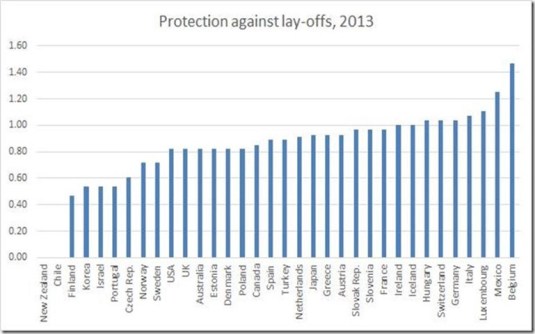
Source: OECD employment protection index.
But you can’t keep an activist Employment Court down. It’s next tactic was salami tactics. Chipping away at the right of the employer to run its business and decide how large its labour force is. Peter Cullen again with the Employment Court pretending it can second-guess entrepreneurial judgements and arithmetic:
In the case between Grace Team Accounting and employee Judith Brake, the Employment Court found that the decision to make Brake’s position redundant was based upon mistaken arithmetic. The Court of Appeal held that Brake’s redundancy amounted to an unjustified dismissal.
Next cab off the rank was requiring employers to give preference to redundant employees pretty much no matter what. Peter Cullen again:
In the case of Neil Wang and his employer the Hamilton Multicultural Services Trust, the trust encouraged Wang to apply for another role within the organisation.
However, the Employment Court said the trust should have considered whether they should have simply offered Wang the position without having to go through an application process.
The court found that even though the other role was not the same, it required the same skills and minimal retraining and so the trust should have simply given Wang the role.
It is standard in the redundancies and restructurings I’ve been involved with for non-managerial employees to go through internal reassignment panels. Some didn’t make it and were laid off.

It’s common for the managerial vacancies to be advertised externally so that redundant managers must compete with external applicants so that the workplace can renew itself. Quite a few managers don’t make it through this process because of the external competition.
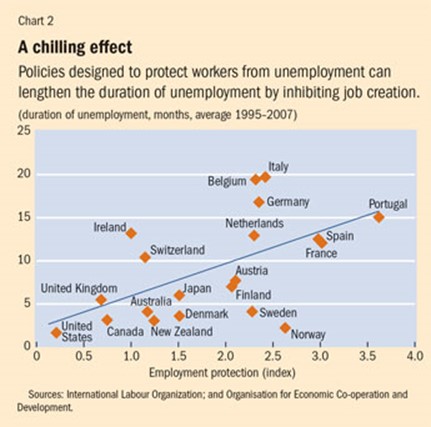
This clear preference for existing employees is a major reregulation of the labour market. Now, every redundant employee can engage in vexatious litigation and squeeze a few thousand dollars extra out of the employer by threatening to go to the Employment Court for a second opinion on the entrepreneurial judgements of the employer. To save managerial time as well is legal fees, it’s cheaper for most employers to pay the redundant employee off with a small settlement.

Anything that makes it more expensive to fire an employee makes it more expensive to hire an employee. This will reduce job creation in New Zealand now that the French standard applies:
…businesses remain obligated to assist laid-off employees in finding other jobs and in retraining them for their new positions – a distinctly French phenomenon. For businesses with more than 1,000 employees, this limbo period before dismissal can last from four to nine months.

Back when Amazon One-Click would have required an import licence every time you used it
03 Mar 2015 Leave a comment
in economic history, economics of regulation, international economics, politics - New Zealand
Wilful ignorance is at its best when criticising the post-1984 economic reforms in New Zealand. Critics can’t be bothered, don’t want to know or pretend they don’t know how heavily regulated the New Zealand economy was up until 1984.

An example is the use of Amazon One-Click which everyone takes for granted. Back in 1984 it would have required an import licence:
To send money overseas you bought money orders from the Post Office. Above a certain amount “about $5 a day” you applied to the Reserve Bank. Same for international magazines – you filled out a form, sent it to the Reserve Bank, and got permission from Nanny to send funds offshore
Of course, when in our intrepid left-wing reactionaries hear of this, they would say that they would agree that that is a bit too much and that regulation should have been repealed. That just makes them Roger Douglas lite!
What else do they want to not bring back: give Telecom back its monopoly; marginal tax rates will go back to 66 per cent, kicking in at $30,000? All shops must close of the weekends?
Importing consumer goods generally required a licence prior to the economic reforms of the labour government that was elected in 1984. In addition, up until 1984, a wide range of goods had quotas that restricted how much could be imported in any one year.
Alan Gibbs recently told a story about every time his tractor company wanted to import a tractor, he needed a new import licence and his competitors could object to the issue of that licence! Nowadays, they would use the Resource Management Act resource consenting process to object to competitors when they try and expanded their business.
David Friedman on global warming, population and problems with the externality argument
02 Mar 2015 Leave a comment
in applied price theory, applied welfare economics, comparative institutional analysis, constitutional political economy, David Friedman, economic history, economics of information, economics of regulation, environmental economics, environmentalism, global warming, law and economics, population economics, property rights Tags: climate alarmism, competition as a discovery procedure, David Friedman, externalities, global warming, population bomb, The fatal conceit, The pretence to knowledge




 Utopia, you are standing in it!
Recent Comments