NewstalkZB reports: Police have restrained more than $2.5 million in assets, including four properties in Gisborne, after a discovery of undeclared tobacco was intercepted at the border. It comes after Customs intercepted 110kg of loose tobacco and more than 230,000 cigarettes – approximately 10,000 packets – concealed in Chinese tea packets in November last year, bound for residential and […]
Another big tobacco black market bust
Another big tobacco black market bust
05 Jan 2025 Leave a comment
in applied price theory, economics of regulation, health economics, politics - New Zealand Tags: black markets, economics of smoking
Modern Scientific Controversies: The War on Food: Part 1
04 Jan 2025 1 Comment
in economics of regulation, health economics Tags: Anti-Science left, food safety
The nutrition and food news today, including radio, TV, blogs, is full of stories decrying the consumption of Ultra-Processed Foods – UPFs. Normally I would give a series of links to the latest headlines but I doubt anyone could have missed them – they have been ubiquitous.
Modern Scientific Controversies: The War on Food: Part 1
Some Links
03 Jan 2025 1 Comment
in applied price theory, comparative institutional analysis, constitutional political economy, defence economics, economic history, economics of crime, economics of regulation, industrial organisation, international economics, International law, law and economics, politics - USA, war and peace
TweetArnold Kling ponders producers versus parasites. A slice: What I notice is that the elites on the Republican side tend to earn a living as producers. They make things that other people want or need. In contrast, elites on the Democratic side include many people one may think of as parasites. They depend on producers…
Some Links
Te Pati Maori promise retrospective legislation
02 Jan 2025 Leave a comment
in comparative institutional analysis, constitutional political economy, economics of regulation, industrial organisation, law and economics, politics - New Zealand, property rights Tags: constitutional law
Te Pati Maori have written to organisations saying that if they are part of a Labour-led Government, they will pass retrospective legislation to punish organisations for actions that were entirely legal. You wonder how much more they need to do, to have media hold them to the same account as any other political party. They […]
Te Pati Maori promise retrospective legislation
Some Links
02 Jan 2025 Leave a comment
in applied price theory, economics of regulation, history of economic thought, industrial organisation, politics - USA
TweetMike Munger explains that “the only way to gain jobs is to lose jobs.” Two slices: Politicians want to create jobs, “good-paying union jobs,” in existing industries. But that’s not what markets do. The “destructive” part of creative destruction eliminates jobs in existing industries. In a dynamic economy, innovations indivision of labor can create good-paying…
Some Links
Some Jimmy Carter observations from the 1970s
01 Jan 2025 Leave a comment
in business cycles, defence economics, economic history, economics of regulation, energy economics, macroeconomics, monetary economics, politics - USA, war and peace Tags: Middle-East politics
Usually I am reluctant to criticize or even write about the recently departed, but perhaps for former Presidents there is greater latitude to do so. I never loved Jimmy Carter, and I saw plenty of him on TV and read about his administration on a daily basis in The New York Times. I fully appreciate […]
Some Jimmy Carter observations from the 1970s
Argentina facts of the day
29 Dec 2024 Leave a comment
in budget deficits, comparative institutional analysis, development economics, economic growth, economics of bureaucracy, economics of regulation, F.A. Hayek, financial economics, fiscal policy, growth disasters, income redistribution, international economics, labour economics, law and economics, liberalism, libertarianism, macroeconomics, Milton Friedman, monetarism, monetary economics, property rights, Public Choice, rentseeking, unemployment Tags: Argentina
Argentina’s bonds have already rallied dramatically. One gauge of the nation’s hard-currency debt, the ICE BofA US Dollar Argentina Sovereign Index, has generated a total return of about 90% this year. Meanwhile, the S&P Merval Index has risen more than 160% this year through Monday, far outpacing stock benchmarks in developed, emerging and frontier markets […]
Argentina facts of the day
The New FDA and the Regulation of Laboratory Developed Tests
28 Dec 2024 Leave a comment
in applied price theory, economics of bureaucracy, economics of regulation, health economics, politics - USA, Public Choice Tags: drug lags
The FDA under President Trump and new FDA head Martin Makary should rapidly reverse the FDA’s powergrab on laboratory developed tests. To recap, laboratory developed tests (LDTs) are the kind your doctor orders, they are a service not a product and are not sold directly to patients. Congress has never given the FDA the authority […]
The New FDA and the Regulation of Laboratory Developed Tests
Govt Consultation on EV Targets
26 Dec 2024 1 Comment
in economics of climate change, economics of regulation, energy economics, environmental economics, environmentalism, global warming, transport economics Tags: British politics, electric cars, hybrid cars

By Paul Homewood The Government has begun consultations on the role of hybrid cars between 2030 and 2035: . The UK automotive and charging industries have been invited to shape the UK’s transition to zero emission vehicles, as the UK government works with the sector to harness the huge opportunities for economic growth and […]
Govt Consultation on EV Targets
Holes in IPCC Science Revealed
26 Dec 2024 1 Comment
in economics of education, economics of regulation, energy economics, environmental economics, global warming, politics - Australia, politics - New Zealand, politics - USA Tags: climate alarmism

Graeme Weber reports from Australia on the history revealing multiple holes in IPCC claimed “settled science.” His paper is IPCC – Miss/Diss information? shared with me by email. Graeme is an earth scientist, retired consulting geologist and advocate for nuclear energy. His text is in italics with my bolds and added images. Several years ago, […]
Holes in IPCC Science Revealed
Eminently Overdue: The Supreme Court Considers New York Case That Could Overturn the Infamous Kelo Decision
21 Dec 2024 Leave a comment
in economics of regulation, law and economics, politics - USA, property rights Tags: constitutional law, takings

As an academic and a legal commentator, I have sometimes disagreed with the United States Supreme Court, but I often stress the good-faith differences in how certain rights or protections are interpreted. One case, however, has long stood out for me as wildly off-base and wrongly decided: Kelo v. New London. The case allowed the […]
Eminently Overdue: The Supreme Court Considers New York Case That Could Overturn the Infamous Kelo Decision
British Government Climate Advisors Demand Everyone Live like Poor People
15 Dec 2024 1 Comment
in economics of climate change, economics of regulation, energy economics, environmental economics, environmentalism, global warming, liberalism, Marxist economics Tags: British politics, climate activists, climate alarmism
“… fly less, eat less meat and use public transport more often …”
British Government Climate Advisors Demand Everyone Live like Poor People
The Nobel Prize lectures in economics
12 Dec 2024 Leave a comment
in applied price theory, comparative institutional analysis, constitutional political economy, development economics, economics of crime, economics of regulation, growth disasters, growth miracles, history of economic thought, law and economics, property rights, Public Choice
More on Business Dynamism
11 Dec 2024 Leave a comment
in applied price theory, economic history, economics of bureaucracy, economics of regulation, entrepreneurship, financial economics, income redistribution, industrial organisation, labour economics, labour supply, managerial economics, organisational economics, personnel economics, Public Choice, rentseeking, survivor principle, theory of the firm Tags: creative destruction, employment law
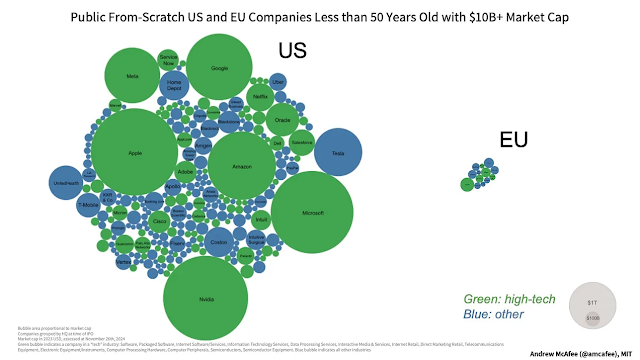
Over at the Geek Way, Andrew McAfee has created a startling visualization related to entrepreneurship in the US and EU. The Draghi Report on EU competitiveness is generating a small buzz among economists. One startling claim is thatthere is no EU company with a market capitalisation over EUR 100 billion that has been set up…
More on Business Dynamism
How is the Russian war economy doing?
08 Dec 2024 1 Comment
in applied price theory, defence economics, development economics, economic growth, economics of regulation, entrepreneurship, fiscal policy, growth disasters, income redistribution, industrial organisation, international economics, law and economics, macroeconomics, monetary economics, property rights, Public Choice, war and peace Tags: Russia, Ukraine
Here is a gloomy account from Vladimir Mirov: Ruble depreciation will contribute to inflation even further, as Russia is continued to be heavily reliant on imports – this is a kind of self-sustaining spiral. I also strongly disagree with those who say that cheaper ruble is “good” for exporters and the budget. Exporters have yet […]
How is the Russian war economy doing?
 Utopia, you are standing in it!
Recent Comments