I have made no secret of me deep skepticism about President Trump’s tariff policies since he announced his “Liberation Day” tariffs in April 2025. My first-blink “Thoughts on the Trump Tariffs” from a few days after the announcement has held held up reasonably well, and I have posted follow-ups on the subject a number of…
The Cato Institute, Michael McConnell, and I filed an amicus brief in litigation challenging Trump’s massive Section 301 tariffs, which use “forced labor” as a pretext for sweeping protectionism.
TweetHere’s a letter to F&D Magazine, a publication of the IMF. Editor: U.S. Trade Representative Jamieson Greer wrote more than 2,100 words about trade yet managed to get correct approximately nothing (“Economics for the Real Economy,” June 2026). Just listing his errors would take nearly as many words, so I here address only one of…
TweetHere’s a letter to a new correspondent. Mr. H__: Thanks for your email. You write, in response to this post of mine, that I am “too quick at second guessing the president and his administration on its determination of the trade behaviors of other countries.” You say that I “owe the administration the benefit of…
By Inti Pacheco of The WSJ. Excerpts:”Behind the jump: Extreme weather, including droughts in Brazil and Vietnam, had hit coffee crops. And even before any tariff increases, hedge-fund bets anticipating the levies were pushing commodity prices higher.” (droughts cause supply to shift to the left which raises price)”Then in July, President Trump slapped an additional 40%…
In our textbook, Modern Principles, Tyler and I emphasize that Congress and the President are subject to a higher law, the law of supply and demand. In an excellent column, Jason Furman gives a clear example of how difficult it is to fight the law of inelastic demand: …Today a given number of autoworkers can…
The recent Supreme Court decision that President Trump did not have arbitrary and unbounded powers he has claimed to impose or retrace tariffs came as no surprise, for a variety reasons laid out in earlier posts here, here, and here. But here I want to focus on a different claim: that the reason for tariffs…
In Part I of this series, we reviewed some new research from the New York Federal Reserve. That study showed that Americans bear about 90 percent of the burden of Trump’s Liberation Day trade taxes. Though I added my own two cents because I don’t actually care that much about who bears the burden of […]
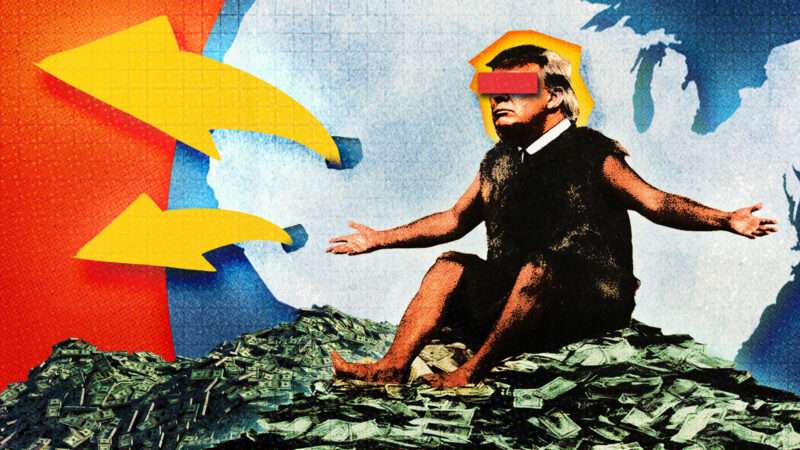
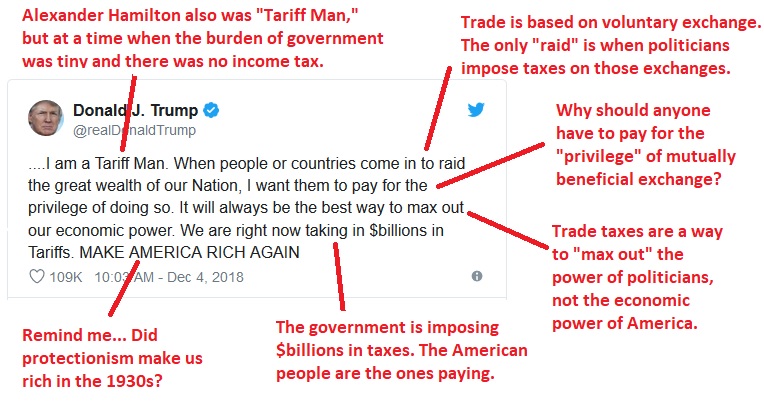
Donald Trump, who describes himself as “Tariff Man,” recently wrote a column in defense of his protectionist trade policy for the Wall Street Journal. After reading the column, my first thought was that Trump was trying to show he is more economically illiterate than Joe Biden (a big challenge, as seen here and here). And […]
TweetHere’s a letter to AP Fact Check. Editor: Melissa Goldin does a deep dive into the cause(s) of the U.S. “agricultural trade deficit” (“FACT FOCUS: Trump blames Biden for the agricultural trade deficit. It’s not that simple,” December 10). To what extent is this “deficit” caused by the policies of Biden? To what extent is…
It seems as if a few times every week, I see a headline about President Trump announcing a new tariff or repealing a tariff, sometimes involve many countries and sometime just a few. However, it is not at all clear that any president has a right to alter tariffs. This question was raised before Trump…
TweetThe Civitas Institute at UT-Austin just published a superb symposium on tariffs, with contributions by Richard Epstein, Samuel Gregg, Dirk Mateer, Dominic Pino, and my intrepid Mercatus Center colleague, Veronique de Rugy. Below are some slices. “The Man Who Knew Too Little: Donald Trump on Tariffs” (Richard Epstein): It is a dangerous state of affairs…
TweetHere’s a follow-up letter to a new correspondent. Mr. K__: Thanks for your follow-up email, and no need to apologize for what you call your “continued confusion about tariffs as taxes.” It’s I who apologize for communicating unclearly. So, especially because you’re not the only person who I managed to confuse, I’ll take one more…
TweetFareed Zakaria, writing in the Washington Post, eloquently corrects many of the fallacies believed by MAGA-types (and also by many – most? – progressives’) about the American economy. Two slices: The Organization for Economic Cooperation and Development’s measure of median disposable household income in America was higher than in all but one advanced industrial economy…
Why Evolution is True is a blog written by Jerry Coyne, centered on evolution and biology but also dealing with diverse topics like politics, culture, and cats.
In Hume’s spirit, I will attempt to serve as an ambassador from my world of economics, and help in “finding topics of conversation fit for the entertainment of rational creatures.”





Recent Comments