
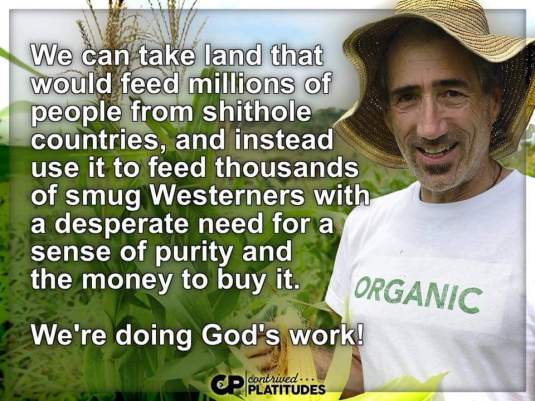
So true
31 Mar 2018 Leave a comment
in development economics, economics of regulation, environmental economics, health economics Tags: agricultural economics, food snobs, organic farming
Are Republicans or Democrats More Anti-Science?
30 Mar 2018 Leave a comment
in economics of information, economics of regulation, health economics Tags: Anti-Science left
Thomas Sowell on the Vulgar Pride of Intellectuals
27 Mar 2018 Leave a comment
in applied price theory, applied welfare economics, comparative institutional analysis, constitutional political economy, development economics, discrimination, economic history, economics of education, economics of regulation, labour economics Tags: Thomas Sowell
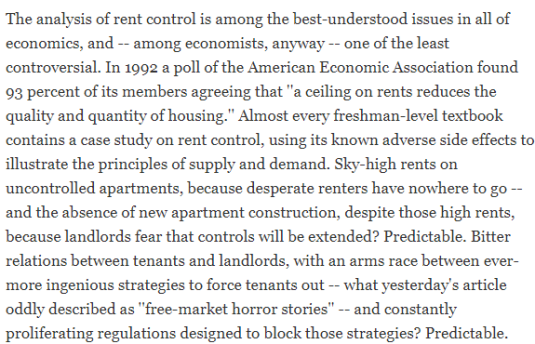
@paulkrugman & #Seinfeld explain rent controls
23 Mar 2018 Leave a comment
in applied price theory, economics of regulation, politics - New Zealand, television, urban economics
Submission to Select Committee: International treaty examination of the Comprehensive and Progressive Agreement for Trans-Pacific Partnership
14 Mar 2018 1 Comment
in applied price theory, applied welfare economics, economics of regulation, international economics, politics - New Zealand, Public Choice
This submission is in my personal capacity. I am an economic consultant in Wellington who has worked in the past for the Ministry of Business, Innovation and Employment, the Department of Labour, the Ministry of Social Development, Child, Youth and Families Department and the New Zealand Treasury, and in Canberra for the Productivity Commission, the Department of Prime Minister and Cabinet, and the Department of Finance. I have Masters degrees in economics and in public policy from the Australian National University and from the now National Graduate Institute for Policy Studies in Tokyo respectively. I have written op-eds on the Trans-Pacific Partnership Agreement and other topics for the New Zealand Herald, Dominion Post and National Business Review. I blog at www.utopiayouarestandinginit.com
Free trade agreements are at best suspect. That is not me saying this. That is Paul Krugman, his generation’s leading trade theorist.
Krugman argues that you should start as a mild opponent of any free trade agreement. Closely inspect the baggage they carry; environment and labour chapters, intellectual property, investor state dispute settlement (ISDS) and government procurement such as Pharmac. Start with a sceptical eye.
These add-on chapters are the costs of free trade agreements that are relatively obvious to the untrained eye. No technical economics is yet required to suspect that any trade agreement will be an opportunity for special interests on the right and the left, both unions and big corporations, to feather their own nest. Longer patent lives, more stringent enforcement of overseas copyrights, Pharmac buying more expensive drugs, and so on in return for tariff cuts in export markets.
But let us start with what is claimed as the benefits by the government. In a TPPA without the USA, in about 30-years’ time, as little as 0.3% extra GDP and at most 1% more GDP in sum will be generated. Less than one quarter of these modest gains over 30 years come from tariff cuts.
The rest of the gains are from behind the border changes from streamlining customs to investor state dispute settlement. Never easy to quantify because even the most impartial spectators can disagree amongst themselves on whether these regulations are a plus or minus to begin with, so they cannot agree on whether reducing or increasing them are a plus or not. The 20 odd carve-outs and side letters negotiated by the new government was all about prying back this baggage. This suggests that most of this baggage should not have been loaded up to begin with.
The only time tariff cuts are suspect is when they are part of a free trade agreement. The reason is trade diversion. A technical concept which MFAT does not know about because I received a nil response to an Official Information Act request about their TPPA advice to ministers about the costs and benefits including any reference to trade diversion.
We have been of the rough end of trade diversion in the two biggest trade agreements to affect us. When Britain entered the Common Market in 1973, they stop buying cheap New Zealand lamb in favour of expensive French lamb. The tariff revenue collected by the British on our lamb exports was converted into payments to prop up hopelessly inefficient French farmers. British consumers paid the same or more for lamb and there was no tariff revenue to collect.
New Zealand car buyers then got screwed by Closer Economic Relations. Instead of buying cheap Japanese imports and collecting a tariff, Holdens and Fords became cheap because they did not pay this tariff. Cars were not cheaper for New Zealand buyers; the tariff revenue went off to Australian car manufacturers as higher import prices to keep their hopelessly inefficient car plants open.
With the USA out of the TPPA, the tariff cuts are less even if there was no trade diversion and we still have all the baggage in the agreement from environment and labour chapters, intellectual property, threats to Pharmac, and ISDS. The costs have not gone down but the benefits have because of the loss of the single biggest market planning to join the agreement.
Investor state dispute settlement has no place in trade agreements between democracies. They have the rule of law where investors can take their chances in domestic politics just like the rest of us. Yes, there will be breathless populism from the left or right from time to time, such as recently over foreign land sales, but by and large foreign investment is welcome and gets a fair deal.
Developing countries offered to sign on to investor state dispute settlement because their own courts are corrupt. Maybe investor state dispute settlement worked 50 years ago when investment in developing countries was tiny and handled by a few big players who might get picked on by politicians looking for a few cheap votes or more likely, a backhander to the Swiss bank account.
Now there is broad-based trade and investment in developing countries despite their corrupt courts and dodgy politicians. Many exporters and investors are willing to take their chances. When the local politicians and bureaucrats get rough, investors have already factored that in by backing investments with high enough returns to compensate for these risks. Tourists buy travel insurance and keep their eyes open; investors know the rules abroad are different and must be just as watchful.
Japan, Singapore, South Korea, Hong Kong, Taiwan and the other Asian Tigers and now India too managed to have development miracles without investor state dispute settlement. Extreme poverty dropped by about 1/3rd around the globe over the decade or so course of the TPPA negotiations and far more than that in China so I think they are getting on pretty well without it.
Most of these points are lost in the debate on the TPPA because too many of its opponents are motivated by anti-capitalist or anti-foreign sentiments rather than cost benefit analysis. They would oppose a trade agreement solely about tariffs that lowered prices to New Zealand consumers.
Not every trade negotiation is successful. For some, you reach the point where you must walk away. More so because of all the baggage loaded up into trade agreements in the last few decades.
There should be a hard-nosed benefit cost analysis and when the USA was in, the TPPA might have been worth the risk, just. More access to the US market may have made up for all the other baggage. The price has gone up on signing the TPPA, so much so we probably should give it a miss.
The Most Dangerous Monopoly: When Caution Kills
13 Mar 2018 Leave a comment
in applied price theory, applied welfare economics, economics of information, economics of regulation, environmental economics, health economics Tags: drug lags, Drug safety, Product safety, The fatal conceit
2 Minutes with Friedman
12 Mar 2018 Leave a comment
in applied price theory, David Friedman, development economics, economics of regulation, labour economics Tags: spontaneous order, The fatal conceit
.@nzfamilies commission estimate of cost of zoning
11 Mar 2018 1 Comment
in applied price theory, economics of regulation, politics - New Zealand, Public Choice, rentseeking, urban economics Tags: housing affordability, land supply, zoning

The Coase Theorem
06 Mar 2018 1 Comment
in applied price theory, applied welfare economics, comparative institutional analysis, economics of regulation, law and economics, Ronald Coase Tags: Coase theorem
Will bicyclists be banned when human driving is banned because self-driving cars are so much safer?
05 Mar 2018 Leave a comment
in economics of regulation, transport economics
.
The Most Dangerous Monopoly: When Caution Kills
25 Feb 2018 Leave a comment
in applied price theory, applied welfare economics, comparative institutional analysis, economic history, economics of information, economics of regulation, health economics, law and economics Tags: drug lags
Do-gooders want to introduce rent controls and security of tenure to restrain rapacious landlords further. Little wonder every 3rd Auckland rental property is sold and the tenants evicted every 2 years.
12 Feb 2018 1 Comment
in applied price theory, economics of regulation, politics - New Zealand, poverty and inequality, urban economics


Recent Comments