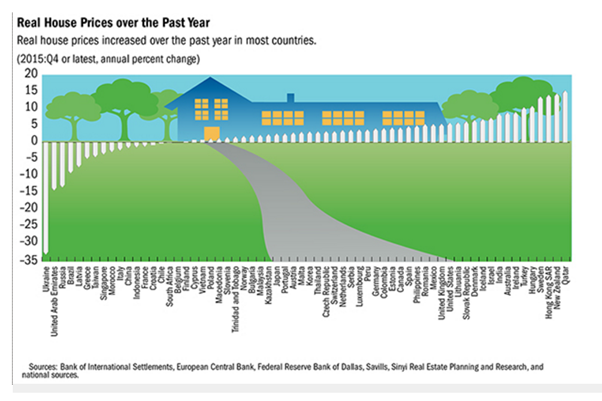
Source: IMF Global Housing Watch.
Celebrating humanity's flourishing through the spread of capitalism and the rule of law
13 Jul 2016 Leave a comment
in economics of regulation, politics - New Zealand, urban economics Tags: housing affordability, land supply, zoning
Source: IMF Global Housing Watch.
08 Jul 2016 Leave a comment
in applied price theory, economics of regulation, politics - New Zealand, urban economics

Source: Housing ‘challenge’ still not a ‘crisis’ | Radio New Zealand News.
Neither Labour nor the Greens have explained where the new land will come from inside the Auckland Metropolitan Limit to build their 100,000 additional houses nor why their proposals will be granted resource consents under existing resource management legislation.
The National Party is unwilling to push shared with resource management law reform despite having 61 votes to do so because of fear of losing votes in the centre.
03 Jul 2016 Leave a comment
in applied price theory, economics of regulation, law and economics, property rights Tags: price controls
03 Jul 2016 Leave a comment
in economics of regulation, health economics Tags: alcohol regulation, black markets, economics of prohibition, economics of smoking, marijuana decriminalisation, offsetting behaviour, The fatal conceit, The pretense the knowledge
02 Jul 2016 1 Comment
in economics of regulation, libertarianism, Public Choice
Only 4% of UKIP voters do not understand why they vote that way.
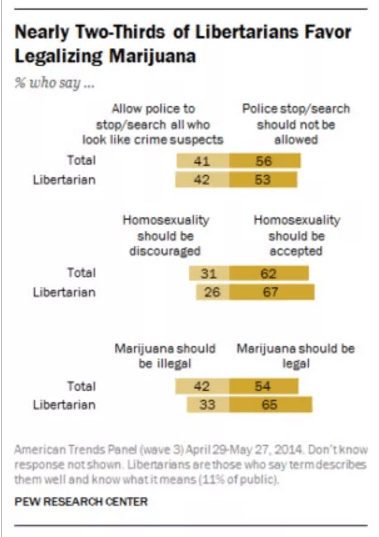
1/3rd of libertarians do not understand that to be a libertarian means you have to have rather liberal views on marijuana decriminalisation but 1/3rd do not know this.
There has to be some sort of litmus test of being both a UKIP voter and on the on the list the name at night will pick me as we all take more a you being a libertarian. 1/3rd of libertarians failing compared to 4% of UKIP voters do but these probably have already joined the perpetually baffled.
29 Jun 2016 Leave a comment
in economics, economics of regulation, law and economics, urban economics Tags: land supply, land use planning, NIMBYs, zoning
23 Jun 2016 Leave a comment
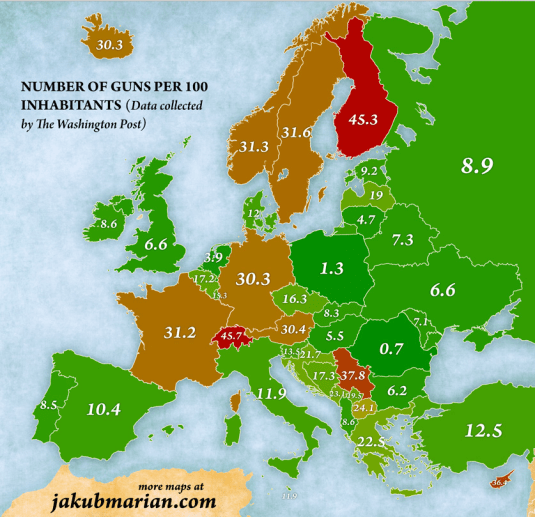
in economics of regulation Tags: gun control
18 Jun 2016 Leave a comment
in applied price theory, applied welfare economics, comparative institutional analysis, economics of crime, economics of regulation, law and economics, politics - USA Tags: expressive voting, game theory, gun control, offsetting the, unintended consequences
https://twitter.com/Thomas_Conerty/status/649800146528563200
If you want fewer mass shootings, reduce the supply of gun free zones where even the craziest gunmen have been able to find despite being tormented by the voices as John Lott explains
Time after time, we see that these killers tell us they pick soft targets. With just two exceptions, from at least 1950, the mass public shootings have occurred in these gun-free zones. From last summer’s mass public killers in Santa Barbara and Canada, to the Aurora movie theatre shooter, these killers made it abundantly clear in their diaries or on Facebook how they avoided targets where people with guns could stop them.
And even when concealed handgun permit holders don’t deter the killers, the permit holders stop them. Just a couple of weeks ago, a mass public shooting at a liquor store in Conyers, Ga., was stopped by a concealed handgun permit holder.
The USA is in an arms race between criminals and law-abiding citizens. Both have lots of guns so the only people who gain from disarmament to those who obey the law to have fewer guns. They are in a high gun equilibrium where it very difficult to get out of this arms race.
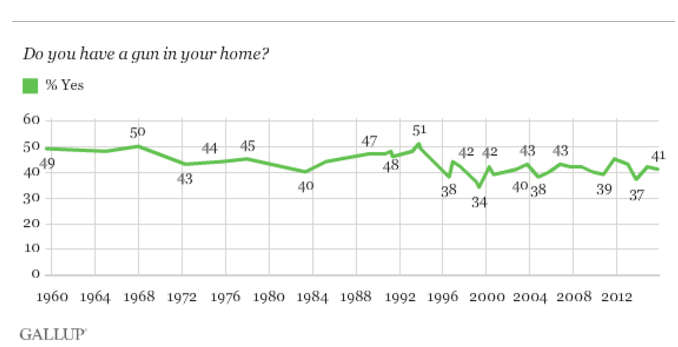
Demands for more gun control and bans on specific weapons postpone the hard work of how to reduce mass shootings in a society with easy gun access. It is expressive politics at its worse.
What does U.S. gun ownership really look like? Load up with #PollPosition’s @Johnnydontlike: bit.ly/1y2EMjX http://t.co/fn5EpM75U7—
(@PJTV) March 25, 2015
An Australian politician today in an unrelated context regarding universal health insurance in Australia called Medicare made this point about politics is hard work, not political theatre
It’s so much easier today to be a cynical poseur than a committed democrat, it’s easier to retreat to observer status than convince your friends of the merits of incremental change.
It required hard slog to ensure those institutions could survive the heat of adversarial politics. Then it took election campaign after election campaign, tough political negotiation, administrative effort, and the making and breaking of careers and governments to finally make Medicare stick,” she said.
The creation of Medicare took more than a hollow-principled stand, it took more than just wishful thinking, it took more than slogans, it took more than protests. It took real, tough politics. It took idealists who were prepared to fight to win government.
Expressive politics is about what voters boo and cheer, not whether policies actually work if adopted. Voters want to feel good about what they voted for and find a sense of identity in who they oppose and what they support. After a mass shooting, voters feel they must do something, cheer for something better and cheering for more gun control is an easy way to feel better.
Gun control is not going to happen in the USA because of the poor incentives for law-abiding individuals to retreat from high levels of legal private gun ownership when criminals will keep their guns. Harry Clarke pointed out that:
The political popularity of guns is strengthened by Prisoner’s Dilemma disincentives for individuals to retreat from high levels of gun ownership.
Accepting a gun buyback would be unattractive to citizens who would recognize high levels of overall gun ownership in the community and, hence, their own personal increased vulnerability if those with criminal intent acted rationally and kept their weapons.
If you want fewer mass shootings, fewer gun free zones is the way to go. That might have other unintended consequences but more mass shootings is not likely to be one of them. Ready access to guns in moments of despair increases suicide rates. Suicides in the Israeli Defence Force fell 40% when young soldiers were not allowed to take their guns home at the week-end. Suicides do not increase during the week so the lack of weekend access to guns got them through dangerous moments of despair where ready access to a firearm would have led to a suicide.

The last thing spree killers want is to be quickly shot down like the dogs they are such as at an American church in 2007. The last wannabe jihadist to try it on in Texas died in a hail of gunfire.
The U.S. Department of Justice’s National Crime Victimization Survey showed the risk of serious injury from a criminal attack is 2.5 times greater for women offering no resistance than for women resisting with a gun. 97% of murders are by men. Any arguments about gun control should be about gun control for men.
The sharemarket perception of gun control is every time there are calls for more gun controls, the share prices of gun manufacturers surge of the back of an anticipated spike in sale. Buying two gun shares on the first trading day after 12 recent mass shootings and selling them 90 days later produces a return of 365% over a nine-year period compared to 66 percent for the S&P 500 Index. A buy-and-hold bet on Smith & Wesson stock starting in January 2007returns 137%.
What gun-control headlines mean for gun-industry bottom lines: reut.rs/20LPJGf via @specialreports https://t.co/R3QiG4MuSM—
Reuters Top News (@Reuters) February 05, 2016
The key to the success of Australian and New Zealand gun laws was low levels of gun crime and minimal use of guns for self-defence. There was no arms race as compared to the USA where criminals and civilians are both armed. It is easy to control an arms race that has not started. The New Zealand, Australian and even the British police rarely have to discharge their weapons.

Martin Luther King was a gun owner for obvious reasons. Tom Palmer was the lead litigant in the recent Supreme Court case on gun control in the USA. He saved himself and a fellow gay man from a severe beating in 1987 by gang of 20 men by pulling a gun on them. Pink pistols has been in the thick of anti-gun control litigation in the USA.
18 Jun 2016 Leave a comment
in applied price theory, comparative institutional analysis, economics of regulation, Public Choice, rentseeking, Ronald Coase
.
17 Jun 2016 Leave a comment
in applied price theory, econometerics, economics of regulation, labour economics, minimum wage, politics - New Zealand Tags: employment law, employment protection law, employment regulation, offsetting behaviour, probationary periods, trial periods
https://twitter.com/moturesearch/status/743595301345333248
Media reporting and Motu’s own tweet on its research contradict its own conclusions about what it found about the introduction of 90-day trial periods for new jobs in New Zealand.
https://twitter.com/moturesearch/status/743563189451841537
Motu’s executive summary is both as bold as the Motu tweet and directly contradicts it
We find no evidence that the ability to use trial periods significantly increases firms’ overall hiring; we estimate the policy effect to be a statistically and economically insignificant 0.8 percent increase in hiring on average across all industries.
However, within the construction and wholesale trade industries, which report high use of trial periods, we estimate a weakly significant 10.3 percent increase in hiring as a result of the policy.
No evidence means no evidence. Not no evidence but we did find some evidence in two large industries – evidence of a 10.3% increase in hiring. That is a large effect.
Both economic and statistical significance matter. Not only is the effect of 90-day trial periods in the construction and wholesale trades other than zero, 10% is large – a hiring boom. No evidence of any effects on employment of 90 day trial periods means no evidence.
Neither Treasury nor Motu understand their own research and the evidence of large effects in two industries. Can you conclude you have no evidence when you have some evidence, which they did in construction and wholesale trades? There is evidence, there is not no evidence.
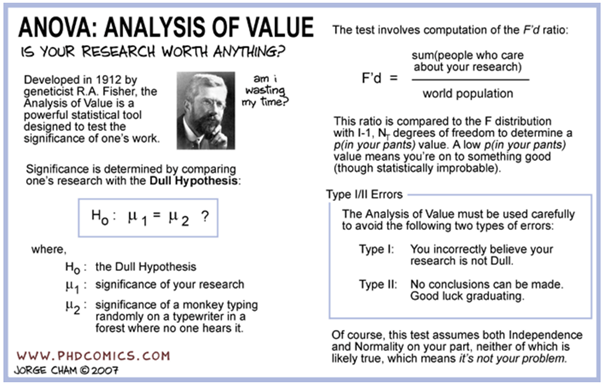
The paper was weak in hypothesis development and in its literature review. It was not clear whether the paper was testing the political hypothesis or the economic hypotheses. Neither were well explained or situated within modern labour economics or labour macroeconomics. If a political hypothesis does not stand up as a question of applied price theory, you cannot test it.
The Motu paper does not remind that graduate textbooks in labour economics show that a wide range of studies have found the predicted negative effects of employment law protections on employment and wages and on investment and the establishment and growth of businesses:
1. Employment law protections make it more costly to both hire and fire workers.
2. The rigour of employment law has no great effect on the rate of unemployment. That being the case, stronger employment laws do not affect unemployment by much.
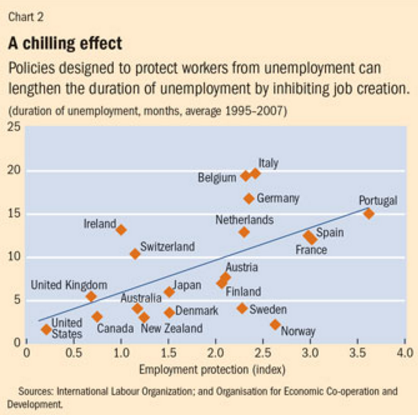
3. What is very clear is that is more rigourous employment law protections increase the duration of unemployment spells. With fewer people being hired, it takes longer to find a new job.
4. Stronger employment law protections also reduce the number of young people and older workers working age who hold a job.
5. The people who suffer the most from strong employment laws are young people, women and older adults. They are outside looking in on a privileged subsection of insiders in the workforce who have stable, long-term jobs and who change jobs infrequently.
Trial periods are common in OECD countries. There is plenty of evidence that increased job security leads to less employee effort and more absenteeism. Some examples are:
Jacob (2013) found that the ability to dismiss teachers on probation – those with less than five years’ experience – reduced teacher absences by 10% and reduced frequent absences by 25%.
Studies also show that where workers are recruited on a trial, employers have to pay higher wages. For example, teachers that are employed with less job security, or with longer trial periods are paid more than teachers that quickly secure tenure.
Workers who start on a trial tend to be more productive and quit less often. The reason is that there was a better job match. Workers do not apply for jobs to which they think they will be less suited. By applying for jobs that the worker thinks they will be a better fit, everyone gains in terms of wages, job security and productivity. For more information see
In the labour market, screening and signalling take the form of probationary periods, promotion ladders, promotion tournaments, incentive pay and the back loading of pay in the form of pension vesting and other prizes and bonds for good performance over a long period.
There is good reasons to have strong priors about how employment regulation will work. Employment law protects a limited segment of the workforce against the risk of losing their job. These are those who have a job and in particular those that have a steady job, a long-term job.
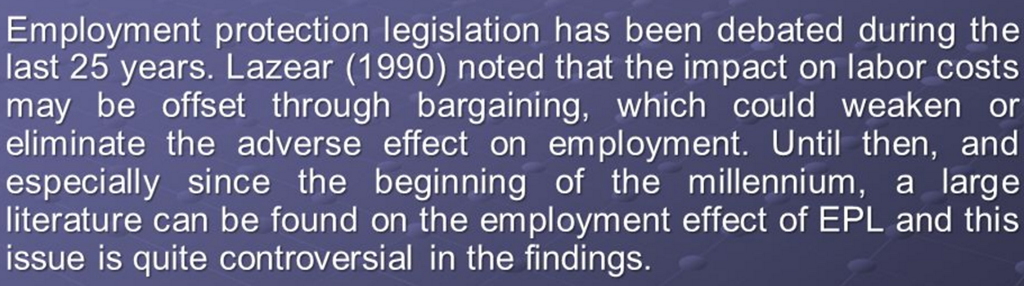
The impact of the introduction of trial periods on employment will be ambiguous because the lack of a trial period can be undone by wage bargaining.
The twist in the tail is whether there is a binding minimum wage. If there is a binding minimum wage, either the legal minimum or in a collective bargaining agreement, the employer cannot reduce the wage offer to offset the hiring risk so fewer are hired.
The introduction of trial periods will affect both wages and employment and employment more in industries that are low pay or often pay the minimum wage. Motu found large effects on hiring in two industries that used trial periods frequently. That vindicates the supporters of the law.
Motu said that 36% of employers have used trial periods at least once. The average is 36% of employers have used them with up to 50% using them in construction and wholesale trade. That the practice survives in competition for recruits suggested that it has some efficiency value.
The large size of the employment effect in construction and wholesale trades is indeed a little bit surprising. Given that a well-grounded in economic theory hypothesis about the effect of trial period is ambiguous in regard to what will happen to wages and unemployment, a large employment effect is a surprise. If Motu had spent more time explaining employment protection laws and what hypotheses they imply, that surprise would have come to light sooner.
Motu’s research for the remaining New Zealand industries was a bit of an outlier. It should have spent more time explaining how to manage that anomalous status in light of the strong priors impartial spectators are entitled to have on the economics of employment protection laws.
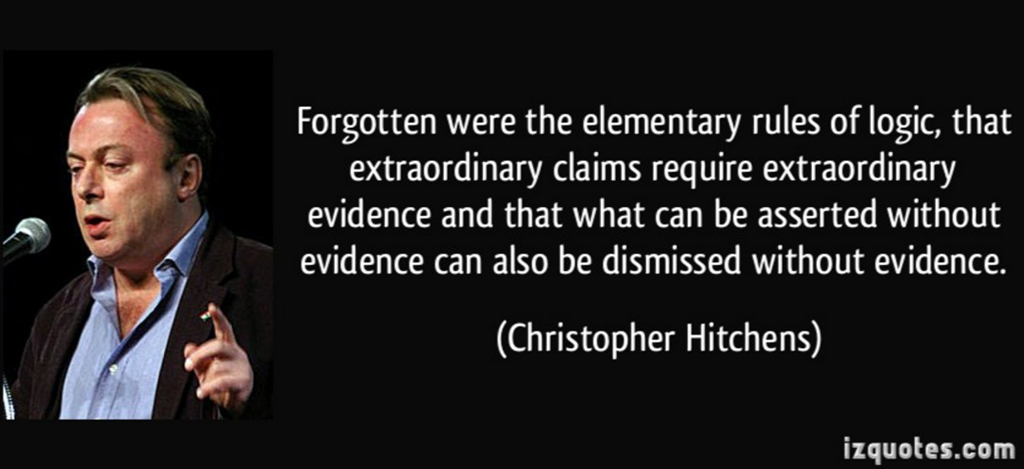
A conflicting study about the effects of any regulation should be no surprise. If there are not conflicting empirical studies, the academics are not working hard enough to win tenure and promotion. Extraordinary claims nonetheless require extraordinary evidence.
14 Jun 2016 Leave a comment
in economics of regulation, health economics Tags: economics of smoking, meddlesome preferences, nanny state
13 Jun 2016 Leave a comment
in applied price theory, applied welfare economics, defence economics, economic history, economics of education, economics of media and culture, economics of regulation, environmental economics, industrial organisation, politics - USA, survivor principle Tags: 2016 presidential election, Twitter left
11 Jun 2016 Leave a comment
in applied price theory, economics, economics of regulation Tags: gun control
Celebrating humanity's flourishing through the spread of capitalism and the rule of law
Celebrating humanity's flourishing through the spread of capitalism and the rule of law
Celebrating humanity's flourishing through the spread of capitalism and the rule of law
Celebrating humanity's flourishing through the spread of capitalism and the rule of law
Celebrating humanity's flourishing through the spread of capitalism and the rule of law
Celebrating humanity's flourishing through the spread of capitalism and the rule of law
Celebrating humanity's flourishing through the spread of capitalism and the rule of law
Celebrating humanity's flourishing through the spread of capitalism and the rule of law
A History of the Alt-Right
Econ Prof at George Mason University, Economic Historian, Québécois
Celebrating humanity's flourishing through the spread of capitalism and the rule of law
Scholarly commentary on law, economics, and more
Beatrice Cherrier's blog
Celebrating humanity's flourishing through the spread of capitalism and the rule of law
Celebrating humanity's flourishing through the spread of capitalism and the rule of law
Celebrating humanity's flourishing through the spread of capitalism and the rule of law
Why Evolution is True is a blog written by Jerry Coyne, centered on evolution and biology but also dealing with diverse topics like politics, culture, and cats.
Celebrating humanity's flourishing through the spread of capitalism and the rule of law
A rural perspective with a blue tint by Ele Ludemann
DPF's Kiwiblog - Fomenting Happy Mischief since 2003
Celebrating humanity's flourishing through the spread of capitalism and the rule of law
The world's most viewed site on global warming and climate change
Tim Harding's writings on rationality, informal logic and skepticism
A window into Doc Freiberger's library
Let's examine hard decisions!
Commentary on monetary policy in the spirit of R. G. Hawtrey
Thoughts on public policy and the media
Celebrating humanity's flourishing through the spread of capitalism and the rule of law
Politics and the economy
A blog (primarily) on Canadian and Commonwealth political history and institutions
Reading between the lines, and underneath the hype.
Economics, and such stuff as dreams are made on
"The British constitution has always been puzzling, and always will be." --Queen Elizabeth II
Celebrating humanity's flourishing through the spread of capitalism and the rule of law
Celebrating humanity's flourishing through the spread of capitalism and the rule of law
WORLD WAR II, MUSIC, HISTORY, HOLOCAUST
Undisciplined scholar, recovering academic
Celebrating humanity's flourishing through the spread of capitalism and the rule of law
Res ipsa loquitur - The thing itself speaks
In Hume’s spirit, I will attempt to serve as an ambassador from my world of economics, and help in “finding topics of conversation fit for the entertainment of rational creatures.”
Researching the House of Commons, 1832-1868
Articles and research from the History of Parliament Trust
Reflections on books and art
Posts on the History of Law, Crime, and Justice
Celebrating humanity's flourishing through the spread of capitalism and the rule of law
Exploring the Monarchs of Europe


Recent Comments