
Deciding science by voting – updated
13 Feb 2015 1 Comment
in economics of religion, environmental economics, global warming, Public Choice, rentseeking Tags: appeal to authority, climate alarmism, conjecture and refutation, global cooling, global warming, JS Mill, logical fallacies, marketing, persuasion
 One of the troubling aspects of climate alarmism is its repeated appeals to authority. Rather odd for a bunch left-wingers trying to overthrow the status quo and the established order.
The most obvious manifestation of this tactics to go on about how there is a consensus of scientists, the science is settled or the debate is over.

These repeated and unimaginative appeals to authority are either to champion the existing scientific views about global warming or to suggest that previous scientific predictions of global cooling in the 1960s and 1970s were only a minority view.

Again, an appeal to authority is an odd communication strategy for the climate alarmists. Their movement is made up more of young people because of the overweening conceit of youth. Many of their recruits are young people.The debate over the causes of global warming and its likelihood must be repeated over and over again, if only to introduce and socialise their new recruits to the arguments and counterarguments.
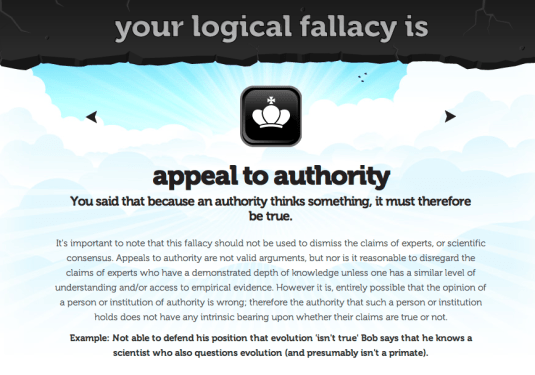
One of the reasons I changed my mind on the economics and politics of climate science is these repeated appeals to authority and general bully boy tactics made me suspicious of the underlying merits of the arguments canvassed.

The only profession I know of which actually does take a vote on what is the truth in a scientific sense is psychiatrists. Their American annual conference has a vote on what to put out their professional diagnostic manual. This science by voting never went well with various psychiatric disorders voted in and out of their professional diagnostic manual on the basis of politics, cultural bias and the medicalisation of human distress.

John Stuart Mill emphasise the value of even completely false arguments in keeping us on our toes. His scenarios involves both parties of opinion, majority and minority, having a portion of the truth but not the whole of it. He regards this as the most common of the three scenarios, and his argument here is very simple. To enlarge its grasp of the truth the majority must encourage the minority to express its partially truthful view.
J.S. Mill pointed out that critics who are totally wrong still add value because they keep you on your toes and sharpened both your argument and the communication of your message.
If the righteous majority silences or ignores its opponents, it will never have to defend its belief and over time will forget the arguments for it. As well as losing its grasp of the arguments for its belief, J.S. Mill adds that the majority will in due course even lose a sense of the real meaning and substance of its belief. What earlier may have been a vital belief will be reduced in time to a series of phrases retained by rote. The belief will be held as a dead dogma rather than as a living truth.
Three scenarios – the majority is wrong, partly wrong, or totally right – exhaust for Mill the possible permutations on the distribution of truth, and he holds that in each case the search for truth is best served by allowing free discussion.
Mill thinks history repeatedly demonstrates this process at work where silencing falsehood led to dogmas rather than living truth. He offered Christianity as an illustrative example. By suppressing opposition to it over the centuries Christians ironically weakened rather than strengthened Christian belief. Mill thinks this explains the decline of Christianity in the modern world. Christians forgot why they were Christians and in the Reformation could not successfully rebut who came up with valid criticisms of their existing profession of faith.
Going on about how climate science is settled and the debate is over is bad tactics for the climate alarmists. Attempts to close the debate this way provokes suspicion among those who expect some attempt to persuade them rather than to instruct them from on high. Presumptuousness is never a good persuasion tactic nor is dismissiveness.
A salesman trying to sell a product would never use any of the persuasion tactics or selling tactics of the climate alarmists. They would quickly go out of business if they did.


the number of terrorist incidents driven by religion has increased dramatically since 2000
07 Feb 2015 Leave a comment
in economics of crime, economics of religion, law and economics, politics - Australia, politics - New Zealand, politics - USA Tags: war against terror

HT: wonkblog
Profits Are So High, Why Don’t More Farmers Switch To Organic?
02 Feb 2015 Leave a comment
in economics of information, economics of religion, health economics, occupational regulation Tags: compensating differentials, consumer fraud, entrepreneurial alertness, expressive voting, food snobs, organic farming, reputational capital, social norms

HT: Yet Again, Organic Ag Proves Just as Productive as Chemical Ag | Mother Jones.
The increase is partly because more farmers are taking advantage of the healthier profit margins and partly because organic marketing groups sell a health food mythology where cost is not a factor, so costs can rise along with more product. It is a miracle of capitalism.
But given a consumer-base that is wealthy and that is educated by advertising so completely, why don’t all farmers switch?It just takes paying for a sticker and promising to use an organic toxic chemical rather than a synthetic one, there is no testing of organic food, so it would be easy to just make more money.
The reason more don’t move to organic, according to a paper in the Journal of Marketing, is because conventional farmers know in their hearts and minds they are deceiving the public if they switch – making that change is like switching belief systems.
via “Chemical Farmers”: Profits Are So High, Why Don’t More Farmers Switch To Organic?.
Adam Smith wrote about religion in the Wealth of Nations in part because how it infused moral fibre into market dealings. Smith offered a theory explaining the participation of individuals in religion based on his theory of human capital.
In particular, businessmen want to signal to customers that they were moral upstanding people who will not cheat them because that would be against their own moral code and sense of self-respect.
For this reason, Adam Smith suggested that religious sects proliferating in cities because people wanted to join them as a way of signalling they were morally upstanding people. These sects were demanding and rigourously policed the morals of their membership and expelled those who fell in any way short.
A reputation for honesty is both an entrepreneurial investment as well as a way of living a decent life.
People value their reputations and self-respect for being a good and decent man or woman, but some do so more than others. This is why the wage premium under the theory of compensating differentials is large enough only for the trailing edge of the business community. What is that premium?
In 2011, [the] organic premium for a bushel of wheat was 52.2% after factoring in reduced yield per acre of organic production versus total [chemical] average yield per acre. In other terms, [chemical] wheat would have had to have yielded over 53 bushels [a two-thirds increase] per acre to match organic return per acre. (Ted Craig, Wyoming Department of Agriculture, personal communication)
Being an organic farmer is somewhat trendy these days and raises you in the eyes of many but not all. As such, self-respect rather than reputation would be the bigger driver of how large the compensating differential must be before more move to organic farming.

Spot the jihadist translated from French
31 Jan 2015 Leave a comment
in economics of crime, economics of religion, occupational choice, war and peace Tags: France, Jihadists, war on terror
Link to share: Blasphemous artwork removed from Paris exhibition (due to Islamist threats)
30 Jan 2015 Leave a comment
in economics of religion, liberalism, politics - Australia, politics - New Zealand, politics - USA Tags: Blasphemy, Censorship, free speech, freedom from religion, Freedom of religion, religious bigotry, religious tolerance, terrorism, The Age of Enlightenment
Portable Confessional
29 Jan 2015 Leave a comment
in economics of religion, entrepreneurship Tags: entrepreneurial alertness
Mohammed — in pictures » The Spectator
27 Jan 2015 Leave a comment
in economics of religion Tags: bigotry, Censorship, Islam, religious intolerance

How to choose a religion
21 Jan 2015 Leave a comment
in economics of religion Tags: The Age of Enlightenment
The Kaaba, Mecca, in 1889
19 Jan 2015 Leave a comment
The places in the world that have a burqa ban
15 Jan 2015 Leave a comment
in economics of religion Tags: Religious head dress
Several religions have rules about head dress and and clothing.
A number of countries have rules requiring you to either remove the mask it if requested by a police officer to allow identification and about the wearing of masks at demonstrations. These more limited prohibitions are quite justified.
People who wish to enter private property when wearing masks shouldn’t expect banks and other places that are targets for robberies to welcome them.
For decades, now banks have prohibited anyone wearing a motorbike helmet from entering with it on.
When I worked on a bank, if anyone was in the bank wearing a motor bike helmet, we were supposed to get straight on the phone to the security department to give early notice of an attempted robbery.


Recent Comments