
Radical Islam is the defining oppositional identity of our generation
13 Jan 2015 Leave a comment
in applied price theory, economics of religion, human capital, occupational choice Tags: economics of oppositional identities, Jihadists, radical Islam
Each generation has its defining oppositional identity.

Radical Islam is the oppositional identity of choice for today’s angry young men and women. Mind you, they have to buy Islam for dummies to understand what they’re signing up for in the most crude way.
In previous generations, it was communism, the Red Brigade, weird religious sects, eco-terrorism, animal liberationist terrorism and a variety of domestic terrorists of the left and right with conspiratorial motivations. Look at the level of diversity of the angry young men and women on the domestic terrorists list of the FBI.

Plenty of young people were attracted to communism in previous generations as a way of sticking it to the man.

The appeal of radical Islam Islamic State rests on what psychologists call personal significance. The quest for personal significance by these angry young men and women is the desire to matter, to be respected, to be somebody in one’s own eyes and in the eyes of others.
A person’s sense of significance may be lost for many reasons, including economic conditions. The anger can grow out of a sense of disparagement and discrimination; it can come from a sense that one’s brethren in faith are being humiliated and disgraced around the world.
Extremist ideologies be they communism, fascism or extreme religions are effective in such circumstances because it offers a quick-fix remedy to a perceived loss of significance and an assured way to regain it. It accomplishes this by exploiting primordial instincts for aggression, sex and revenge.
The Islamic State is using a social-networking website to answer mundane questions from aspiring militants. They want answers on what to wear, how cold it gets, access to medical and dental services, if they have to buy their own weapons, whether there is wi-fi, and how soon they can capture women to rape. the answer to the last question is “Dawlah [ISIS] sorts that out”.
The two brothers responsible for the attacks in Paris were known to French intelligence but were not seen as not much of a threat because they were judged to be dope smoking, 30 something has been Jihadists. They were thought by the French intelligence services to have aged out of radical jihad.
The main difference between the two brothers in France and a common garden spree killer is their grievance was given a narrative of radical Islam rather than just the plain old hate that drives other spree killers.
Radical Islam is a magnet for wannabe spree killers who need a support network and a bit of rationalisation to pluck up the courage to kill unarmed people who can’t fight back.
Fareed Zakaria: Blasphemy and the law of fanatics
10 Jan 2015 Leave a comment
in economics of media and culture, economics of religion, liberalism Tags: Blasphemy
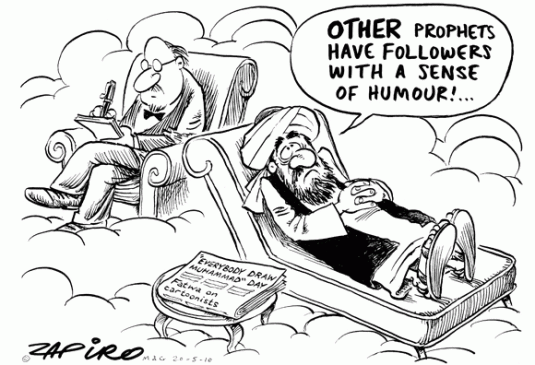
By contrast, the word blasphemy appears nowhere in the Koran. (Nor, incidentally, does the Koran anywhere forbid creating images of Muhammad, though there are commentaries and traditions — “hadith” — that do, to guard against idol worship.)
Islamic scholar Maulana Wahiduddin Khan has pointed out that “there are more than 200 verses in the Koran, which reveal that the contemporaries of the prophets repeatedly perpetrated the same act, which is now called ‘blasphemy or abuse of the Prophet’ . . . but nowhere does the Koran prescribe the punishment of lashes, or death, or any other physical punishment.” On several occasions, Muhammad treated people who ridiculed him and his teachings with understanding and kindness.
“In Islam,” Khan says, “blasphemy is a subject of intellectual discussion rather than a subject of physical punishment.”
HT: http://wapo.st/1zXY2PA but cartoon inserted independently, not in Washington Post
Perception and reality about the number of Muslims in Europe
08 Jan 2015 Leave a comment
Islam in Europe perception reality @calestous @2kdei @KhaledAlmaeena @RasheedsWorld @arsched @Matiullahjan919 @AQpk http://t.co/fqJWxWCUGJ—
syedasad (@dsyedasad) January 08, 2015
Thomas Babington Macaulay on the banality of the latest jihadists
08 Jan 2015 Leave a comment
in economics of crime, economics of media and culture, economics of religion, liberalism Tags: economics of oppositional identities, Thomas Babington Macaulay, war on terror

HT: Daniel Hannan, MEP
When Graveyards had Protestant and Catholic sections
16 Nov 2014 Leave a comment
in economics of religion Tags: sectarianism
Israel Kirzner on the sole exception that justify competition laws and the regulation of network industries
14 Nov 2014 Leave a comment

Solutions should reflect the problem definition and analysis: Duncan Garner on child poverty
02 Nov 2014 Leave a comment
in economics of religion, labour economics, politics - New Zealand, urban economics, welfare reform Tags: child poverty, Duncan Garner, expressive voting, green rent seeking, land use zoning, regulation of land supply, Resource Management Act
Duncan Garner wrote a passionate column yesterday in the local paper calling for gutsy action on child poverty.
His analysis of the causes of child poverty in New Zealand was good. Garner’s solutions had nothing to do with what he had identified as the causes of child poverty. As Garner himself wrote:
… in order to tackle poverty it’s important to attempt to define what it means today.
Poverty is children living in crowded, damp homes who don’t get three square meals a day.
They may not have their own bed, they won’t see a doctor when they’re sick and many of them will be admitted to hospital with serious poverty-related illnesses such as respiratory problems and skin infections.
They may live in households where paying the rent accounts for 60 per cent of the family’s income every week.
Garner then discussed the plight of one particular family in Auckland:
The parents are nice people, with seven children.
They shared a tiny home with three other adults and another child.
Dad works full-time at a meat factory and they had been waiting 10 months for a state house. They had beds in the dining room and lounge.
They couldn’t afford the cost of a private rental home. One son, aged 11, had a serious lung problem. I saw poverty in action that day and it was deeply disturbing. I highlighted their plight on my radio show and within weeks a shamed Housing NZ had found them a home.
The family Garner discussed is in a tiny house because they lacked the income to rent a better one. They must rely on social housing provided by government with income related rents.
Recurring through his problem definition is the impact that rising housing costs is having on the poor.
Nonetheless, Garner then advocates cash payments to low income families, a tax credit system seen as more generous and inclusive, and a back to school bonus without addressing the supply of housing.
The evidence is overwhelming in New Zealand that the main driver of the increases in the child poverty since the 1980s is rising housing costs.
In the longer run after housing costs child poverty rates in 2013 were close to double what they were in the late 1980s mainly because housing costs in 2013 were much higher relative to income than they were in the late 1980s.
– Bryan Perry, 2014 Household Incomes Report – Key Findings. Ministry of Social Development (July 2014).
Any policy to reduce child poverty must increase the supply of houses by reducing regulatory restrictions on the supply of land.
The Metropolitan Limit confines the expansion of Auckland beyond the existing built-up area. This regulatory constraint explains the exceptionally high housing price-income ratio of Auckland.

The limit imposed on the horizontal expansion of the city in green fields encourages increases in residential prices. As demand for new housing increases, no new land supply can enter the market and stem price rises in response to this increased demand.

If you serious about child poverty, you have to criticise government regulation: the dead hand of the Resource Management Act (RMA) on the poor and the vulnerable.


Recent Comments