John Sculley on the ‘myth’ of home computer market “it doesn’t exist” (1985) https://t.co/askOp1yMBw pic.twitter.com/WlQzKKDOai
— Pessimists Archive (@PessimistsArc) May 4, 2016
John Sculley on the ‘myth’ of home computer market “it doesn’t exist”
08 May 2016 Leave a comment
in economic history, entrepreneurship, industrial organisation, survivor principle Tags: creative destruction, pessimism bias
Johan Norberg on Tax Havens
07 May 2016 Leave a comment
in comparative institutional analysis, entrepreneurship, public economics Tags: bribery and corruption, tax havens
How much do you get paid if you can pick winners? @JulieAnneGenter @simonjbridges
05 May 2016 Leave a comment
in applied price theory, comparative institutional analysis, entrepreneurship, fisheries economics, politics - New Zealand Tags: entrepreneurial alertness, hedge fund managers, industry policy, picking winners, superstar wages, superstars
Electric cars have joined the long list of mendicant mendicant businesses that have been backed by the New Zealand government of late. Picking winners again.
The payrolls of entire government departments in New Zealand are not enough to hire a single successful hedge fund manager to pick winners for their political masters. To get on the list of the top 25 hedge fund managers, you need to earn at least $300 million a year.
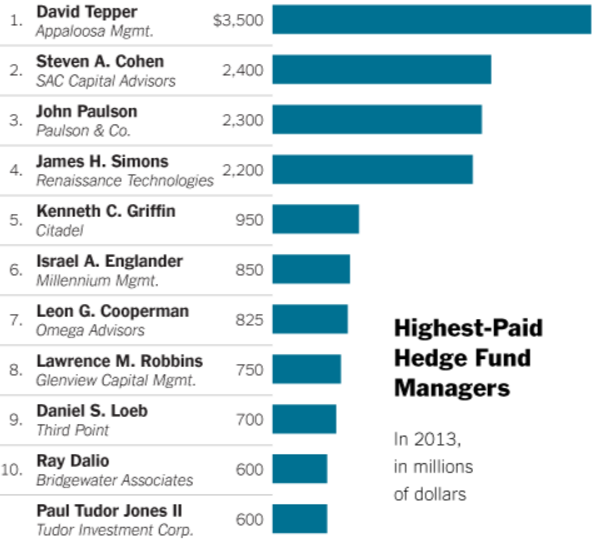
The 25 highest-earning hedge fund managers and traders made a combined $12 billion in 2015, slightly less than the $12.5 billion the 25 top-earning hedge fund managers together made in 2014.
Why do investment advisors sell and often give away their sage advice? If their insights were any good, they could trade on the share market before others caught on and make a killing!
I will give a personal example based on the skills of bureaucracies in picking winners. The test of my hypothesis is based on the transferability of human capital across jobs.
My graduate school professors in Japan included many retired bureaucrats from the Ministry of Finance and MITI. These agencies were heralded by Joe Stiglitz and others for picking winners and guiding Japanese companies to choose the right technologies and what to export.
The skills that my graduate school professors learned at picking winners over their careers with the Ministry of Finance and MITI in the high-growth years in the 1970s would now be available to them in their retirements to trade on their own account.
Page 32 of "An Illustrated Guide to Income" more economic #dataviz at: bit.ly/12SEI9p http://t.co/HYm0II2UNI—
Catherine Mulbrandon (@VisualEcon) May 08, 2013
My graduate school professors should quickly become very rich after retiring because of the skills they learned in picking winners while at the Ministry of Finance and MITI, which should cross over into their private share portfolios. The rich lists world-wide should be full of retired industry and finance ministry bureaucrats.
Instead, my graduate school professors took the train and bus to work and their families lived off their salaries in standard sized Japanese government apartments. All looked forward to their annual bonus of 5.15 months salary.
If governments are any good at picking winners, people should be willing to pay big time to get jobs at ministries of finance and ministries of international trade and industry to get access to their unique and highly secret skills they learn therein on how to pick winners.
I am still waiting for that tell-all book by an insider on these skills. Why is there no Picking Winners for Dummies on Amazon kindle as yet?
Does ethical investing pay? Barrier Fund and Ave Maria Catholic Values Fund head to head
04 May 2016 Leave a comment
in economics of regulation, economics of religion, entrepreneurship, financial economics Tags: efficient markets hypothesis, entrepreneurial alertness, ethical investing
Virtue is not its own reward if you invest in the Ave Maria Catholic Values Fund which is AVEMX in the head-to-head comparison with the Barriers Fund, formerly the Vice Fund. The Ave Maria Catholic Values Fund return since inception was 5.63% as compared to the 9.95% return of the Barrier Fund.
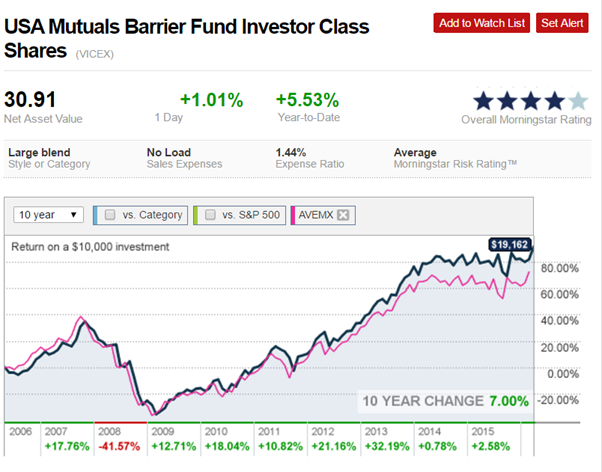
Source: VICEX – USA Mutuals Barrier Fund Investor Class Shares Mutual Fund Quote – CNNMoney.com
The S&P index grew by 8 .34% since the inception of the then Vice Fund, now the Barrier Fund. Such is the price of risking of going to hell if you lose Pascal’s wager by investing in tobacco, alcoholic beverage, gaming and defence/aerospace industries.
All of the equity investments (which include common stocks, preferred stocks and securities convertible into common stock) and at least 80% of the net assets of the Ave Maria Catholic Values Fund is invested in companies meeting its religious criteria as the fund manager explains
Morally Responsible Investing (MRI) is a subset of socially responsible investing, which often screens out companies engaged in environmental issues, tobacco products, alcohol, nuclear power, defense, oil and “unfair” labor practices. MRI is different in that it screens out companies engaged in activities that are not pro-life or pro-family…
All investments are screened to eliminate any company engaged in abortion, pornography, embryonic stem cell research, or those that make corporate contributions to Planned Parenthood
Traditional ethical funds use negative screens (to eliminate arms manufacturers and other frowned upon activities) and positive screens (to favour businesses with a good record on corporate social responsibility or that are involved in low-carbon industries etc).
why the world isn’t even more corrupt than what we observe
04 May 2016 Leave a comment
in applied price theory, development economics, economic history, economics, economics of crime, economics of regulation, entrepreneurship, Gordon Tullock, growth disasters, growth miracles, income redistribution, law and economics, Public Choice, rentseeking Tags: bribery and corruption, Tullock paradox
The Vice Fund (now the Barriers Fund) continues to outperform S&P 500
03 May 2016 Leave a comment
in defence economics, energy economics, entrepreneurship, financial economics, health economics Tags: BDS, efficient markets hypothesis, entrepreneurial alertness, ethical investing
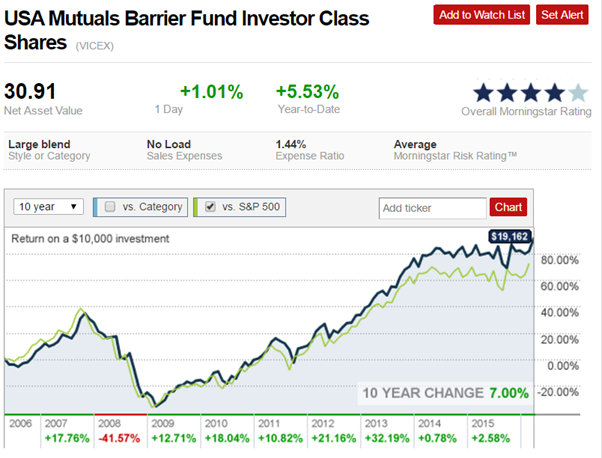
Source: VICEX – USA Mutuals Barrier Fund Investor Class Shares Mutual Fund Quote – CNNMoney.com
The Vice Fund has outperformed the S&P 500 since 2004 as shown by the green line. This mutual fund invests invest in sinful stocks as its managers describe it:
Designed with the goal of delivering better risk-adjusted returns than the S&P 500 Index. It invests primarily in stocks in the tobacco, alcohol, gaming and defence industries. Vice Funds believes these industries tend to thrive regardless of the economy as a whole.
The Vice Fund is now known as the Barrier Fund because it extended out of sinful stocks into industries with high barriers to entry. Minimum Investment is $2,000.
The Barrier Fund primarily invests in the following industries: Aerospace/Defense, Gaming, Tobacco and Alcoholic Beverages. These four industries were chosen because they demonstrate one or more of these compelling and distinctive investment characteristics:
- Natural barriers to new competition
- Steady demand regardless of economic condition
- Global Marketplace – not limited to the U.S. economy
- Potentially high profit margins
- Ability to generate excess cash flow and pay and increase dividends
The Barrier Fund believes numerous investment opportunities in these industries which have been largely overlooked by other funds.
The Fund has high management fees of 2%. Americans can buy Vanguard’s or Fidelity’s index funds and pay only 0.1% in expenses.
Two myths about multinationals by Tyler Cowen
30 Apr 2016 Leave a comment
in comparative institutional analysis, development economics, economics, economics of media and culture, entrepreneurship, growth disasters, growth miracles, industrial organisation, survivor principle Tags: multinational corporations
“Bourgeois Equality” lecture
28 Apr 2016 Leave a comment
in applied welfare economics, development economics, economic history, economics, economics of regulation, entrepreneurship, growth disasters, growth miracles, history of economic thought, industrial organisation, poverty and inequality, survivor principle Tags: Deirdre McCloskey, industrial revolution, The Great Enrichment

Creative destruction in billionaires
25 Apr 2016 Leave a comment
in economic history, entrepreneurship, industrial organisation, survivor principle Tags: billionaires, entrepreneurial alertness, superstars

Source: Price Waterhouse Coopers (2016) BILLIONAIRES INSIGHTS The changing faces of billionaires.
Why environmentalists are adverse to real solutions #earthday
22 Apr 2016 Leave a comment
in applied price theory, applied welfare economics, comparative institutional analysis, constitutional political economy, economics of media and culture, economics of regulation, energy economics, entrepreneurship, environmental economics, environmentalism, global warming, politics - USA Tags: anti-market bias, Earth Day, expressive voting, rational ignorance, rational rationality

Source: Quotation of the day for Earth Day on the ‘science of economics versus the religion of environmentalism’ … – AEI | Carpe Diem Blog » AEIdeas from Steven E. Landsburg’s book “The Armchair Economist: Economics and Everyday Life,” in his chapter titled “Why I Am Not an Environmentalist: The Science of Economics versus the Religion of Ecology“.
 Utopia, you are standing in it!
Recent Comments