
Source: Death to Capitalism? Visitors to Marx’s Grave Balk at Fee – WSJ
Celebrating humanity's flourishing through the spread of capitalism and the rule of law
26 Oct 2015 Leave a comment
in entrepreneurship, Marxist economics Tags: entrepreneurial alertness, Karl Marx
25 Oct 2015 Leave a comment
in applied price theory, applied welfare economics, economics of education, entrepreneurship, human capital, labour economics, labour supply, Marxist economics, occupational choice Tags: College premium, creative destruction, education premium, entrepreneurial alertness, graduate premium, Leftover Left, superstar wages, superstars, top 1%
21 Oct 2015 Leave a comment
in applied price theory, applied welfare economics, economics of regulation, entrepreneurship, health economics, politics - USA Tags: 2016 presidential election, creative destruction, drug lags, entrepreneurial alertness, innovations, intellectual property, patents and copyright, price controls
Drug price controls have populist appeal, but patients are the ones they would hurt the most bit.ly/1X3e742 http://t.co/ulXuGHLSld—
Manhattan Institute (@ManhattanInst) October 17, 2015
19 Oct 2015 Leave a comment
in economic history, entrepreneurship, industrial organisation, survivor principle Tags: creative destruction, entrepreneurial alertness, market for corporate control, mergers and takeovers
The 12 biggest #technology acquisitions of all time wef.ch/1QrO2b5 http://t.co/Dx0YTm8NpA—
World Economic Forum (@wef) October 15, 2015
18 Oct 2015 Leave a comment
in development economics, economic history, entrepreneurship, growth disasters, growth miracles Tags: China, The Great Escape
18 Oct 2015 Leave a comment
in applied price theory, applied welfare economics, entrepreneurship, human capital, labour economics, occupational choice, politics - USA, poverty and inequality Tags: Gini coefficient, rational irrationality, taxation and entrepreneurship, taxation and human capital, taxation and labour supply, taxation investment
17 Oct 2015 Leave a comment
in economic history, economics of media and culture, entrepreneurship, industrial organisation, survivor principle Tags: creative destruction, entrepreneurial alertness
17 Oct 2015 Leave a comment
in economic history, economics of media and culture, entrepreneurship, industrial organisation, survivor principle Tags: creative destruction, entrepreneurial alertness, Twitter
2015 has not been a particularly good year for Twitter. Will share prices go further down? econ.st/1PfOAmW http://t.co/ME1RbnlmNE—
The Economist (@TheEconomist) October 14, 2015
Our interactive chart explains why Twitter remains a minnow in the tech industry econ.st/1LkhVqi http://t.co/sCQWStMEC3—
The Economist (@TheEconomist) October 14, 2015
14 Oct 2015 Leave a comment
in economic history, economics of media and culture, entrepreneurship Tags: creative destruction, smart phones
Why are we still calling them phones? qz.com/509442 http://t.co/mIqCVnsyrY—
Quartz (@qz) September 26, 2015
13 Oct 2015 Leave a comment
in applied welfare economics, economic history, economics of media and culture, entrepreneurship, technological progress Tags: creative destruction, desktops, entrepreneurial alertness, innovation
Computers in 1964 vs. 2014: buff.ly/1NoBa3N http://t.co/4MFBCyk1D3—
HumanProgress.org (@humanprogress) June 28, 2015
12 Oct 2015 Leave a comment
in development economics, energy economics, entrepreneurship, environmental economics, environmentalism, growth disasters, growth miracles Tags: energy poverty, expressive voting, global poverty, green rent seeking, Leftover Left, Oxfam, rational ignorance, rational irrationality, stream poverty, The Great Escape
https://twitter.com/MichaelBTI/status/651503672002785281
Outrageous & Orwellian for @Oxfam to lobby to deny cheap energy to poorest people in world. #ElectrifyAfrica http://t.co/b2P09Gn7rP—
Mike Shellenberger (@MichaelBTI) October 06, 2015
Oxfam world HQ looks like such a pleasant place to work. Grid electricity. Effective security. Ample parking. http://t.co/lsxTf2DN6b—
Mike Shellenberger (@MichaelBTI) October 06, 2015
Here's @Oxfam's luxury office building in UK. Were its steel & glass components constructed with solar panels? http://t.co/642mm2zB4B—
Mike Shellenberger (@MichaelBTI) October 06, 2015
https://twitter.com/MichaelBTI/status/651458416569909248
https://twitter.com/VoxMaps/status/608411758022291456/photo/1?ref_src=twsrc%5Etfw
11 Oct 2015 Leave a comment
in economic history, entrepreneurship Tags: creative destruction
Scribes – Gutenberg – steam power – the internet
Productivity increase in book production over time http://t.co/yuvD7esnD1—
Max Roser (@MaxCRoser) September 23, 2015
11 Oct 2015 Leave a comment
in applied price theory, Austrian economics, entrepreneurship, F.A. Hayek Tags: competition is a discovery procedure, creative destruction, entrepreneurial alertness, market process, market selection, The meaning of competition
08 Oct 2015 Leave a comment
in applied price theory, economics of regulation, entrepreneurship, industrial organisation, managerial economics, organisational economics
The 40 PAKnSAVE supermarkets on the North Island charge for plastic bags which you pack for yourself. The 100 New World supermarkets owned by Foodstuffs on the North Island do not charge for plastic bags and the bags are packed for you. The reason is supply and demand that takes account of the full price of groceries including the time cost of shopping and the incomes of their respective customers.
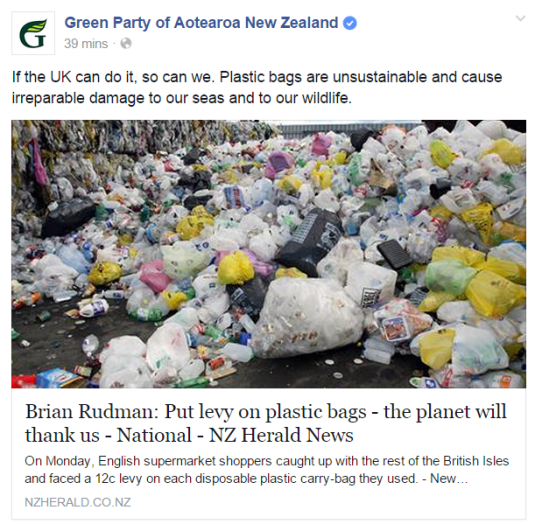
My New World supermarket is just down the road for me – I can see it from my window as I type. The nearest PAKnSAVE is a short drive to a slightly rougher part of town. The PAKnSAVE supermarkets are warehouse style supermarkets rather than a shopping experience made as pleasant as possible and convenient to where you live. PAKnSAVE supermarkets are much larger supermarkets required to be a hub for a number of suburbs rather than one or two.
The type of people who shop at PAKnSAVE are people that the New Zealand Greens pretend to be concerned about. PAKnSAVE customers are lower income people sensitive to prices, willing to go to the trouble of recycling bags.
5p for a plastic bag?
I'm all for a nice little earner, but this is a bleedin' liberty!
#Minder http://t.co/BvfLnjsVy8—
Arthur Daley (@DaleyArfur) October 08, 2015
As you expect under capitalism and freedom, a supermarket chain emerged through market competition to service that more price sensitive niche. The New World supermarket caters more for people in a hurry rather than people on a budget. People on a budget go to PAKnSAVE.
Monday's Daily Mail front page:
Plastic bags chaos looms
#tomorrowspaperstoday #bbcpapers http://t.co/iHHLunYyow—
Nick Sutton (@suttonnick) October 04, 2015
The customers of New World supermarkets are nice members of the middle class who are much more likely to vote Green. They are busy people who do not have the time to keep their bags for next time, much less pack them for themselves. That is before we discuss how unhygienic the recycling of plastic bags is.
Typical of your middle-class Green disposed voter, they are cheapies in a small way as well. When my local supermarket started charging for plastic bags, they quickly dropped the idea because of hostile customer reactions.
The charges are nominal but the people on budgets particularly low income people struggling to with the budget, every cent counts. Naturally the New Zealand Greens are quite dismissive of the cost to shoppers of paying for bags because hardly any of their voters are on a budget.
Typical of the nanny state attitude of the New Zealand Greens, they are happy to compel people to pay for plastic bags and not compensate them for the loss even when they are on low incomes. Do the New Zealand Greens believe plastic bags should be free for low income families?
This same New Zealand Greens pretend to care about poor people who cannot afford to feed their children breakfast, but are happy to make the poor pay for plastic bags.
Let the market sorted it out. There are already supermarkets are charge for plastic bags. Most do not because their customer is uninterested in wasting time paying or bringing their own bags.

I well remember wanting to get time back on my deathbed as we waited behind some arrogant young Green who was packing his own bag after paying for his goods so he kept us waiting for a minute or two.
That is another reason why middle-class supermarkets pack your bags for you. They get you out of the supermarket and away from the lines at the checkouts faster if they pack the bags for you rather than let you do it in a more leisurely pace or perhaps after you have paid.

Again, this is a case about entrepreneurial alertness in the organisation of supermarkets. When your customers are time sensitive, the supermarket does things for them because the supermarket staff can do it faster than they do as they chat to each other and deal with their children.
Celebrating humanity's flourishing through the spread of capitalism and the rule of law
Scholarly commentary on law, economics, and more
Beatrice Cherrier's blog
Celebrating humanity's flourishing through the spread of capitalism and the rule of law
Celebrating humanity's flourishing through the spread of capitalism and the rule of law
Celebrating humanity's flourishing through the spread of capitalism and the rule of law
Why Evolution is True is a blog written by Jerry Coyne, centered on evolution and biology but also dealing with diverse topics like politics, culture, and cats.
Celebrating humanity's flourishing through the spread of capitalism and the rule of law
Celebrating humanity's flourishing through the spread of capitalism and the rule of law
A rural perspective with a blue tint by Ele Ludemann
DPF's Kiwiblog - Fomenting Happy Mischief since 2003
Celebrating humanity's flourishing through the spread of capitalism and the rule of law
The world's most viewed site on global warming and climate change
Tim Harding's writings on rationality, informal logic and skepticism
A window into Doc Freiberger's library
Let's examine hard decisions!
Commentary on monetary policy in the spirit of R. G. Hawtrey
Thoughts on public policy and the media
Celebrating humanity's flourishing through the spread of capitalism and the rule of law
Politics and the economy
A blog (primarily) on Canadian and Commonwealth political history and institutions
Reading between the lines, and underneath the hype.
Economics, and such stuff as dreams are made on
"The British constitution has always been puzzling, and always will be." --Queen Elizabeth II
Celebrating humanity's flourishing through the spread of capitalism and the rule of law
Celebrating humanity's flourishing through the spread of capitalism and the rule of law
WORLD WAR II, MUSIC, HISTORY, HOLOCAUST
Undisciplined scholar, recovering academic
Celebrating humanity's flourishing through the spread of capitalism and the rule of law
Res ipsa loquitur - The thing itself speaks
Celebrating humanity's flourishing through the spread of capitalism and the rule of law
Researching the House of Commons, 1832-1868
Articles and research from the History of Parliament Trust
Reflections on books and art
Posts on the History of Law, Crime, and Justice
Celebrating humanity's flourishing through the spread of capitalism and the rule of law
Exploring the Monarchs of Europe
Cutting edge science you can dice with
Small Steps Toward A Much Better World
“We do not believe any group of men adequate enough or wise enough to operate without scrutiny or without criticism. We know that the only way to avoid error is to detect it, that the only way to detect it is to be free to inquire. We know that in secrecy error undetected will flourish and subvert”. - J Robert Oppenheimer.
The truth about the great wind power fraud - we're not here to debate the wind industry, we're here to destroy it.
Celebrating humanity's flourishing through the spread of capitalism and the rule of law
Celebrating humanity's flourishing through the spread of capitalism and the rule of law
Economics, public policy, monetary policy, financial regulation, with a New Zealand perspective
Celebrating humanity's flourishing through the spread of capitalism and the rule of law
Restraining Government in America and Around the World

 Utopia, you are standing in it!
Recent Comments